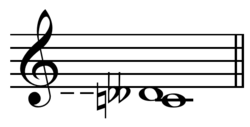

The diaschisma (or diacisma) is a small musical interval defined as the difference between three octaves and four perfect fifths plus two major thirds (in just intonation). It can be represented by the ratio 2048:20251 and is about 19.5 cents. The use of the name diaschisma for this interval is due to Helmholtz; earlier Rameau had called that interval a "diminished comma" or comma minor.
A diaschisma is the difference between a schisma and a syntonic comma,2 as well as the difference between the greater chromatic semitone (135:128 = 92.18 cents) and the just minor second (16:15 = 111.73 cents).3 Medieval theorists Boethius and Tinctoris described the diaschisma as one-half of the Pythagorean minor second, or 256/243, which would make the other half either 25/24 (70.67 cents) or about 45 cents. The diaschisma may be approximated by 89/88, 19.56 cents.

Tempering out the diaschisma, in the modern meaning of the term, leads to a diaschismic temperament. The diaschisma is tempered out in the usual system of 12 equal temperament; in fact, 12 equal temperament can be characterized as the 5-limit temperament that tempers out both the syntonic comma of 81/80 and the diaschisma. However, it is possible to improve the tuning a good deal over that of 12-et and still temper out the diaschisma; the equal temperaments with 22, 34 and 46 notes all temper it out.
References
References
- Haluska, Jan (2003). The Mathematical Theory of Tone Systems, p.xxviii. ISBN 0-8247-4714-3. Diaschisma.
- "Diaschisma", Merriam-Webster.com.
- (1897). Columbian cyclopedia, Volume 9, np. Garretson, Cox & Company. pre-ISBN.