 | |
 | |
| Clinical data | |
|---|---|
| Other names | DAL; Lysergic acid diallylamide; LDA; d-Lysergic acid diallylamide; d-Diallyllysergamide |
| Routes of administration | Oral1 |
| Drug class | Serotonergic psychedelic; Hallucinogen |
| ATC code |
|
| Legal status | |
| Legal status |
|
| Identifiers | |
| |
| CAS Number | |
| PubChem CID | |
| ChemSpider |
|
| CompTox Dashboard (EPA) | |
| ECHA InfoCard | 100.163.206 |
| Chemical and physical data | |
| Formula | C22H25N3O |
| Molar mass | 347.462 g·mol−1 |
| 3D model (JSmol) | |
| |
| |
| (verify) | |

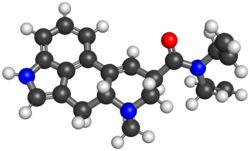
N,N-Diallyllysergamide (DAL), also known as lysergic acid diallylamide (LDA), is a psychedelic drug of the lysergamide family related to lysergic acid diethylamide (LSD).12 It is taken orally.1
Use and effects
In his 1997 book TiHKAL (Tryptamines I Have Known and Loved), Alexander Shulgin described DAL as producing "at best a touch of sparkle" of LSD at dose of 600 μg of the tartrate salt taken orally, but as also producing a sedation.1 Subsequently, in a 2003 literature review, Shulgin listed an active dose as greater than 1 mg.3 He has described the drug as being at least an order of magnitude less potent than LSD.13
Interactions
Pharmacology
Pharmacodynamics
DAL interacts with serotonin receptors, including the serotonin 5-HT1A, 5-HT2A, and 5-HT2C receptors.2 It acts as a serotonin 5-HT2A receptor agonist, but with about 5-fold lower potency than LSD.2
See also
See also
References
References
- Shulgin, Alexander; Shulgin, Ann (September 1997). TiHKAL: The Continuation. Berkeley, California: Transform Press. ISBN 0-9630096-9-9. OCLC 38503252. "DAL, N,N-Diallyllysergamide. As the tartrate salt, there is at best a touch of sparkle seen at 600 micrograms orally, but there is a sedation also reported. It is certainly an order of magnitude less potent than LSD itself."
- Nichols DE (2018). Halberstadt AL, Vollenweider FX, Nichols DE (eds.). Chemistry and Structure-Activity Relationships of Psychedelics. Current Topics in Behavioral Neurosciences. Vol. 36. Springer. pp. 1–43. doi:10.1007/7854_2017_475. ISBN 978-3-662-55878-2. PMID 28401524.
- Shulgin AT (2003). "Basic Pharmacology and Effects". In Laing RR (ed.). Hallucinogens: A Forensic Drug Handbook. Forensic Drug Handbook Series. Elsevier Science. pp. 67–137. ISBN 978-0-12-433951-4. Retrieved 1 February 2025.