| Dermatomyositis | |
|---|---|
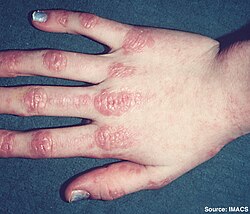 | |
| Discrete red areas overlying the knuckles in a person with juvenile dermatomyositis. These are known as Gottron's papules. | |
| Specialty | Rheumatology |
| Symptoms | Rash, muscle weakness, weight loss, fever1 |
| Complications | Calcinosis, dysphagia, interstitial lung disease, heart disease (rarely), joint pain, other autoimmune conditions |
| Usual onset | 40s to 50s2 |
| Duration | Long term1 |
| Causes | Autoimmune (Type III hypersensitivity) |
| Risk factors | Other autoimmune conditions, ovarian cancer, breast cancer, lung cancer, other cancers |
| Diagnostic method | Based on symptoms, blood tests, electromyography, muscle biopsies2 |
| Differential diagnosis | Polymyositis, inclusion body myositis, scleroderma2 |
| Treatment | Medication, physical therapy, exercise, heat therapy, orthotics, assistive devices, rest1 |
| Medication | Corticosteroids, methotrexate, azathioprine1 |
| Frequency | ~ 1 per 100,000 people per year2 |
Dermatomyositis (DM) is a group of sytemic autoimmune inflammatory diseases primarily affecting the skin and skeletal muscles.34 Its symptoms are generally a skin rash and worsening muscle weakness over time. These may occur suddenly or develop over months. Other symptoms may include weight loss, fever, lung inflammation, or light sensitivity. Complications may include calcium deposits in muscles or skin. Distinct myositis-specific autoantibodies (MSA) define clinically and pathologically distinct DM subtypes, each associated with characteristic disease manifestations, prognosis, and treatment response.35
Eighty percent of adults6 and sixty percent of children with juvenile dermatomyositis have a MSA.7 These autoantibodies, produced by locally infiltrating plasma cells, can enter various cell types and disrupt the function of their target autoantigens, inducing cellular damage and inflammation that directly drive disease pathogenesis.891011 Dermatomyositis may develop as a paraneoplastic syndrome associated with several malignancies, in which tumors harbor genetic alterations, including somatic mutations, in genes encoding the specific autoantigens targeted by the patient's corresponding autoantibodies.12131415 It is known to be associated with several viruses, especially coxsackievirus, but no definitive causal link has been found.16 Diagnosis is typically based on some combination of symptoms, blood tests, electromyography, and muscle biopsies.3
Current treatment of dermatomyositis relies on immunosuppressive agents such as corticosteroids, methotrexate, mycophenolate mofetil, azathioprine, tacrolimus, and cyclosporine, with intravenous immunoglobulin (IVIG) widely used for refractory or severe disease.1718 Rituximab remains an important therapeutic option despite mixed clinical trial results.19 Emerging targeted therapies, including Janus kinase (JAK) inhibitors2021222324 and agents targeting the type I interferon pathway, such as dazukibart,25 have demonstrated promising efficacy. Novel approaches such as CD19 chimeric antigen receptor (CAR) T-cell therapy,26 plasma cell–directed therapies,2728 and neonatal Fc receptor (FcRn) inhibitors, such as efgartigimod, are also showing encouraging results,29 offering the potential for sustained treatment-free disease control in the case of CD19 CAR-T cell therapy. Overall, with timely diagnosis and appropriate treatment, the prognosis of DM is generally favorable.
About one in 100,000 people receive a new diagnosis of dermatomyositis each year.2 The condition usually occurs in those in their 40s and 50s with women being affected more often than men.2 People of any age, however, may be affected.2 The condition was first described in the 1800s.30
Signs and symptoms
The main symptoms include several kinds of skin rash along with muscle weakness in both upper arms or thighs.3
Skin
One form the rashes take is called "heliotrope" (a purplish color) or lilac, but may also be red. It can occur around the eyes along with swelling, but also occurs on the upper chest or back what is called the "shawl" (around the neck) or "V-sign" above the breasts and may also occur on the face, upper arms, thighs, or hands.31 Another form the rash takes is called Gottron's sign, which is red or violet, sometimes scaly, slightly raised papules that erupt on any of the finger joints (the metacarpophalangeal joints or the interphalangeal joints).3132 Gottron's papules may also be found over other bony prominences including the elbows, knees, or feet. All these rashes are made worse by exposure to sunlight, and are often very itchy, painful, and may bleed.32
If a person exhibits only skin findings characteristic of DM, without weakness or abnormal muscle enzymes, may be classified as having amyopathic or clinically amyopathic dermatomyositis (ADM), formerly known as "dermatomyositis sine myositis".33
Muscles
People with DM experience progressively worsening muscle weakness in the proximal muscles (for example, the shoulders and thighs).34 Tasks that use these muscles: standing from sitting, lifting, and climbing stairs, can become increasingly difficult for people with dermatomyositis.34
Respiratory
The primary cause of respiratory failure in dermatomyositis is interstitial lung disease, resulting from damage to the lung interstitium.3 This is particularly prominent in patients with anti–MDA5 autoantibodies, who are at high risk of developing rapidly progressive interstitial lung disease.16 In some people, the condition affects the diaphragm muscle, the lungs directly (through inflammation), or both. This causes difficulty breathing, and dermatomyositis is considered to be a restrictive lung disease in patients with these symptoms. Respiratory symptoms occur in about 40% of people with dermatomyositis, and in these people, the symptoms may slowly progress, contributing to increased morbidity and mortality.
Cardiac
In dermatomyositis, patients can develop myocarditis and cardiac conduction system abnormalities which may be detected if the patient undergoes special testing. However, these abnormalities typically have no symptoms or clinical consequences.16
More rarely, these abnormalities can cause greater issues and lead to arrhythmias, heart failure, or damage to heart valves.16 For those dermatomyositis patients who do have cardiac symptoms caused by the disease, their clinical course may be much worse than usual.35
Other
Around 30% of people have swollen, painful joints, but this is generally mild.36
Later in the course of the disease, patients often experience difficulty swallowing, called dysphagia, which makes it hard to move food from the mouth to the stomach. The muscles of the esophagus may become weak, leading to reduced or irregular movements that prevent proper swallowing. Additionally, individuals might suffer from gastroesophageal reflux disease (GERD), where stomach acid flows back into the esophagus, causing heartburn and irritation.16
- Examples of dermatomyositis
-
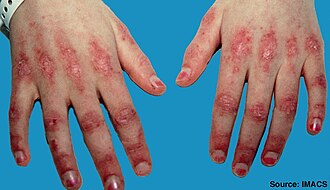 Gottron's papules on finger joints
 -
 Gottron's papules on the elbows of a person with juvenile DM
 -
 Gottron's papules
 -
 Gottron's bumps on a person with juvenile DM
 -
 Gottron's papules in a severe case of juvenile dermatomyositis
 -
 Heliotrope with swelling around the eyes
 -
 Heliotrope
 -
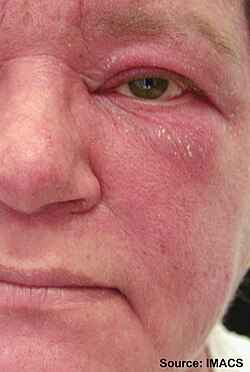 Facial rash
 -
 Severe rash on the hands, extending up the forearm
 -
 Forearm rash
Etiopathogenesis
Recent studies suggest that the pathogenesis of DM is driven by the pathogenic internalization of autoantibodies.9810 Although these antibodies target intracellular proteins, evidence indicates that they can enter different cell types and disrupt the function of their target autoantigens causing inflammation and damage.810 For example, anti-Mi-2 autoantibodies bind PHD-containing proteins,3738 including component of the NuRD complex, inducing derepression of multiple genes,8 and in anti-MDA5 dermatomyositis, autoantibodies activate MDA5 directly inducing the activation of type I interferon pathways.8
The type I interferon pathway is especially prominent in DM and has become a major therapeutic target.3940 Clinical responses to JAK inhibitors,4142434445 anti-IFNβ therapy,46 and agents targeting the interferon receptor support the importance of this pathway in disease activity. Conversely, a negative trial of complement inhibition in immune-mediated necrotizing myopathy47 has challenged earlier models in which complement-mediated muscle injury was considered central to that subtype.484950
The characteristic pathological feature is perifascicular muscle involvement, often accompanied by vasculopathy. Plasma cells are found in close proximity to affected areas with high type I interferon expression and have been observed to externalize immunoglobulin heavy- and light-chain RNA into surrounding muscle cells, suggesting that this may be a potential mechanism for immunoglobulin entry into affected cell types shared across different forms of DM.10
DM is paraneoplastic in up to 40% of cases, most commonly in association with underlying malignancy in patients with anti–TIF1γ autoantibodies.16 A majority of patients with paraneoplastic dermatomyositis harbor somatic mutations or other genetic alterations in tumor genes encoding the target autoantigens of their corresponding autoantibodies, suggesting that, in this context, autoantibody production arises secondary to an anti-tumor immune response that fails to achieve effective tumor control.12131415The most commonly associated cancers are ovarian cancer, breast cancer, and lung cancer overall,51 but the most frequent associations can vary depending on patient race or ethnicity.16
Inherited genetic factors confer a predisposition to developing these diseases, and HLA subtypes HLA-DR3, HLA-DR52, and HLA-DR6 seem to create a disposition to DM.36
Diagnosis and classification

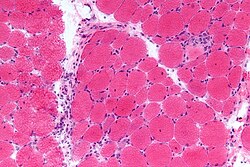
There are several diagnostic and classification criteria have been proposed for dermatomyositis.52535455 Contemporary approaches generally combine clinical features with myositis-specific and myositis-associated autoantibody testing, supported by complementary laboratory, imaging, histopathologic, and electrophysiologic investigations. Some criteria are designed to establish a broad syndromic diagnosis of DM, whereas others provide greater granularity by identifying distinct autoantibody-defined clinical subsets. Despite these differences, the principal diagnostic features include:
- Detection of myositis-specific autoantibodies (MSAs), including anti-Mi-2, anti-NXP2, anti-TIF1-γ, anti-MDA5, and anti-SAE. These autoantibodies are considered pathogenic8109 and are typically mutually exclusive, with most patients harboring only a single MSA.
- Muscle weakness in both thighs or both upper arms.
- Using a blood test, finding higher levels of enzymes found in skeletal muscle, including creatine kinase, aldolase, and glutamate oxaloacetate, pyruvate transaminases or lactate dehydrogenase.
- Using electromyography (testing of electric signalling in muscles), finding all three of: erratic, repetitive, high-frequency signals; short, low-energy signals between skeletal muscles and motor neurons that have multiple phases; and sharp activity when a needle is inserted into the muscle.
- Examining a muscle biopsy under a microscope demonstrating perifascicular atrophy, increased expression of type I interferon–inducible markers (predominantly in the perifascicular regions), mononuclear white blood cells between the muscle cells, and finding abnormal muscle cell degeneration and regeneration, dying muscle cells, and muscle cells being consumed by other cells (phagocytosis).3956
- Rashes typical of dermatomyositis, which include heliotrope rash, Gottron's sign, and Gottron's papules.
The fifth criterion is what differentiates dermatomyositis from other forms of inflammatory myopathy. Patients with antisynthetase autoantibodies, such as anti-Jo-1, may also present with dermatomyositis-like skin manifestations. Although these patients were historically classified as having DM, they are now generally considered to have the distinct clinical entity antisynthetase syndrome, even in the presence of characteristic cutaneous features.3
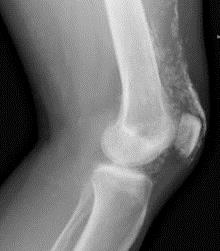
Magnetic resonance imaging may be useful for guiding muscle biopsy and for distinguishing active inflammation from irreversible muscle damage as contributors to muscle weakness. In addition to muscle inflammation, MRI frequently demonstrates fascial inflammation (fasciitis) in patients with DM.5758 X-ray may be used to investigate joint involvement and calcifications.59
A case of DM may be classified as clinically amyopathic dermatomyositis (CADM) when cutaneous manifestations predominate and there is little or no clinical evidence of muscle involvement.60 Anti-MDA5 autoantibodies are strongly associated with CADM and are frequently accompanied by rapidly progressive interstitial lung disease.61 Patients with anti-TIF1-γ autoantibodies also commonly present with clinically amyopathic disease, although less frequently than those with anti-MDA5 autoantibodies.
Juvenile dermatomyositis (JDM) has traditionally been regarded as a distinct entity from adult-onset DM. However, there is no convincing evidence that the two differ fundamentally in their pathophysiology, and they are now generally considered age-specific presentations of the same group of conditions.
Treatment
Multiple effective therapies are available for the treatment of DM.3 Standard treatment typically consists of a combination of glucocorticoids and steroid-sparing immunosuppressive agents, including methotrexate, mycophenolate mofetil, azathioprine, tacrolimus, and cyclosporine. Intravenous immunoglobulin (IVIG) has demonstrated efficacy in DM.6263 Although rituximab did not meet its primary endpoint in randomized clinical trials, it remains an important treatment option in clinical practice, particularly for refractory disease, often in combination with IVIG.64
More recently, Janus kinase (JAK) inhibitors, including tofacitinib,65 ruxolitinib,6667 baricitinib,68 and brepocitinib,69 have shown efficacy in dermatomyositis. Additional strategies targeting the type I interferon pathway have also demonstrated benefit, including blockade of interferon-β with dazukibart.70
Deep B-cell depletion with CD19 chimeric antigen receptor (CAR) T-cell therapy has shown preliminary evidence of inducing sustained, and potentially treatment-free, remission in DM.717273 Similarly, plasma cell–targeted therapies, including CAR T-cell approaches and monoclonal antibodies,74 as well as inhibitors of the neonatal Fc receptor (FcRn), such as efgartigimod,75 have emerged as promising therapeutic strategies for DM.
Antimalarial medications, such as hydroxychloroquine,76 have historically been used to manage the cutaneous manifestations of DM. However, given the potential for hypersensitivity reactions in DM,77 their use is generally limited to patients who have previously responded well and tolerated these therapies, rather than being routinely employed in DM.
Overall, with timely diagnosis and appropriate treatment, the prognosis of DM is generally favorable.
Prognosis
The cutaneous manifestations of dermatomyositis may or may not improve with therapy in parallel with the improvement of the myositis. In some people, the weakness and rash resolve together. In others, the two are not linked, with one or the other being more challenging to control. Often, cutaneous disease persists after adequate control of the muscle disease.7879
The risk of death from the condition is much higher if the heart or lungs are affected.8081
Before the advent of modern therapies, the prognosis was poor. However, with timely diagnosis and appropriate management, the prognosis has improved substantially, and outcomes are now generally favorable.82
Epidemiology
Incidence of DM peaks at ages 40–50, but the disease can affect people of all ages.832 It tends to affect more women than men.2 The prevalence of DM ranges from one to 22 per 100,000 people.848586
People who were affected with dermatomyositis
- Opera singer Maria Callas (1923–1977) allegedly had dermatomyositis from 1975 until her death.87
- Actor Laurence Olivier (1907–1989) had dermatomyositis from 1974 until his death.88
- American football running back Ricky Bell (1955–1984), the runner-up for the Heisman Trophy in 1976, and the number-one pick in the NFL draft in 1977, died at the age of 29 from heart failure caused by this disease.89
- Rob Buckman (1948–2011) a doctor, comedian, and author, and the president of the Humanist Association of Canada.90
- Samantha, Indian actress diagnosed in 2022.
- Suhani Bhatnagar (2005–2024), Indian actress.91
- Tim Rooney (1947–2006), American actor and son of Mickey Rooney.92
References
References
- "Dermatomyositis". GARD. 2017. Archived from the original on 5 July 2017. Retrieved 13 July 2017.
- "Dermatomyositis". NORD (National Organization for Rare Disorders). 2015. Archived from the original on 19 February 2017. Retrieved 13 July 2017.
- Selva-O'Callaghan A, Pinal-Fernandez I, Trallero-Araguás E, Milisenda JC, Grau-Junyent JM, Mammen AL (September 2018). "Classification and management of adult inflammatory myopathies". The Lancet. Neurology. 17 (9): 816–828. doi:10.1016/S1474-4422(18)30254-0. ISSN 1474-4465. PMC 11646336. PMID 30129477.
- Allenbach Y, Benveniste O (14 May 2026). "Inflammatory Myopathies". New England Journal of Medicine. 394 (19): 1925–1938. doi:10.1056/NEJMra2415426. ISSN 0028-4793. PMID 42127392.
- Casal-Dominguez M, Pinal-Fernandez I, Pak K, Huang W, Selva-O'Callaghan A, Albayda J, et al. (March 2022). "Performance of the 2017 European Alliance of Associations for Rheumatology/American College of Rheumatology Classification Criteria for Idiopathic Inflammatory Myopathies in Patients With Myositis-Specific Autoantibodies". Arthritis & Rheumatology. 74 (3): 508–517. doi:10.1002/art.41964. ISSN 2326-5205. PMC 8881307. PMID 34480833.
- Tansley SL, McHugh NJ, Wedderburn LR (April 2013). "Adult and juvenile dermatomyositis: are the distinct clinical features explained by our current understanding of serological subgroups and pathogenic mechanisms?". Arthritis Research & Therapy. 15 (2): 211. doi:10.1186/ar4198. PMC 3672700. PMID 23566358.
Myositis-specific autoantibodies (MSAs) can now be identified in 80% of adults.
- Papadopoulou C, Chew C, Wilkinson MG, McCann L, Wedderburn LR (June 2023). "Juvenile idiopathic inflammatory myositis: an update on pathophysiology and clinical care". Nature Reviews. Rheumatology. 19 (6): 343–362. doi:10.1038/s41584-023-00967-9. PMC 10184643. PMID 37188756.
Approximately 60% of patients with JDM are positive for a myositis-specific antibody (MSA).
- Pinal-Fernandez I, Muñoz-Braceras S, Casal-Dominguez M, Pak K, Torres-Ruiz J, Musai J, et al. (21 October 2024). "Pathological autoantibody internalisation in myositis". Annals of the Rheumatic Diseases. 83 (11): 1549–1560. doi:10.1136/ard-2024-225773. ISSN 1468-2060. PMC 11493519. PMID 38902010.
- Pinal-Fernandez I, Milisenda JC, Pak K, Muñoz-Braceras S, Casal-Dominguez M, Torres-Ruiz J, et al. (August 2023). "Transcriptional derepression of CHD4/NuRD-regulated genes in the muscle of patients with dermatomyositis and anti-Mi2 autoantibodies". Annals of the Rheumatic Diseases. 82 (8): 1091–1097. doi:10.1136/ard-2023-223873. ISSN 1468-2060. PMC 11611052. PMID 37130727.
- Pinal-Fernandez I, Pak K, Casal-Dominguez M, Muñoz-Braceras S, Wigerblad G, Dell'Orso S, et al. (July 2026). "Spatial transcriptomics reveals mechanism of autoimmunity driven by internalised autoantibodies". Annals of the Rheumatic Diseases. doi:10.1016/j.ard.2026.06.028. ISSN 0003-4967. PMID 42493309.
- Giannini M, Quiring G, Oulad-Abdelghani M, Lannes B, Allenbach Y, Benveniste O, et al. (October 2025). "In immune-mediated necrotising myopathy, anti-HMGCR antibodies inhibit HMGCR activity, leading to the sarcoplasmic accumulation of lipid droplets and myofibres necrosis". Annals of the Rheumatic Diseases. 84 (10): 1752–1755. doi:10.1016/j.ard.2025.04.027. ISSN 1468-2060. PMID 40410054.
- Tudorancea AD, Ciurea PL, Vreju AF, Turcu-Stiolica A, Gofita CE, Criveanu C, et al. (July 2021). "A Study on Dermatomyositis and the Relation to Malignancy". Current Health Sciences Journal. 47 (3): 377–382. doi:10.12865/CHSJ.47.03.07. PMC 8679146. PMID 35003769.
- Pinal-Fernandez I, Ferrer-Fabregas B, Trallero-Araguas E, Balada E, Martínez MA, Milisenda JC, et al. (1 February 2018). "Tumour TIF1 mutations and loss of heterozygosity related to cancer-associated myositis". Rheumatology. 57 (2): 388–396. doi:10.1093/rheumatology/kex413. ISSN 1462-0332. PMC 5850766. PMID 29149307.
- Cordel N, Derambure C, Coutant S, Mariette X, Jullien D, Debarbieux S, et al. (1 December 2021). "TRIM33 gene somatic mutations identified by next generation sequencing in neoplasms of patients with anti-TIF1γ positive cancer-associated dermatomyositis". Rheumatology. 60 (12): 5863–5867. doi:10.1093/rheumatology/keab260. ISSN 1462-0332. PMID 33764396.
- Moreno-Cárdenas AB, Ros J, Gil-Vila A, Datta D, Fasani R, Serna G, et al. (March 2026). "Frequent genetic alterations in myositis autoantigen genes in cancer-associated dermatomyositis". Annals of the Rheumatic Diseases. 85 (3): 519–533. doi:10.1016/j.ard.2025.10.018. PMC 13137219. PMID 41290487.
- Didona D, Solimani F, Caposiena Caro RD, Sequeira Santos AM, Hinterseher J, Kussini J, et al. (April 2023). "Dermatomyositis: a comprehensive review of clinical manifestations, serological features, and therapeutic approaches". Italian Journal of Dermatology and Venereology. 158 (2): 84–98. doi:10.23736/S2784-8671.23.07458-3. PMID 37153943.
- Dalakas MC, Illa I, Dambrosia JM, Soueidan SA, Stein DP, Otero C, et al. (30 December 1993). "A Controlled Trial of High-Dose Intravenous Immune Globulin Infusions as Treatment for Dermatomyositis". New England Journal of Medicine. 329 (27): 1993–2000. doi:10.1056/NEJM199312303292704. ISSN 0028-4793. PMID 8247075.
- Aggarwal R, Charles-Schoeman C, Schessl J, Bata-Csörgő Z, Dimachkie MM, Griger Z, et al. (6 October 2022). "Trial of Intravenous Immune Globulin in Dermatomyositis". New England Journal of Medicine. 387 (14): 1264–1278. doi:10.1056/NEJMoa2117912. ISSN 0028-4793. PMID 36198179.
- Oddis CV, Reed AM, Aggarwal R, Rider LG, Ascherman DP, Levesque MC, et al. (February 2013). "Rituximab in the treatment of refractory adult and juvenile dermatomyositis and adult polymyositis: A randomized, placebo-phase trial". Arthritis & Rheumatism. 65 (2): 314–324. doi:10.1002/art.37754. ISSN 0004-3591. PMC 3558563. PMID 23124935.
- Paik JJ, Casciola-Rosen L, Shin JY, Albayda J, Tiniakou E, Leung DG, et al. (May 2021). "Study of Tofacitinib in Refractory Dermatomyositis: An Open-Label Pilot Study of Ten Patients". Arthritis & Rheumatology. 73 (5): 858–865. doi:10.1002/art.41602. ISSN 2326-5191. PMC 8084900. PMID 33258553.
- Ladislau L, Suárez-Calvet X, Toquet S, Landon-Cardinal O, Amelin D, Depp M, et al. (1 June 2018). "JAK inhibitor improves type I interferon induced damage: proof of concept in dermatomyositis". Brain. 141 (6): 1609–1621. doi:10.1093/brain/awy105. ISSN 0006-8950. PMID 29741608.
- Hornung T, Janzen V, Heidgen FJ, Wolf D, Bieber T, Wenzel J (25 December 2014). "Remission of Recalcitrant Dermatomyositis Treated with Ruxolitinib". New England Journal of Medicine. 371 (26): 2537–2538. doi:10.1056/NEJMc1412997. ISSN 0028-4793. PMID 25539124.
- Kim H, Dill S, O'Brien M, Vian L, Li X, Manukyan M, et al. (March 2021). "Janus kinase (JAK) inhibition with baricitinib in refractory juvenile dermatomyositis". Annals of the Rheumatic Diseases. 80 (3): 406–408. doi:10.1136/annrheumdis-2020-218690. PMC 7904969. PMID 32843325.
- Vleugels RA, Paik JJ, Bauer Ventura I, Mangold AR, Gandiga PC, Haemel A, et al. (14 May 2026). "A Phase 3 Trial of Brepocitinib in Dermatomyositis". New England Journal of Medicine. 394 (19): 1883–1893. doi:10.1056/NEJMoa2503531. ISSN 0028-4793. PMID 41910335.
- Fiorentino D, Mangold AR, Werth VP, Christopher-Stine L, Femia A, Chu M, et al. (January 2025). "Efficacy, safety, and target engagement of dazukibart, an IFNβ specific monoclonal antibody, in adults with dermatomyositis: a multicentre, double-blind, randomised, placebo-controlled, phase 2 trial". The Lancet. 405 (10473): 137–146. doi:10.1016/S0140-6736(24)02071-3. PMID 39798982.
- Müller F, Taubmann J, Bucci L, Wilhelm A, Bergmann C, Völkl S, et al. (22 February 2024). "CD19 CAR T-Cell Therapy in Autoimmune Disease — A Case Series with Follow-up". New England Journal of Medicine. 390 (8): 687–700. doi:10.1056/NEJMoa2308917. ISSN 0028-4793. PMID 38381673.
- Müller F, Wirsching A, Hagen M, Völkl S, Tur C, Raimondo MG, et al. (June 2025). "BCMA CAR T cells in a patient with relapsing idiopathic inflammatory myositis after initial and repeat therapy with CD19 CAR T cells". Nature Medicine. 31 (6): 1793–1797. doi:10.1038/s41591-025-03718-3. ISSN 1078-8956. PMC 12176613. PMID 40245922.
- Hagen M, Bucci L, Böltz S, Nöthling DM, Rothe T, Anoshkin K, et al. (5 September 2024). "BCMA-Targeted T-Cell–Engager Therapy for Autoimmune Disease". New England Journal of Medicine. 391 (9): 867–869. doi:10.1056/NEJMc2408786. ISSN 0028-4793. PMID 39231353.
- Chinoy H, Rodriguez-Garcia S, Neto A, Papadopoulou D, Van Baelen B, Duncombe P, et al. (June 2025). "Op0002 Efficacy and Safety of Efgartigimod Ph20 Sc in Adult Participants with Active Idiopathic Inflammatory Myopathy: Phase 2 Results from the Alkivia Study". Annals of the Rheumatic Diseases. 84: 2–3. doi:10.1016/j.ard.2025.05.025.
- "History of Dermatomyositis". Dermatomyositis. 2009. pp. 5–8. doi:10.1007/978-3-540-79313-7_2. ISBN 978-3-540-79312-0.
- Callen JP (June 2010). "Cutaneous manifestations of dermatomyositis and their management". Current Rheumatology Reports. 12 (3): 192–197. doi:10.1007/s11926-010-0100-7. PMID 20425525. S2CID 29083422.
- Kuhn A, Landmann A, Bonsmann G (October 2016). "The skin in autoimmune diseases-Unmet needs". Autoimmunity Reviews. 15 (10): 948–954. doi:10.1016/j.autrev.2016.07.013. PMID 27481041.
- Callander J, Robson Y, Ingram J, Piguet V (December 2018). "Treatment of clinically amyopathic dermatomyositis in adults: a systematic review". The British Journal of Dermatology. 179 (6): 1248–1255. doi:10.1111/bjd.14726. PMID 27167896. S2CID 45638288.
- Dalakas MC (April 2015). "Inflammatory muscle diseases". The New England Journal of Medicine. 372 (18): 1734–1747. doi:10.1056/NEJMra1402225. PMID 25923553. S2CID 37761391.
- Trybuch A, Tarnacka B (2 July 2023). "Cardiac involvement in polymyositis and dermatomyositis: diagnostic approaches". Reumatologia. 61 (3): 202–212. doi:10.5114/reum/168362. PMC 10373167. PMID 37522146.
- Hajj-ali RA (June 2013). "Polymyositis and Dermatomyositis – Musculoskeletal and Connective Tissue Disorders". Merck Manuals Professional Edition. Archived from the original on 12 October 2015.
- Musai J, Jayaraman S, Pak K, Pinal-Fernandez I, Muñoz-Braceras S, Casal-Dominguez M, et al. (1 February 2026). "Myositis-specific autoantibodies recognising Mi2 also target the AIRE protein at a shared PHD zinc finger". Annals of the Rheumatic Diseases. 85 (2): 351–359. doi:10.1016/j.ard.2025.08.023. ISSN 1468-2060. PMC 12676962. PMID 40957771.
- Pinal-Fernandez I, Musai J, Casal-Dominguez M, Pak K, Kaplan M, Warner BM, et al. (1 December 2025). "Anti-Mi2 autoantibodies target PHD fingers of SP140L and TIF1γ, while anti-TIF1γ autoantibodies primarily bind TIF1γ outside the PHD region". Rheumatology (Oxford, England). 64 (12): 6371–6377. doi:10.1093/rheumatology/keaf426. ISSN 1462-0332. PMC 12671865. PMID 40795062.
- Greenberg SA, Pinkus JL, Pinkus GS, Burleson T, Sanoudou D, Tawil R, et al. (1 May 2005). "Interferon-alpha/beta-mediated innate immune mechanisms in dermatomyositis". Annals of Neurology. 57 (5): 664–678. doi:10.1002/ana.20464. ISSN 0364-5134. PMID 15852401.
- Pinal-Fernandez I, Casal-Dominguez M, Derfoul A, Pak K, Plotz P, Miller FW, et al. (17 September 2019). "Identification of distinctive interferon gene signatures in different types of myositis". Neurology. 93 (12): e1193–e1204. doi:10.1212/WNL.0000000000008128. ISSN 1526-632X. PMC 6808530. PMID 31434690.
- Hornung T, Janzen V, Heidgen FJ, Wolf D, Bieber T, Wenzel J (25 December 2014). "Remission of Recalcitrant Dermatomyositis Treated with Ruxolitinib". New England Journal of Medicine. 371 (26): 2537–2538. doi:10.1056/nejmc1412997. ISSN 0028-4793. PMID 25539124.
- Ladislau L, Suárez-Calvet X, Toquet S, Landon-Cardinal O, Amelin D, Depp M, et al. (8 May 2018). "JAK inhibitor improves type I interferon induced damage: proof of concept in dermatomyositis". Brain. 141 (6): 1609–1621. doi:10.1093/brain/awy105. ISSN 0006-8950. PMID 29741608.
- Paik JJ, Casciola-Rosen L, Shin JY, Albayda J, Tiniakou E, Leung DG, et al. (24 March 2021). "Study of Tofacitinib in Refractory Dermatomyositis: An Open-Label Pilot Study of Ten Patients". Arthritis & Rheumatology. 73 (5): 858–865. doi:10.1002/art.41602. ISSN 2326-5191. PMC 8084900. PMID 33258553.
- Kim H, Dill S, O'Brien M, Vian L, Li X, Manukyan M, et al. (1 March 2021). "Janus kinase (JAK) inhibition with baricitinib in refractory juvenile dermatomyositis". Annals of the Rheumatic Diseases. 80 (3): 406–408. doi:10.1136/annrheumdis-2020-218690. ISSN 1468-2060. PMC 7904969. PMID 32843325.
- Vleugels RA, Paik JJ, Bauer Ventura I, Mangold AR, Gandiga PC, Haemel A, et al. (14 May 2026). "A Phase 3 Trial of Brepocitinib in Dermatomyositis". New England Journal of Medicine. 394 (19): 1883–1893. doi:10.1056/NEJMoa2503531. ISSN 0028-4793. PMID 41910335.
- Fiorentino D, Mangold AR, Werth VP, Christopher-Stine L, Femia A, Chu M, et al. (1 January 2025). "Efficacy, safety, and target engagement of dazukibart, an IFNβ specific monoclonal antibody, in adults with dermatomyositis: a multicentre, double-blind, randomised, placebo-controlled, phase 2 trial". The Lancet. 405 (10473): 137–146. doi:10.1016/s0140-6736(24)02071-3. ISSN 0140-6736. PMID 39798982.
- Mammen AL, Amato AA, Dimachkie MM, Chinoy H, Hussain Y, Lilleker JB, et al. (1 February 2023). "Zilucoplan in immune-mediated necrotising myopathy: a phase 2, randomised, double-blind, placebo-controlled, multicentre trial". The Lancet. Rheumatology. 5 (2): e67–e76. doi:10.1016/s2665-9913(23)00003-6. ISSN 2665-9913. PMC 10009502. PMID 36923454.
- Bergua C, Chiavelli H, Allenbach Y, Arouche-Delaperche L, Arnoult C, Bourdenet G, et al. (1 January 2019). "In vivo pathogenicity of IgG from patients with anti-SRP or anti-HMGCR autoantibodies in immune-mediated necrotising myopathy". Annals of the Rheumatic Diseases. 78 (1): 131–139. doi:10.1136/annrheumdis-2018-213518. ISSN 0003-4967. PMID 30309969.
- Allenbach Y, Arouche-Delaperche L, Preusse C, Radbruch H, Butler-Browne G, Champtiaux N, et al. (6 February 2018). "Necrosis in anti-SRP + and anti-HMGCR + myopathies". Neurology. 90 (6): e507–e517. doi:10.1212/wnl.0000000000004923. ISSN 0028-3878. PMID 29330311.
- Julien S, Vadysirisack D, Sayegh C, Ragunathan S, Tang Y, Briand E, et al. (20 August 2022). "Prevention of Anti-HMGCR Immune-Mediated Necrotising Myopathy by C5 Complement Inhibition in a Humanised Mouse Model". Biomedicines. 10 (8): 2036. doi:10.3390/biomedicines10082036. ISSN 2227-9059. PMC 9405589. PMID 36009583.
- Di Rollo D, Abeni D, Tracanna M, Capo A, Amerio P (October 2014). "Cancer risk in dermatomyositis: a systematic review of the literature". Giornale Italiano di Dermatologia e Venereologia. 149 (5): 525–537. PMID 24975953.
- Lundberg IE, Tjärnlund A, Bottai M, Werth VP, Pilkington C, Visser Md, et al. (December 2017). "2017 European League Against Rheumatism/American College of Rheumatology classification criteria for adult and juvenile idiopathic inflammatory myopathies and their major subgroups". Annals of the Rheumatic Diseases. 76 (12): 1955–1964. doi:10.1136/annrheumdis-2017-211468. PMC 5736307. PMID 29079590.
- Allenbach Y, Mammen AL, Benveniste O, Stenzel W, Allenbach Y, Amato A, et al. (January 2018). "224th ENMC International Workshop". Neuromuscular Disorders. 28 (1): 87–99. doi:10.1016/j.nmd.2017.09.016. PMID 29221629.
- Mammen AL, Allenbach Y, Stenzel W, Benveniste O, Allenbach Y, Benveniste O, et al. (January 2020). "239th ENMC International Workshop: Classification of dermatomyositis, Amsterdam, the Netherlands, 14–16 December 2018". Neuromuscular Disorders. 30 (1): 70–92. doi:10.1016/j.nmd.2019.10.005. PMID 31791867.
- Casal-Dominguez M, Pinal-Fernandez I, Pak K, Huang W, Selva-O'Callaghan A, Albayda J, et al. (March 2022). "Performance of the 2017 European Alliance of Associations for Rheumatology/American College of Rheumatology Classification Criteria for Idiopathic Inflammatory Myopathies in Patients With Myositis-Specific Autoantibodies". Arthritis & Rheumatology. 74 (3): 508–517. doi:10.1002/art.41964. ISSN 2326-5191. PMC 8881307. PMID 34480833.
- Pinal-Fernandez I, Casciola-Rosen LA, Christopher-Stine L, Corse AM, Mammen AL (August 2015). "The Prevalence of Individual Histopathologic Features Varies according to Autoantibody Status in Muscle Biopsies from Patients with Dermatomyositis". The Journal of Rheumatology. 42 (8): 1448–1454. doi:10.3899/jrheum.141443. ISSN 1499-2752. PMC 6544046. PMID 26443871.
- Simon JP, Marie I, Jouen F, Boyer O, Martinet J (14 June 2016). "Autoimmune Myopathies: Where Do We Stand?". Frontiers in Immunology. 7: 234. doi:10.3389/fimmu.2016.00234. PMC 4905946. PMID 27379096.
- Pinal-Fernandez I, Casal-Dominguez M, Carrino JA, Lahouti AH, Basharat P, Albayda J, et al. (1 April 2017). "Thigh muscle MRI in immune-mediated necrotising myopathy: extensive oedema, early muscle damage and role of anti-SRP autoantibodies as a marker of severity". Annals of the Rheumatic Diseases. 76 (4): 681–687. doi:10.1136/annrheumdis-2016-210198. ISSN 0003-4967. PMC 6019551. PMID 27651398.
- Ramos-E-Silva M, Lima Pinto AP, Pirmez R, Cuzzi T, Carneiro S (1 October 2016). "Dermatomyositis-Part 2: Diagnosis, Association With Malignancy, and Treatment". Skinmed. 14 (5): 354–358. PMID 27871347.
- Euwer RL, Sontheimer RD (1993). "Amyopathic Dermatomyositis: A Review". Journal of Investigative Dermatology. 100 (1): S124–S127. doi:10.1038/jid.1993.35.
- Sato S, Hirakata M, Kuwana M, Suwa A, Inada S, Mimori T, et al. (2005). "Autoantibodies to a 140-kd polypeptide, CADM-140, in Japanese patients with clinically amyopathic dermatomyositis". Arthritis & Rheumatism. 52 (5): 1571–1576. doi:10.1002/art.21023. ISSN 1529-0131. PMID 15880816.
- Dalakas MC, Illa I, Dambrosia JM, Soueidan SA, Stein DP, Otero C, et al. (30 December 1993). "A Controlled Trial of High-Dose Intravenous Immune Globulin Infusions as Treatment for Dermatomyositis". New England Journal of Medicine. 329 (27): 1993–2000. doi:10.1056/NEJM199312303292704. ISSN 0028-4793. PMID 8247075.
- Aggarwal R, Charles-Schoeman C, Schessl J, Bata-Csörgő Z, Dimachkie MM, Griger Z, et al. (5 October 2022). "Trial of Intravenous Immune Globulin in Dermatomyositis". New England Journal of Medicine. 387 (14): 1264–1278. doi:10.1056/NEJMoa2117912. ISSN 0028-4793. PMID 36198179.
- Oddis CV, Reed AM, Aggarwal R, Rider LG, Ascherman DP, Levesque MC, et al. (February 2013). "Rituximab in the treatment of refractory adult and juvenile dermatomyositis and adult polymyositis: A randomized, placebo-phase trial". Arthritis & Rheumatism. 65 (2): 314–324. doi:10.1002/art.37754. ISSN 0004-3591. PMC 3558563. PMID 23124935.
- Paik JJ, Casciola-Rosen L, Shin JY, Albayda J, Tiniakou E, Leung DG, et al. (2021). "Study of Tofacitinib in Refractory Dermatomyositis: An Open-Label Pilot Study of Ten Patients". Arthritis & Rheumatology. 73 (5): 858–865. doi:10.1002/art.41602. ISSN 2326-5205. PMC 8084900. PMID 33258553.
- Hornung T, Janzen V, Heidgen FJ, Wolf D, Bieber T, Wenzel J (25 December 2014). "Remission of Recalcitrant Dermatomyositis Treated with Ruxolitinib". New England Journal of Medicine. 371 (26): 2537–2538. doi:10.1056/NEJMc1412997. ISSN 0028-4793. PMID 25539124.
- Ladislau L, Suárez-Calvet X, Toquet S, Landon-Cardinal O, Amelin D, Depp M, et al. (1 June 2018). "JAK inhibitor improves type I interferon induced damage: proof of concept in dermatomyositis". Brain. 141 (6): 1609–1621. doi:10.1093/brain/awy105. ISSN 0006-8950. PMID 29741608.
- Kim H, Dill S, O'Brien M, Vian L, Li X, Manukyan M, et al. (1 March 2021). "Janus kinase (JAK) inhibition with baricitinib in refractory juvenile dermatomyositis". Annals of the Rheumatic Diseases. 80 (3): 406–408. doi:10.1136/annrheumdis-2020-218690. ISSN 0003-4967. PMC 7904969. PMID 32843325.
- Vleugels RA, Paik JJ, Ventura IB, Mangold AR, Gandiga PC, Haemel A, et al. (13 May 2026). "A Phase 3 Trial of Brepocitinib in Dermatomyositis". New England Journal of Medicine. 394 (19): 1883–1893. doi:10.1056/NEJMoa2503531. ISSN 0028-4793. PMID 41910335.
- Fiorentino D, Mangold AR, Werth VP, Christopher-Stine L, Femia A, Chu M, et al. (11 January 2025). "Efficacy, safety, and target engagement of dazukibart, an IFNβ specific monoclonal antibody, in adults with dermatomyositis: a multicentre, double-blind, randomised, placebo-controlled, phase 2 trial". The Lancet. 405 (10473): 137–146. doi:10.1016/S0140-6736(24)02071-3. ISSN 0140-6736. PMID 39798982.
- Müller F, Taubmann J, Bucci L, Wilhelm A, Bergmann C, Völkl S, et al. (21 February 2024). "CD19 CAR T-Cell Therapy in Autoimmune Disease — A Case Series with Follow-up". New England Journal of Medicine. 390 (8): 687–700. doi:10.1056/NEJMoa2308917. ISSN 0028-4793. PMID 38381673.
- Nicolai R, Merli P, Moran Alvarez P, Bracaglia C, Del Bufalo F, Marasco E, et al. (October 2024). "Autologous CD19-Targeting CAR T Cells in a Patient With Refractory Juvenile Dermatomyositis". Arthritis & Rheumatology. 76 (10): 1560–1565. doi:10.1002/art.42933. ISSN 2326-5205. PMID 38924652.
- París-Muñoz A, Alcobendas-Rueda RM, Verdú-Sánchez C, Udaondo C, Galán-Gómez V, González-Martínez B, et al. (8 August 2025). "CD19 CAR-T cell therapy in a pediatric patient with MDA5+ dermatomyositis and rapidly progressive interstitial lung disease". Med. 6 (8) 100676. doi:10.1016/j.medj.2025.100676. ISSN 2666-6340. PMID 40306284.
- Albach FN, Phithak E, Biesen R, Kleyer A, Siegert E, Minopoulou I, et al. (19 June 2026). "Teclistamab for treatment-refractory autoimmune diseases: a multicentre case series". Annals of the Rheumatic Diseases. 0. doi:10.1016/j.ard.2026.05.021. ISSN 0003-4967. PMID 42321107.
- Chinoy H, Rodriguez-Garcia S, Neto A, Papadopoulou D, Van Baelen B, Duncombe P, et al. (June 2025). "OP0002 EFFICACY AND SAFETY OF EFGARTIGIMOD PH20 SC IN ADULT PARTICIPANTS WITH ACTIVE IDIOPATHIC INFLAMMATORY MYOPATHY: PHASE 2 RESULTS FROM THE ALKIVIA STUDY". Annals of the Rheumatic Diseases. 84: 2–3. doi:10.1016/j.ard.2025.05.025. ISSN 0003-4967.
- Gonçalves Júnior J, Santos JI, Shinjo SK (29 August 2025). "Is Hydroxychloroquine Useful for the Treatment of Cutaneous Manifestations of Idiopathic Inflammatory Myopathies? A Systematic Review". Pharmaceuticals. 18 (9): 1293. doi:10.3390/ph18091293. ISSN 1424-8247. PMC 12472818. PMID 41011164.
- Wolstencroft PW, Casciola-Rosen L, Fiorentino DF (1 October 2018). "Association Between Autoantibody Phenotype and Cutaneous Adverse Reactions to Hydroxychloroquine in Dermatomyositis". JAMA Dermatology. 154 (10): 1199–1203. doi:10.1001/jamadermatol.2018.2549. ISSN 2168-6068. PMC 6233745. PMID 30140893.
- "Dermatomyositis". Genetic and Rare Diseases Information Center (GARD). Retrieved 11 July 2021.
- "Dermatomyositis". Johns Hopkins Medicine. 19 November 2019. Retrieved 11 July 2021.
- Danieli MG, Gelardi C, Guerra F, Cardinaletti P, Pedini V, Gabrielli A (May 2016). "Cardiac involvement in polymyositis and dermatomyositis". Autoimmunity Reviews. 15 (5): 462–465. doi:10.1016/j.autrev.2016.01.015. PMID 26826433.
- "Dermatomyositis Information". National Institute of Neurological Disorders and Stroke. 27 July 2015. Archived from the original on 2 December 2016.
- Page 285 in: Thomson and Cotton Lecture Notes in Pathology, Blackwell Scientific. Third Edition
- Tymms KE, Webb J (December 1985). "Dermatopolymyositis and other connective tissue diseases: a review of 105 cases". The Journal of Rheumatology. 12 (6): 1140–1148. PMID 4093921.
- Cooper GS, Stroehla BC (May 2003). "The epidemiology of autoimmune diseases". Autoimmunity Reviews. 2 (3): 119–125. doi:10.1016/s1568-9972(03)00006-5. PMID 12848952.
- Bernatsky S, Joseph L, Pineau CA, Bélisle P, Boivin JF, Banerjee D, et al. (July 2009). "Estimating the prevalence of polymyositis and dermatomyositis from administrative data: age, sex and regional differences". Annals of the Rheumatic Diseases. 68 (7): 1192–1196. doi:10.1136/ard.2008.093161. PMID 18713785. S2CID 21500536.
- Bendewald MJ, Wetter DA, Li X, Davis MD (January 2010). "Incidence of dermatomyositis and clinically amyopathic dermatomyositis: a population-based study in Olmsted County, Minnesota". Archives of Dermatology. 146 (1): 26–30. doi:10.1001/archdermatol.2009.328. PMC 2886726. PMID 20083689.
- "Greek Reporter: 'Maria Callas did not kill herself from grief for Onassis, a rare disease cost her career and life'". GR Reporter. 28 December 2010. Archived from the original on 4 January 2015. Retrieved 1 January 2015.
- "Laurence Olivier Dies: 'The Rest Is Silence'". People Magazine. 24 July 1989. Archived from the original on 10 March 2011. Retrieved 16 July 2012.
- "Forgotten: Ricky Bell". Pro Football Weekly. 8 January 2010. Archived from the original on 11 January 2010. Retrieved 26 January 2010.
- Jones T (12 October 2011). "Rob Buckman obituary". The Guardian. Archived from the original on 1 October 2013. Retrieved 16 July 2012.
- "'Dangal' actor Suhani Bhatnagar succumbs to dermatomyositis: Know about this rare condition". The Times of India. 18 February 2024.
- "Mickey Rooney's Son Timothy Dies at 59". Fox News. 27 September 2006.
This article incorporates public domain material from NINDS Dermatomyositis Information Page. United States Department of Health and Human Services. Retrieved 12 December 2016.