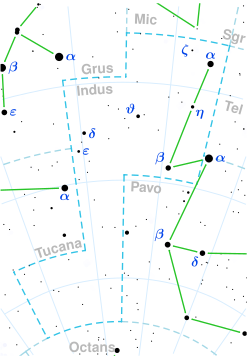
  | |
| Observation data Epoch J2000.0 Equinox J2000.0 (ICRS) | |
|---|---|
| Constellation | Indus |
| Right ascension | 21h 57m 55.07353s1 |
| Declination | −54° 59′ 33.2740″1 |
| Apparent magnitude (V) | +4.402 (4.80 + 5.96)3 |
| Characteristics | |
| Spectral type | F0 IV4 |
| U−B color index | +0.102 |
| B−V color index | +0.282 |
| Astrometry | |
| Proper motion (μ) | RA: +41.941 mas/yr Dec.: −3.931 mas/yr |
| Parallax (π) | 17.34±0.48 mas1 |
| Distance | 188 ± 5 ly (58 ± 2 pc) |
| Absolute magnitude (MV) | +0.605 |
| Orbit4 | |
| Period (P) | 12.237±0.080 yr |
| Semi-major axis (a) | 0.176±0.004″ |
| Eccentricity (e) | 0.032±0.032 |
| Inclination (i) | 76.3±2.0° |
| Longitude of the node (Ω) | 90.8±2.0° |
| Periastron epoch (T) | 2007.518±0.480 |
| Argument of periastron (ω) (secondary) | 64.9±11.0° |
| Details | |
| δ Ind A | |
| Mass | 1.78±0.214 M☉ |
| Luminosity | 485 L☉ |
| Surface gravity (log g) | 3.856 cgs |
| Temperature | 7,445±2536 K |
| Metallicity [Fe/H] | −0.215 dex |
| Rotational velocity (v sin i) | 1307 km/s |
| Age | 4626 Myr |
| δ Ind B | |
| Mass | 1.33±0.164 M☉ |
| Other designations | |
| δ Ind, CPD−55°9733, FK5 824, HD 208450, HIP 108431, HR 8368, SAO 247244, WDS J21579-5500AB8 | |
| Database references | |
| SIMBAD | data |
Delta Indi, Latinized from δ Indi, is a binary star4 system in the southern constellation of Indus. It is visible to the naked eye with a combined apparent visual magnitude of +4.40.2 The brighter primary, designated component A, is magnitude 4.80 while the companion, component B, is magnitude 5.96.3 Based upon an annual parallax shift of 17.34 mas as measured from Earth,1 the system is located about 188 light years from the Sun.
The binary nature of this system was discovered by South African astronomer William Stephen Finsen from 1936 onward,4 with his published orbital elements appearing in 1956.9 The pair have an orbital period of 12.2 years, a semimajor axis of 0.176 arc seconds, and an eccentricity of around 0.03. They have been listed with a stellar classification of F0 IV by multiple authors, suggesting they are yellow-white hued F-type subgiant stars. However, their estimated masses don't match this classification, so Docobo and Andrade (2013) suggest the Hipparcos parallax may have been underestimated.4 One paper has published separate spectral classes of A8(V) and F3(V) respectively for the two components.10
References
References
- van Leeuwen, F. (2007), "Validation of the new Hipparcos reduction", Astronomy and Astrophysics, 474 (2): 653–664, arXiv:0708.1752, Bibcode:2007A&A...474..653V, doi:10.1051/0004-6361:20078357, S2CID 18759600.
- Nicolet, B. (1978), "Photoelectric photometric Catalogue of homogeneous measurements in the UBV System", Astronomy and Astrophysics Supplement Series, 34: 1–49, Bibcode:1978A&AS...34....1N.
- Malkov, O. Yu.; et al. (2012), "Dynamical Masses of a Selected Sample of Orbital Binaries", Astronomy & Astrophysics, 546: 5, Bibcode:2012A&A...546A..69M, doi:10.1051/0004-6361/201219774, A69.
- Docobo, J. A.; Andrade, M. (2013), "Dynamical and physical properties of 22 binaries discovered by W. S. Finsen", Monthly Notices of the Royal Astronomical Society, 428 (1): 321–339, Bibcode:2013MNRAS.428..321D, doi:10.1093/mnras/sts045.
{{citation}}: CS1 maint: deprecated archival service (link) - Anderson, E.; Francis, Ch. (2012), "XHIP: An extended hipparcos compilation", Astronomy Letters, 38 (5): 331, arXiv:1108.4971, Bibcode:2012AstL...38..331A, doi:10.1134/S1063773712050015, S2CID 119257644.
- David, Trevor J.; Hillenbrand, Lynne A. (2015), "The Ages of Early-Type Stars: Strömgren Photometric Methods Calibrated, Validated, Tested, and Applied to Hosts and Prospective Hosts of Directly Imaged Exoplanets", The Astrophysical Journal, 804 (2): 146, arXiv:1501.03154, Bibcode:2015ApJ...804..146D, doi:10.1088/0004-637X/804/2/146, S2CID 33401607.
- van Belle, Gerard T. (March 2012), "Interferometric observations of rapidly rotating stars", The Astronomy and Astrophysics Review, 20 (1) 51, arXiv:1204.2572, Bibcode:2012A&ARv..20...51V, doi:10.1007/s00159-012-0051-2, S2CID 119273474.
- "del Ind". SIMBAD. Centre de données astronomiques de Strasbourg. Retrieved 2017-08-18.
{{cite web}}: CS1 maint: postscript (link) - Finsen, W. S. (1956), "The Orbit of Phi 312 = Delta Indi", Monthly Notes of the Astronomical Society of South Africa, 15: 49, Bibcode:1956MNSSA..15...49F.
- Beavers, W. I.; Cook, D. B. (1980), "Scanner studies of composite spectra I. Dwarfs.", The Astrophysical Journal Supplement Series, 44: 489, Bibcode:1980ApJS...44..489B, doi:10.1086/190702.