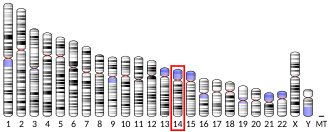
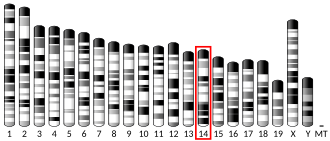
Dolichyl-diphosphooligosaccharide—protein glycosyltransferase subunit DAD1 is an enzyme that in humans is encoded by the DAD1 gene.5
Function
DAD1, the defender against apoptotic cell death, was initially identified as a negative regulator of programmed cell death in the temperature sensitive tsBN7 cell line. The DAD1 protein disappeared in temperature-sensitive cells following a shift to the nonpermissive temperature, suggesting that loss of the DAD1 protein triggered apoptosis. DAD1 is believed to be a tightly associated subunit of oligosaccharyltransferase both in the intact membrane and in the purified enzyme, thus reflecting the essential nature of N-linked glycosylation in eukaryotes.5
Interactions
DAD1 has been shown to interact with MCL1.6
References
References
- GRCh38: Ensembl release 89: ENSG00000129562 – Ensembl, May 2017
- GRCm38: Ensembl release 89: ENSMUSG00000022174 – Ensembl, May 2017
- "Human PubMed Reference:". National Center for Biotechnology Information, U.S. National Library of Medicine.
- "Mouse PubMed Reference:". National Center for Biotechnology Information, U.S. National Library of Medicine.
- "Entrez Gene: DAD1 defender against cell death 1".
- Makishima T, Yoshimi M, Komiyama S, Hara N, Nishimoto T (September 2000). "A subunit of the mammalian oligosaccharyltransferase, DAD1, interacts with Mcl-1, one of the bcl-2 protein family". J. Biochem. 128 (3): 399–405. doi:10.1093/oxfordjournals.jbchem.a022767. PMID 10965038.
Further reading
Further reading
- Yulug IG, See CG, Fisher EM, Ylug IG (1995). "The DAD1 protein, whose defect causes apoptotic cell death, maps to human chromosome 14". Genomics. 26 (2): 433–5. doi:10.1016/0888-7543(95)80241-D. PMID 7601483.
- Apte SS, Mattei MG, Seldin MF, Olsen BR (1995). "The highly conserved defender against the death 1 (DAD1) gene maps to human chromosome 14q11-q12 and mouse chromosome 14 and has plant and nematode homologs". FEBS Lett. 363 (3): 304–6. doi:10.1016/0014-5793(95)00321-Y. PMID 7737422. S2CID 39270530.
- Maruyama K, Sugano S (1994). "Oligo-capping: a simple method to replace the cap structure of eukaryotic mRNAs with oligoribonucleotides". Gene. 138 (1–2): 171–4. doi:10.1016/0378-1119(94)90802-8. PMID 8125298.
- Nakashima T, Sekiguchi T, Kuraoka A, Fukushima K, Shibata Y, Komiyama S, Nishimoto T (1993). "Molecular cloning of a human cDNA encoding a novel protein, DAD1, whose defect causes apoptotic cell death in hamster BHK21 cells". Mol. Cell. Biol. 13 (10): 6367–74. doi:10.1128/mcb.13.10.6367. PMC 364695. PMID 8413235.
- Kelleher DJ, Gilmore R (1997). "DAD1, the defender against apoptotic cell death, is a subunit of the mammalian oligosaccharyltransferase". Proc. Natl. Acad. Sci. U.S.A. 94 (10): 4994–9. Bibcode:1997PNAS...94.4994K. doi:10.1073/pnas.94.10.4994. PMC 24619. PMID 9144178.
- Makishima T, Nakashima T, Nagata-Kuno K, Fukushima K, Iida H, Sakaguchi M, Ikehara Y, Komiyama S, Nishimoto T (1997). "The highly conserved DAD1 protein involved in apoptosis is required for N-linked glycosylation". Genes Cells. 2 (2): 129–41. doi:10.1046/j.1365-2443.1997.1070303.x. PMID 9167970. S2CID 25807010.
- Suzuki Y, Yoshitomo-Nakagawa K, Maruyama K, Suyama A, Sugano S (1997). "Construction and characterization of a full length-enriched and a 5'-end-enriched cDNA library". Gene. 200 (1–2): 149–56. doi:10.1016/S0378-1119(97)00411-3. PMID 9373149.
- Zhong XP, Krangel MS (1999). "Enhancer-blocking activity within the DNase I hypersensitive site 2 to 6 region between the TCR alpha and Dad1 genes". J. Immunol. 163 (1): 295–300. doi:10.4049/jimmunol.163.1.295. PMID 10384128.
- Makishima T, Yoshimi M, Komiyama S, Hara N, Nishimoto T (2000). "A subunit of the mammalian oligosaccharyltransferase, DAD1, interacts with Mcl-1, one of the bcl-2 protein family". J. Biochem. 128 (3): 399–405. doi:10.1093/oxfordjournals.jbchem.a022767. PMID 10965038.
- Gevaert K, Goethals M, Martens L, Van Damme J, Staes A, Thomas GR, Vandekerckhove J (2003). "Exploring proteomes and analyzing protein processing by mass spectrometric identification of sorted N-terminal peptides". Nat. Biotechnol. 21 (5): 566–9. doi:10.1038/nbt810. PMID 12665801. S2CID 23783563.
- Shibatani T, David LL, McCormack AL, Frueh K, Skach WR (2005). "Proteomic analysis of mammalian oligosaccharyltransferase reveals multiple subcomplexes that contain Sec61, TRAP, and two potential new subunits". Biochemistry. 44 (16): 5982–92. doi:10.1021/bi047328f. PMID 15835887.