| Apocytochr_F_C | |||||||
|---|---|---|---|---|---|---|---|
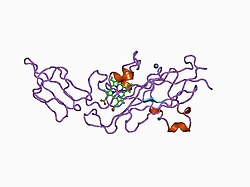 cytochrome f from the b6f complex of Phormidium laminosum | |||||||
| Identifiers | |||||||
| Symbol | Apocytochr_F_C | ||||||
| Pfam | PF01333 | ||||||
| Pfam clan | CL0105 | ||||||
| InterPro | IPR002325 | ||||||
| PROSITE | PDOC00169 | ||||||
| SCOP2 | 1ctm / SCOPe / SUPFAM | ||||||
| TCDB | 3.D.3 | ||||||
| OPM superfamily | 92 | ||||||
| OPM protein | 3h1j | ||||||
| |||||||
Cytochrome f is the largest subunit of cytochrome b6f complex (plastoquinol—plastocyanin reductase; EC 1.10.99.1). In its structure and functions, the cytochrome b6f complex bears extensive analogy to the cytochrome bc1 complex of mitochondria and photosynthetic purple bacteria. Cytochrome f (cyt f) plays a role analogous to that of cytochrome c1, in spite of their different structures.1
The 3D structure of Brassica rapa (Turnip) cyt f has been determined.2 The lumen-side segment of cyt f includes two structural domains: a small one above a larger one that, in turn, is on top of the attachment to the membrane domain. The large domain consists of an anti-parallel beta-sandwich and a short haem-binding peptide, which form a three-layer structure. The small domain is inserted between beta-strands F and G of the large domain and is an all-beta domain. The haem nestles between two short helices at the N terminus of cyt f. Within the second helix is the sequence motif for the c-type cytochromes, CxxCH (residues 21–25), which is covalently attached to the haem through thioether bonds to Cys-21 and Cys-24. His-25 is the fifth haem iron ligand. The sixth haem iron ligand is the alpha-amino group of Tyr-1 in the first helix.2 Cyt f has an internal network of water molecules that may function as a proton wire.2 The water chain appears to be a conserved feature of cyt f.
References
References
- Prince RC, George GN (June 1995). "Cytochrome f revealed". Trends Biochem. Sci. 20 (6): 217–8. doi:10.1016/S0968-0004(00)89018-0. PMID 7631417.
- Martinez SE, Huang D, Ponomarev M, Cramer WA, Smith JL (June 1996). "The heme redox center of chloroplast cytochrome f is linked to a buried five-water chain". Protein Sci. 5 (6): 1081–92. doi:10.1002/pro.5560050610. PMC 2143431. PMID 8762139.
Further reading
Further reading
- Bendall, D.S. (2004). "The unfinished story of cytochrome f". Photosynth. Res. 80 (1–3): 265–276. doi:10.1023/B:PRES.0000030454.23940.f9. PMID 16328825.
- Cramer, W.A.; Martinez, S.E.; Huang, D.; Tae, G.S.; Everly, R.M.; Heymann, J.B.; Cheng, R.H.; Baker, T.S. & Smith, J.L. (1994). "Structural aspects of the cytochrome b6f complex; structure of the lumen-side domain of cytochrome f". J. Bioenerg. Biomembr. 26 (1): 31–47. doi:10.1007/BF00763218. PMC 4167668. PMID 8027021.
External links
External links
- Cytochrome+f at the U.S. National Library of Medicine Medical Subject Headings (MeSH)