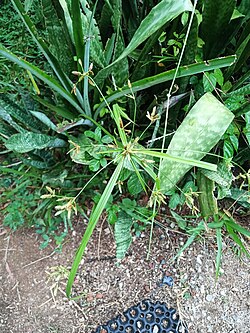
| Cyperus laxus | |
|---|---|
| |
Scientific classification 
| |
| Kingdom: | Plantae |
| Clade: | Embryophytes |
| Clade: | Tracheophytes |
| Clade: | Spermatophytes |
| Clade: | Angiosperms |
| Clade: | Monocots |
| Clade: | Commelinids |
| Order: | Poales |
| Family: | Cyperaceae |
| Genus: | Cyperus |
| Species: | C. laxus
|
| Binomial name | |
| Cyperus laxus Lam., Tab. Encycl. 1: 146. 1791.
| |
Cyperus laxus is a sedge species in the Cyperaceae. It is native to tropical regions of the Western Hemisphere (from central Mexico and the West Indies south to Argentina) and also to Africa (from Liberia to Zimbabwe and Tanzania). The species is reportedly naturalized in Assam and the Andaman and Nicobar Islands.123456
Subspecies
Three subspecies are recognized:1
- Cyperus laxus subsp. buchholzii (Boeckeler) Lye - western and central Africa
- Cyperus laxus subsp. laxus - Western Hemisphere; naturalized in India
- Cyperus laxus subsp. sylvestris (Ridl.) Lye - Tanzania, Uganda, Zimbabwe
References
References
- Kew World Checklist of Selected Plant Families
- Hokche, O., Berry, P.E. & Huber, O. (eds.) (2008). Nuevo Catálogo de la Flora Vascular de Venezuela: 1-859. Fundación Instituto Botánico de Venezuela.
- Pandey, R.P. & Dilwakar, P.G. (2008). An integrated check-list flora of Andaman and Nicobar islands, India. Journal of Economic and Taxonomic Botany 32: 403-500.
- Sarmah, K.K. & Borthakur, S.K. (2009). A checklist of angiospermic plants of Manas national park in Assam, India. Pleione 3: 190-200.
- Hoenselaar, K., Verdcourt, B. & Beentje, H. (2010). Cyperaceae. Flora of Tropical East Africa: 1-466.
- Acevedo-Rodríguez, P. & Strong, M.T. (2012). Catalogue of seed plants of the West Indies. Smithsonian Contributions to Botany 98: 1-1192.
External links
External links
- Dressler, S.; Schmidt, M. & Zizka, G. (2014). "Cyperus laxus". African plants – a Photo Guide. Frankfurt/Main: Forschungsinstitut Senckenberg.