 | |
| Clinical data | |
|---|---|
| Other names | Cyheptamine |
| Identifiers | |
| |
| CAS Number | |
| PubChem CID | |
| ChemSpider | |
| UNII | |
| KEGG | |
| ChEMBL | |
| CompTox Dashboard (EPA) | |
| ECHA InfoCard | 100.027.792 |
| Chemical and physical data | |
| Formula | C16H15NO |
| Molar mass | 237.302 g·mol−1 |
| 3D model (JSmol) | |
| |
| |
Cyheptamide was a investigational new drug that was developed by Ayerst Research Laboratories in the 1960s and was evaluated as an anticonvulsant.1
Cyheptamide undergoes significant metabolic transformation in both animals and humans, primarily through hydroxylation pathways.2
Cyheptamide exhibits moderate acute toxicity in animal models, with species-specific variations in lethal dose values.3
Related compounds
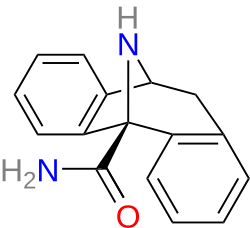
SGB-017 has a similar chemical structure and has also been evaluated for its potential use as an anticonvulsant.4
References
References
- "Cyheptamide". Inxight: Drugs. NCATS. Retrieved 2025-06-25.
- Kraml M, Sestanj K, Dvornik D (September 1971). "Metabolism of the anticonvulsant 10,11-dihydro-5H-dibenzo(a,d)cycloheptene-5-carboxamide. I. Metabolic fate of (14C)cyheptamide in animals and man". Biochemical Pharmacology. 20 (9): 2327–2338. doi:10.1016/0006-2952(71)90232-2. PMID 5163146.
- van Eeken CJ, Birtwhistle RD, Mulder D (November 1970). "Toxicological study of cyheptamide: 10,11-dihydro-5H-dibenzo[a,d]cycloheptene-5-carboxamide (BS 7029)". Archives Internationales de Pharmacodynamie et de Therapie. 188 (1): 79–85. PMID 5485105.
- Lin, S. S., Sun, L. R. (December 1999). "SGB‐017 (ADCI): A Novel Anticonvulsant with a Dual Mechanism of Action". CNS Drug Reviews. 5 (4): 365–378. doi:10.1111/j.1527-3458.1999.tb00111.x.