| |||
| Names | |||
|---|---|---|---|
| Preferred IUPAC name
4-Isopropylbenzaldehyde | |||
| Systematic IUPAC name
4-(1-Methylethyl)benzenecarbaldehyde | |||
| Other names
p-Isopropylbenzaldehyde
4-(1-Methylethyl)benzaldehyde Cuminal Cumaldehyde | |||
| Identifiers | |||
| |||
3D model (JSmol)
|
|||
| ChEBI | |||
| ChEMBL | |||
| ChemSpider |
| ||
| ECHA InfoCard | 100.004.107 | ||
| EC Number |
| ||
| KEGG |
| ||
PubChem CID
|
|||
| RTECS number |
| ||
| UNII | |||
CompTox Dashboard (EPA)
|
|||
| |||
| |||
| Properties | |||
| C10H12O | |||
| Molar mass | 148.205 g·mol−1 | ||
| Appearance | Colorless oil | ||
| Density | 0.978 g/cm3 | ||
| Boiling point | 235.5 °C (455.9 °F; 508.6 K) | ||
| Insoluble | |||
| Hazards | |||
| GHS labelling: | |||

| |||
| Warning | |||
| H302, H317 | |||
| P261, P264, P270, P272, P280, P301+P312, P302+P352, P321, P330, P333+P313, P363, P501 | |||
| NFPA 704 (fire diamond) | |||
| Flash point | 93 °C (199 °F; 366 K) | ||
| Related compounds | |||
Related compounds
|
Benzaldehyde Cumene Cuminol | ||
Except where otherwise noted, data are given for materials in their standard state (at 25 °C [77 °F], 100 kPa).
| |||
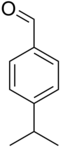
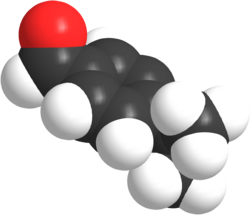



Cuminaldehyde (4-isopropylbenzaldehyde) is a natural organic compound with the molecular formula C10H12O. It is a benzaldehyde with an isopropyl group substituted in the 4-position.
Uses and occurrence
Cuminaldehyde is responsible for the characteristic aroma of cumin seed. It has an intense aroma described as "spicy, cumin, green, herbal".2 Cuminaldehyde is a precursor to another commercially important fragrance, cyclamen aldehyde.3
Cuminaldehyde has been investigated for inhibition of the fibrillation of alpha-synuclein,4
Cuminaldehyde can be prepared synthetically by the reduction of 4-isopropylbenzoyl chloride or by the formylation of cumene.
References
References
- Merck Index, 11th Edition, 2623
- "cuminaldehyde". Scents and Flavors. Scents and Flavors. Retrieved 29 March 2026.
- Panten, Johannes; Surburg, Horst (2016). "Flavors and Fragrances, 3. Aromatic and Heterocyclic Compounds". Ullmann's Encyclopedia of Industrial Chemistry. pp. 1–45. doi:10.1002/14356007.t11_t02. ISBN 978-3-527-30673-2.
- Morshedi D; Aliakbari F; Tayaranian-Marvian, Fassihi; Pan-Montojo, Pérez-Sánchez (Sep 2015). "Cuminaldehyde as the Major Component of Cuminum cyminum, a Natural Aldehyde with Inhibitory Effect on Alpha-Synuclein Fibrillation and Cytotoxicity". Journal of Food Science. 80 (10): H2336–H2345. doi:10.1111/1750-3841.13016. PMID 26351865.