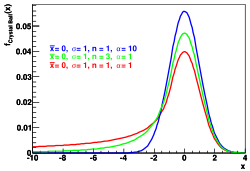
The Crystal Ball function, named after the Crystal Ball Collaboration (hence the capitalized initial letters), is a probability density function (PDF) commonly used to model various lossy processes in high-energy physics such as Bremsstrahlung by electrons. It consists of a Gaussian core portion and a power-law low-end tail, below a certain threshold. The function itself and its first derivative are both continuous.
The Crystal Ball function is given by:
where
- ,
- ,
- ,
- ,
- ,
with the error function erf.
The parameters of the function (that are usually determined by a fit) are:
- is a normalization factor (Skwarnicki 1986)
- defines the point where the PDF changes from a power-law to a Gaussian distribution
- is the power of the power-law tail
- and are the mean and the standard deviation of the Gaussian
External links
External links
- J. E. Gaiser, Appendix-F Charmonium Spectroscopy from Radiative Decays of the J/Psi and Psi-Prime, Ph.D. Thesis, SLAC-R-255 (1982). (This is a 205-page document in .pdf form – the function is defined on p. 178.)
- M. J. Oreglia, A Study of the Reactions psi prime → gamma gamma psi, Ph.D. Thesis, SLAC-R-236 (1980), Appendix D.
- T. Skwarnicki, A study of the radiative CASCADE transitions between the Upsilon-Prime and Upsilon resonances, Ph.D Thesis, DESY F31-86-02(1986), Appendix E.