| Cryptomonadaceae | |
|---|---|
| |
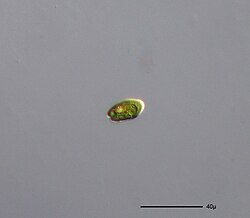
| Cryptomonas platyuris | |
Scientific classification 
| |
| Domain: | Eukaryota |
| Phylum: | Cryptista |
| Superclass: | Cryptomonada |
| Class: | Cryptophyceae |
| Order: | Cryptomonadales |
| Family: | Cryptomonadaceae Ehrenberg, 1831 |
| Type genus | |
| Cryptomonas Ehrenberg, 18311
| |
| Genera2 | |
| |
| Synonyms | |
| |
Cryptomonadaceae is a family of Cryptophyceae in the order Cryptomonadales. The unicellular algae of this family have a furrow-gullet complex. They typically have chloroplasts that are reddish or greenish in color, with nucleomorphs located between the nucleus and the pyrenoid (if present). There may be more than one pyrenoid. The life cycle of these organisms is complex, as they can have cryptomorph and campylomorph phases. Both states have morphological differences.3
Thus, the cryptomorph has a complex furrow with a stoma, a more oval or rounded cell shape, and an internal periplast component (IPC) made of multiple plates. In the campylomorph, the furrow is simple without a stoma, the vestibulum has a vestibular ligule, the cell shape is more sigmoid, and the IPC is composed of a single lamella.3
Cryptomorphs possess a fibrous furrow plate and a short rhizostyle without wings (lamellae). Campylomorphs possess a scalariform plate and a long, keeled rhizostyle with wings (lamellae).3
Not all species have found both cryptomorph-campylomorph states; in some, only one of these states has been found, and the other is unknown or still under investigation, since there are described species that were later reassigned as synonyms of others, when it was seen that they were actually one of these morphological states.4
References
References
- Guiry, M.D. & Guiry, G.M. 2025. AlgaeBase. World-wide electronic publication, University of Galway. https://www.algaebase.org; searched on 14 May 2026.
- Cryptomonadaceae (Ehrenberg, 1831) . Retrieved through: Interim Register of Marine and Nonmarine Genera on 15 May 2026.
- "Cryptomonads", Freshwater Algae of North America, Academic Press, pp. 809–850, 2015-01-01, doi:10.1016/B978-0-12-385876-4.00018-9, retrieved 2026-05-06
- Hoef-Emden, Kerstin; Melkonian, Michael (2003-10-01). "Revision of the Genus Cryptomonas (Cryptophyceae): a Combination of Molecular Phylogeny and Morphology Provides Insights into a Long-Hidden Dimorphism". Protist. 154 (3): 371–409. doi:10.1078/143446103322454130. ISSN 1434-4610.