| Crescentia | |
|---|---|
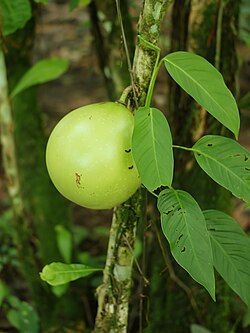
| |
| Crescentia cujete | |
Scientific classification 
| |
| Kingdom: | Plantae |
| Clade: | Embryophytes |
| Clade: | Tracheophytes |
| Clade: | Spermatophytes |
| Clade: | Angiosperms |
| Clade: | Eudicots |
| Clade: | Asterids |
| Order: | Lamiales |
| Family: | Bignoniaceae |
| Clade: | Crescentiina |
| Clade: | Tabebuia alliance |
| Tribe: | Crescentieae |
| Genus: | Crescentia L. (1753) |
| Species1 | |
|
six; see text | |
| Synonyms1 | |
| |
Crescentia (calabash tree, huingo, krabasi, or kalebas) is a genus of six species2 of flowering plants in the family Bignoniaceae, native to Mexico, the Caribbean, Central America, and northern South America.1 The species are moderate-size trees growing to 10 m (35 ft) tall, and producing large spherical fruits, with a thin, hard shell and soft pulp,3 up to 25 cm (10 in) in diameter.4
Uses
The hard shell can be used for containers, scoops, cups etc.3
Species
Six species are accepted.1
- Crescentia alata Kunth
- Crescentia amazonica Ducke
- Crescentia cujete L.
- Crescentia linearifolia Miers
- Crescentia mirabilis Eckman ex Urb.
- Crescentia portoricensis Britton
References
References
- Crescentia L. Plants of the World Online. Retrieved 21 August 2024.
- "Crescentia". Germplasm Resources Information Network. Archived from the original on 2013-03-27. Retrieved 2011-09-24.
- "Crescentia cujete (Huingo)". Rainforest Conservation Fund. Retrieved 2011-09-24.
- "Calabash Tree Fruit". Mission to Belize. Archived from the original on 2011-08-29. Retrieved 2011-09-24.