 | |
| Names | |
|---|---|
| Preferred IUPAC name
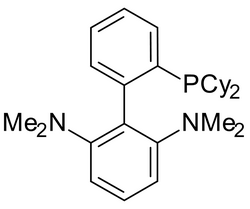
2′-(Dicyclohexylphosphanyl)-N2,N2,N6,N6-tetramethyl[1,1′-biphenyl]-2,6-diamine | |
| Other names
CPhos
| |
| Identifiers | |
3D model (JSmol)
|
|
| ChemSpider | |
PubChem CID
|
|
| UNII | |
CompTox Dashboard (EPA)
|
|
| |
| |
| Properties | |
| C28H41N2P | |
| Molar mass | 436.61 |
| Appearance | white solid1 |
| Melting point | 111 to 113 °C (232 to 235 °F; 384 to 386 K)1 |
| organic solvents | |
Except where otherwise noted, data are given for materials in their standard state (at 25 °C [77 °F], 100 kPa).
| |

CPhos is a phosphine ligand derived from biphenyl. It is a white solid that is soluble in organic solvents.
Its palladium complexes exhibit high activity for Negishi coupling reactions involving aryl bromides, chlorides and triflates. CPhos mediated reactions performed with secondary (sp3) alkylzinc halides often give excellent yields, with low conversion to the frequently encountered primary substituted by-products.1
Utility in Negishi Coupling
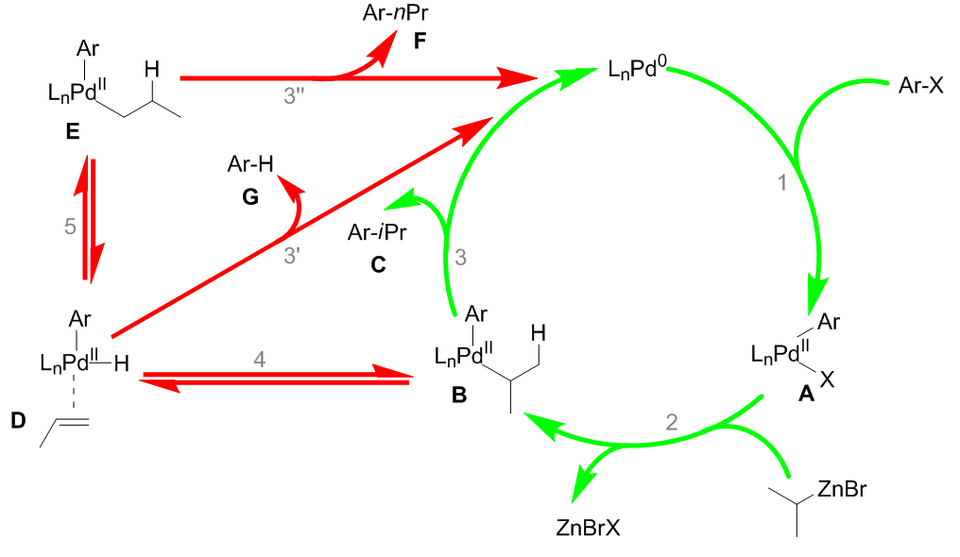
A simplified scheme showing the reaction course of isopropylzinc bromide with an aryl halide is shown below. Processes leading to byproduct formation are highlighted in red.
Oxidative addition (1) of the aryl halide to the palladium-ligand complex followed by transmetalation (2) gives intermediate B which can undergo reductive elimination (3) to afford the desired isopropyl arene C. However, intermediate B can also undergo β-hydride elimination (4) to afford D, which can either reductively eliminate (3’) to afford de-halogenated product G, or undergo insertion (5) leading to the formation of E. Once formed, E may also undergo reductive elimination (3’’) to afford the n-propyl by-product F.
CPhos minimises the conversion to undesired products F & G by increasing the rate of the reductive elimination of B, relative to the rate of β-hydride elimination.
References
References
- Han, C.; Buchwald, S. L. (2009). "Negishi Coupling of Secondary Alkylzinc Halides with Aryl Bromides and Chlorides". J. Am. Chem. Soc. 131 (22): 7532–7533. doi:10.1021/ja902046m. PMC 2746668. PMID 19441851.