Cotia | |
|---|---|
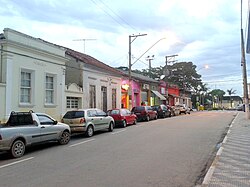 View of the historic center of Cotia | |
 Flag 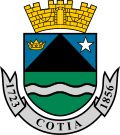 Coat of arms | |
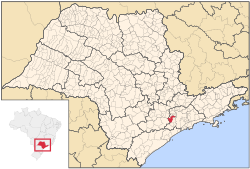 Location in the state of São Paulo and Brazil | |
Cotia Location within Brazil | |
| Coordinates: 23°36′15″S 46°55′10″W / 23.60417°S 46.91944°W / -23.60417; -46.91944 | |
| Country | Brazil |
| Region | Southeast |
| State | São Paulo |
| Founded | April 2, 1856 |
| Government | |
| • Mayor | Welington Aparecido Alfredo (PDT) |
| Area | |
• Total | 323.99 km2 (125.09 sq mi) |
| Elevation | 853 m (2,799 ft) |
| Population (2022)1 | |
• Total | 274,413 |
• Estimate (2025) | 289,493 |
| • Density | 846.98/km2 (2,193.7/sq mi) |
| Time zone | UTC-3 (UTC-3) |
| • Summer (DST) | UTC-2 (UTC-2) |
| Website | Prefeitura Municipal de Cotia |
Cotia is a municipality in the state of São Paulo in Brazil. It is part of the Metropolitan Region of São Paulo.2 The population is 274.413 (2022 est.) in an area of 323.99 km2.3 The city is at an elevation of 853 m. Cotia is linked with the Rodovia Raposo Tavares highway.
The municipality is made up of the headquarters and the district of Caucaia do Alto, with its former districts of Jandira, Itapevi and Vargem Grande Paulista (originally called Raposo Tavares) having been split off to form new municipalities.4
History
Cotia was founded in 1580, and was an active village during the "bandeiras" expeditions. In 1626, Raposo Tavares and his companions arrived in the city. The "Sítio do Mandú" and "Sítio do Padre Inácio" (Mandu's Ranch and Priest Inácio's Ranch) were some of the first rural houses to be built there. Nowadays, they are preserved by the "Instituto Brasileiro de Patrimônio Cultural". Cotia was declared an independent municipality on April 2, 1856. According to the 1980 demographic census, the city had a population of over 62 thousand people.
Geography
The city is located west of São Paulo, and has a terrain made of valleys and mountains, reaching a maximum elevation of 1,074 meters above sea level 5
The city has the Cotia River as its main river.
The city has a densely populated urban area, but the less developed areas to the west attract people interested in ecotourism. The only naturally occurring case of Brazilian hemorrhagic fever took place here.
Demography
| |||||||||||||||||||||||||||||||||||||||||||||||||||
Economy
The city's economy is quite diverse, with the industrial and agricultural sectors standing out.
In the industrial sector located along the Raposo Tavares Highway and its surroundings, the most important products are electrical materials, chemicals, ceramics, toys, textiles, explosives, food, wine, brandy and agricultural machinery.
In agriculture, the most notable are potatoes, tomatoes, corn, beans, garlic and various fruits, most of which come from Caucaia do Alto. Poultry farming is also developed in the municipality.
In 2014, the municipality had 1,200 licensed companies (micro, small, medium and service providers) and, by the first quarter of 2015, it had 6,186 individual microentrepreneurs.10
Media
In telecommunications, the city was served by Telecomunicações de São Paulo.11 In July 1998, this company was acquired by Telefónica, which adopted the Vivo brand in 2012. The company is currently an operator of cell phones, fixed lines, internet (fiber optics/4G) and television (satellite and cable).12
Religion
Christianity is present in the city as follows:
Catholic Church
The Catholic church in the municipality is part of the Diocese of Osasco.13
Protestant Church
The most diverse evangelical beliefs are present in the city, mainly Pentecostal, including the Assemblies of God in Brazil (the largest evangelical church in the country),1415 Christian Congregation in Brazil,16 among others. These denominations are growing more and more throughout Brazil.
References
References
- IBGE
- "Lei Complementar nº 1.139, de 16 de junho de 2011". Archived from the original on 2015-10-01. Retrieved 2015-09-30.
- Instituto Brasileiro de Geografia e Estatística
- "EncontraCotia.com | Guia de Cotia » EncontraCotia.com". EncontraCotia.com (in Brazilian Portuguese). Retrieved 2024-10-08.
- "Terrain of the city at CityBrazil.com.br". Archived from the original on 2016-03-05. Retrieved 2009-03-07.
- "Censos Demográficos (1991-2022) | IBGE". www.ibge.gov.br (in Portuguese).
- "Censos Demográficos (1920-1980) | IBGE". biblioteca.ibge.gov.br (in Portuguese).
- "Evolução da população segundo os municípios (1872-2010) | IBGE" (PDF). geoftp.ibge.gov.br (in Portuguese).
- "Biblioteca Digital Seade | Fundação Seade". bibliotecadigital.seade.gov.br (in Portuguese).
- cotia.net.br. "cotia.net.br | Guia de empresas e serviços em Cotia". cotia.net.br (in Portuguese). Retrieved 2025-01-14.
- "Creation of Telesp - April 12, 1973". www.imprensaoficial.com.br (in Portuguese). Retrieved 2024-06-04.
- "Our History - Telefônica RI". Telefônica. Retrieved 2024-06-04.
- "Sul 1 Region of Brazil [Catholic-Hierarchy]". www.catholic-hierarchy.org. Retrieved 2026-03-22.
- "Campos Eclesiásticos". CONFRADESP (in Portuguese). 2018-12-10. Retrieved 2026-03-22.
- "Arquivos: Locais". Assembleia de Deus Belém – Sede (in Portuguese). Retrieved 2026-03-22.
- "Localidade - Congregação Cristã no Brasil". congregacaocristanobrasil.org.br (in Portuguese). Retrieved 2026-03-22.
External links
External links
Cotia travel guide from Wikivoyage
- (in Portuguese) http://www.cotia.sp.gov.br
- (in Portuguese) Cotia on citybrazil.com.br
- (in Portuguese) Encontra Cotia - Find everything about Cotia city
- History of Cotia at the City Hall website