| Corumbella Temporal range: Ediacaran,
| |
|---|---|
| |
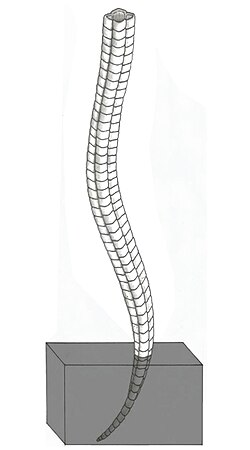
| C. werneri reconstruction1 | |
Scientific classification 
| |
| Kingdom: | Animalia |
| Phylum: | Cnidaria |
| Class: | Scyphozoa |
| Family: | †Corumbellidae Hahn, Hahn, Leonardos, Pflug, and Walde, 19821 |
| Genus: | †Corumbella Hahn, Hahn, Leonardos, Pflug, and Walde, 19821 |
| Species: | †C. werneri
|
| Binomial name | |
| †Corumbella werneri Hahn, Hahn, Leonardos, Pflug, and Walde, 19821
| |
Corumbella is an extinct genus of terminal-Ediacaran animals. It is the only genus in the monotypic family Corumbellidae, and is represented by a single species Corumbella werneri.2 It possessed a carapace made up of thick polygonal rings3 in which plates with pores and papillae4 attest to the advent of skeletogenesis in the latest Neoproterozoic metazoan.34 It was sessile and somewhat resembles the later conulariids,35 though this similarity is likely superficial; its secretion of an aragonitic scleritome suggests a eumetazoan affinity.6
References
References
- Pacheco, Mírian L. A. Forancelli; Galante, Douglas; Rodrigues, Fabio; Leme, Juliana de M.; Bidola, Pidassa; Hagadorn, Whitey; Stockmar, Marco; Herzen, Julia; Rudnitzki, Isaac D.; Pfeiffer, Franz; Marques, Antonio C. (2015). "Insights into the skeletonization, lifestyle, and affinity of the unusual Ediacaran fossil Corumbella". PLOS ONE. 10 (3) e0114219. Bibcode:2015PLoSO..1014219P. doi:10.1371/journal.pone.0114219. PMC 4379158. PMID 25822998.
- Hahn, G.; Hahn, R.; Leonardos, O.H.; Pflug, H.D.; Walde, D.H.G. (1982). "Körperlich erhaltene Scyphozoen-Reste aus dem Jungpräkambrium Brasiliens". Geologica et Palaeontologica. 16: 1–18.
- Pacheco, M. L. A. F.; Leme, J.; Machado, A. (2011). "Taphonomic analysis and geometric modelling for the reconstitution of the Ediacaran metazoan Corumbella werneri Hahn et al. 1982 (Tamengo Formation, Corumbá Basin, Brazil)". Journal of Taphonomy. 9 (4): 269–283.
- Warren, L. V.; Pacheco, M. L. A. F.; Fairchild, T. R.; Simoes, M. G.; Riccomini, C.; Boggiani, P. C.; Caceres, A. A. (2012). "The dawn of animal skeletogenesis: Ultrastructural analysis of the Ediacaran metazoan Corumbella werneri". Geology. 40 (8): 691. Bibcode:2012Geo....40..691W. doi:10.1130/G33005.1.
- Babcock, L. E.; Grunow, A. M.; Sadowski, G. R.; Leslie, S. A. (2005). "Corumbella, an Ediacaran-grade organism from the Late Neoproterozoic of Brazil". Palaeogeography, Palaeoclimatology, Palaeoecology. 220 (1–2): 7–18. Bibcode:2005PPP...220....7B. doi:10.1016/j.palaeo.2003.01.001.
- Osés, Gabriel Ladeira; Wood, Rachel; Romero, Guilherme Raffaeli; Evangelista Martins Prado, Gustavo Marcondes; Bidola, Pidassa; Herzen, Julia; Pfeiffer, Franz; Stampar, Sérgio Nascimento; Alves Forancelli Pacheco, Mírian Liza (2022). "Ediacaran Corumbella has a cataphract calcareous skeleton with controlled biomineralization". iScience. 25 (12) 105676. Bibcode:2022iSci...25j5676O. doi:10.1016/j.isci.2022.105676. PMC 9763863. PMID 36561886.