| Coronet Cluster | |
|---|---|
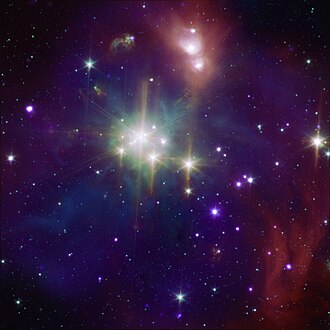 The Coronet Cluster, R CrA is the central dominantly bright star, with reflection nebulae NGC 6726/NGC 6727 lit by TY CrA and HD 176386 to upper right and parts of IC 4812 at the lower right. | |
| Observation data (J2000.0 epoch) | |
| Right ascension | 19h 1m 54s |
| Declination | −36° 57.2′ |
| Distance | 420–550 ly (130–170 pc) |
| Apparent magnitude (V) | 8 |
| Apparent dimensions (V) | 26 arcmin |
| Physical characteristics | |
| Mass | unknown M☉ |
| Radius | 2.1 light years |
| Estimated age | 0.5–2 million years |
| relative scarcity of circumstellar discs | |
| Other designations | R CRA, G359.93-17.85 by BDB2003 catalog |
| Associations | |
| Constellation | Corona Australis |
The Coronet Cluster, also known as the R CrA cluster after its best-known member, is a small open cluster located about 170 parsecs away in the southern constellation Corona Australis, isolated at the edge of the Gould Belt.12 It is 3.5 times closer to Earth than the Orion Nebula Cluster.3 The cluster's center is composed of mostly young stars.4 The variable T Coronae Australis is also a member, located just one arcminute from R CrA.
References
References
- "APOD - Coronet in the Southern Crown". Retrieved 2016-12-30.
- Sicilia-Aguilar, Aurora; Henning, Thomas; Juha´sz, Attila; Bouwman, Jeroen; Garmire, Gordon; Garmire, Audrey (10 November 2008). "Very Low Mass Objects in the Coronet Cluster: The Realm of the Transition Disks" (PDF). The Astrophysical Journal. 687 (2): 1145–1167. arXiv:0807.2504. Bibcode:2008ApJ...687.1145S. doi:10.1086/591932. S2CID 119208696.
- "Coronet Cluster: A Neighbor of Star Formation (A region of star formation about 420 light years from Earth.)". Retrieved 10 Jan 2013.
{{cite web}}: CS1 maint: deprecated archival service (link) - Sicilia-Aguilar, Aurora; Henning, Thomas; Linz, Hendrik; Krause, Oliver; André, Philippe (2012). "The star formation and disk evolution history of a sparse region: The Coronet cluster". Proceedings of the Symposium "From Atoms to Pebbles: Herschel's View of Star and Planet Formation": 29. Bibcode:2012faph.confE..29S.