 | |
 | |
| Clinical data | |
|---|---|
| ATC code |
|
| Identifiers | |
| |
| CAS Number | |
| PubChem CID | |
| ChemSpider | |
| ChEBI | |
| CompTox Dashboard (EPA) | |
| ECHA InfoCard | 100.006.727 |
| Chemical and physical data | |
| Formula | C21H26N2O2 |
| Molar mass | 338.451 g·mol−1 |
| 3D model (JSmol) | |
| |
| |
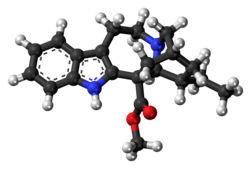
Coronaridine, also known as 18-carbomethoxyibogamine, is an alkaloid found in Tabernanthe iboga and related species, including Tabernaemontana divaricata for which (under the now obsolete synonym Ervatamia coronaria) it was named.1
Like ibogaine, (R)-coronaridine and (S)-coronaridine can decrease intake of cocaine and morphine in animals2 and it may have muscle relaxant and hypotensive activity.3
Chemistry
Congeners
Coronaridine congeners are important in drug discovery and development due to multiple actions on different targets. They have ability to inhibit Cav2.2 channel,4 modulate and inhibit subunits of nAChr selectively such as α9α10,4 α3β456 and potentiate GABAA activity.7
Pharmacology
Coronaridine has been reported to bind to an assortment of molecular sites, including: μ-opioid (Ki = 2.0 μM), δ-opioid (Ki = 8.1 μM), and κ-opioid receptors (Ki = 4.3 μM), NMDA receptor (Ki = 6.24 μM) (as an antagonist),8 and nAChRs (as an antagonist).9 It has also been found to inhibit the enzyme acetylcholinesterase, act as a voltage-gated sodium channel blocker,10 and displays estrogenic activity in rodents.89 In contrast to ibogaine and other iboga alkaloids, coronaridine does not bind to either the σ1 or σ2 receptor.10
Sources
Sources
| Family | Plants |
|---|---|
| Apocynaceae | T. catharinensis, T. ternifolia, T. pandacaqui, T. heyneana, T. litoralis, T. divaricata, T. penduliflora.11 |
References
References
- Delorenzi JC, Freire-de-Lima L, Gattass CR, de Andrade Costa D, He L, Kuehne ME, Saraiva EM (July 2002). "In vitro activities of iboga alkaloid congeners coronaridine and 18-methoxycoronaridine against Leishmania amazonensis". Antimicrobial Agents and Chemotherapy. 46 (7): 2111–2115. doi:10.1128/aac.46.7.2111-2115.2002. PMC 127312. PMID 12069962.
- Spinella M (2001). The Psychopharmacology of Herbal Medicine: Plant Drugs that Alter Mind, Brain, and Behavior. The MIT Press; Illustrated edition. ISBN 978-0262692656.
- Perera P, Kanjanapothy D, Sandberg F, Verpoorte R (May 1985). "Muscle relaxant activity and hypotensive activity of some Tabernaemontana alkaloids". Journal of Ethnopharmacology. 13 (2): 165–173. doi:10.1016/0378-8741(85)90004-2. PMID 4021514.
- Arias HR, Tae HS, Micheli L, Yousuf A, Ghelardini C, Adams DJ, Di Cesare Mannelli L (September 2020). "Coronaridine congeners decrease neuropathic pain in mice and inhibit α9α10 nicotinic acetylcholine receptors and CaV2.2 channels". Neuropharmacology. 175 108194. doi:10.1016/j.neuropharm.2020.108194. hdl:2158/1213504. PMID 32540451. S2CID 219705597.
- Arias HR, Targowska-Duda KM, Feuerbach D, Jozwiak K (August 2015). "Coronaridine congeners inhibit human α3β4 nicotinic acetylcholine receptors by interacting with luminal and non-luminal sites". The International Journal of Biochemistry & Cell Biology. 65: 81–90. doi:10.1016/j.biocel.2015.05.015. PMID 26022277.
- Arias HR, Lykhmus O, Uspenska K, Skok M (March 2018). "Coronaridine congeners modulate mitochondrial α3β4* nicotinic acetylcholine receptors with different potency and through distinct intra-mitochondrial pathways". Neurochemistry International. 114: 26–32. doi:10.1016/j.neuint.2017.12.008. PMID 29277577. S2CID 3675707.
- Arias HR, Do Rego JL, Do Rego JC, Chen Z, Anouar Y, Scholze P, Gonzales EB, Huang R, Chagraoui A (July 2020). "Coronaridine congeners potentiate GABAA receptors and induce sedative activity in mice in a benzodiazepine-insensitive manner" (PDF). Progress in Neuro-psychopharmacology & Biological Psychiatry. 101 109930. doi:10.1016/j.pnpbp.2020.109930. PMID 32194202. S2CID 212734631.
- Wiart C (16 December 2013). Lead Compounds from Medicinal Plants for the Treatment of Neurodegenerative Diseases. Academic Press. pp. 67–69, 73. ISBN 978-0-12-398383-1.
- Polya G (15 May 2003). Biochemical Targets of Plant Bioactive Compounds: A Pharmacological Reference Guide to Sites of Action and Biological Effects. CRC Press. pp. 203–. ISBN 978-0-203-01371-7.
- Popik P, Skolnick P (1999). "Pharmacology of Ibogaine and Ibogaine-Related Alkaloids". In Cordell GA (ed.). The Alkaloids. Chemistry and Biology. Vol. 52. San Diego: Academic Press. pp. 197–232 (222). ISBN 978-0-08-086576-8.
- "(−)-Coronaridine". ChEBI. European Bioinformatics Institute. CHEBI:3887.