| Copperback quail-thrush | |
|---|---|
| |
Scientific classification 
| |
| Kingdom: | Animalia |
| Phylum: | Chordata |
| Class: | Aves |
| Order: | Passeriformes |
| Family: | Cinclosomatidae |
| Genus: | Cinclosoma |
| Species: | C. clarum
|
| Binomial name | |
| Cinclosoma clarum Morgan, 1926
| |
| Subspecies | |
| |
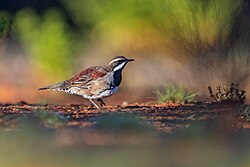
The copperback quail-thrush (Cinclosoma clarum) is a species of bird in the family Cinclosomatidae. It was split from the chestnut quail-thrush in 2015.1 It is endemic to Australia. Its natural habitat is Mediterranean-type shrubby vegetation.
Subspecies
- C. c. clarum: little to no sexual dimorphism.2 They tend to be brown with rust-colored back bands.2
- C. c. fordianum: does exhibit sexual dimorphism.2 Males are gray with dark brown streaks; females are usually brownish-gray with similar patterning.2 Some females have a faint, narrow back band, and some have none at all.2
- C. c. morgani: Eyre Peninsula
References
References
- Dolman, Gaynor; Joseph, Leo (2015). "Evolutionary history of birds across southern Australia: structure, history and taxonomic implications of mitochondrial DNA diversity in an ecologically diverse suite of species". Emu. 115 (1): 35–48. Bibcode:2015EmuAO.115...35D. doi:10.1071/MU14047.
- McElroy, Kerensa; Black, Andrew; Dolman, Gaynor; Horton, Philippa; Pedler, Lynn; Campbell, Catriona D.; Drew, Alex; Joseph, Leo (2020-05-31). "Robbery in progress: Historical museum collections bring to light a mitochondrial capture within a bird species widespread across southern Australia, the Copperback Quail-thrush Cinclosoma clarum". Ecology and Evolution. 10 (13): 6785–6793. Bibcode:2020EcoEv..10.6785M. doi:10.1002/ece3.6403. ISSN 2045-7758. PMC 7381587. PMID 32724551.