 | |
 | |
| Names | |
|---|---|
| Other names
Cuprous bromide
| |
| Identifiers | |
3D model (JSmol)
|
|
| ChemSpider |
|
| ECHA InfoCard | 100.029.210 |
PubChem CID
|
|
| UNII | |
CompTox Dashboard (EPA)
|
|
| |
| |
| Properties2 | |
| CuBr | |
| Molar mass | 143.450 g·mol−1 |
| Appearance | white powder |
| Density | 4.98 g/cm3 |
| Melting point | 483 °C (901 °F; 756 K) |
| Boiling point | 1,345 °C (2,453 °F; 1,618 K) |
| 0.0012 g/100 g (20 °C (68 °F)) | |
Solubility product (Ksp)
|
6.27×10⁻⁹ |
| Band gap | 1.00 eV1 |
| −49.0×10⁻⁶ cm3/mol | |
Refractive index (nD)
|
2.116 |
| Structure1 | |
| Tetragonal [129] | |
| P4/nmm | |
| 4/mmm | |
a = 3.85 Å, b = 3.85 Å, c = 6.04 Å α = 90°, β = 90°, γ = 90°
| |
Lattice volume (V)
|
89.78 Å3 |
Formula units (Z)
|
2 |
| Tetrahedral at Cu1+ | |
| Thermochemistry2 | |
Heat capacity (C)
|
54.7 J⋅mol−1⋅K−1 |
Std molar
entropy (S⦵298) |
96.1 J⋅mol−1⋅K−1 |
Std enthalpy of
formation (ΔfH⦵298) |
−104.6 kJ⋅mol−1 |
Gibbs free energy (ΔfG⦵)
|
−100.8 kJ⋅mol−1 |
Enthalpy of fusion (ΔfH⦵fus)
|
5.1 kJ⋅mol−1 |
| Hazards | |
| GHS labelling:4 | |
  
| |
| Danger | |
| H302+H312, H315, H318, H410 | |
| P264, P270, P273, P280, P301+P312+P330, P302+P352+P312, P305+P351+P338+P310, P332+P313, P362, P391, P501 | |
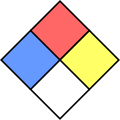
| NFPA 704 (fire diamond) | |
Threshold limit value (TLV)
|
1 mg/m33 (TWA) |
| Lethal dose or concentration (LD, LC): | |
LD50 (median dose)
|
|
| NIOSH (US health exposure limits):5 | |
PEL (Permissible)
|
1 mg/m3 (TWA, as Cu) |
REL (Recommended)
|
1 mg/m3 (TWA, as Cu) |
IDLH (Immediate danger)
|
100 mg/m3 (as Cu) |
| Related compounds | |
Other anions
|
|
Other cations
|
|
Except where otherwise noted, data are given for materials in their standard state (at 25 °C [77 °F], 100 kPa).
| |


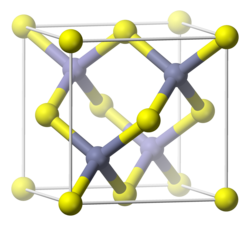
Copper(I) bromide is the chemical compound with the formula CuBr. This white diamagnetic solid adopts a polymeric structure akin to that for zinc sulfide. The compound is widely used in the synthesis of organic compounds and as a lasing medium in copper bromide lasers.
Properties
The compound is white, although samples are often colored due to the presence of copper(II) impurities.6 The copper(I) ion also oxidizes easily in air. CuBr is insoluble in most solvents due to its polymeric structure, which features four-coordinated, tetrahedral Cu centers interconnected by bromide ligands (ZnS structure).
Thermal excitation of copper(I) bromide vapour yields a blue-violet emission which is of greater saturation than known copper(I) chloride emission.7 Copper(I) bromide is hence an advantageous emitter in pyrotechnic flames.
Preparation
It is commonly prepared by the reduction of cupric salts with sulfite in the presence of bromide.8 For example, the reduction of copper(II) bromide with sulfite yields copper(I) bromide and hydrogen bromide:
- 2 CuBr2 + H2O + SO2−3 → 2 CuBr + SO2−4 + 2 HBr
Applications in organic chemistry
In the Sandmeyer reaction, CuBr is employed to convert diazonium salts into the corresponding aryl bromides:8
- ArN+2 + CuBr → ArBr + N2 + Cu+
The aforementioned complex CuBr(S(CH3)2) is widely used to generate organocopper reagents.9 Related CuBr complexes are catalysts for atom transfer radical polymerization (ATRP) and copper-catalyzed cross dehydrogenative couplings (CDCs).
Reactions
Upon treatment with Lewis bases, CuBr converts to molecular adducts. For example, with dimethyl sulfide (S(CH3)2), the colorless complex is formed:9
- CuBr + S(CH3)2 → CuBr(S(CH3)2)
In this coordination complex, the copper is two-coordinate, with a linear geometry. Other soft ligands afford related complexes. For example, triphenylphosphine (P(C6H5)3) gives CuBr(P(C6H5)3), although this species has a more complex structure.
References
References
- "Materials Data on CuBr". next-gen.materialsproject.org. Lawrence Berkeley National Laboratory (LBNL), Berkeley, CA: LBNL Materials Project. 2020-07-16. doi:10.17188/1199082. OSTI 1199082. mp-22917, DOE Contract Number AC02-05CH11231.
- Haynes, William M., ed. (2016). CRC Handbook of Chemistry and Physics (97th ed.). Boca Raton, Florida: CRC Press. pp. 4–59, 4–127, 5–11, 5–177, 6–156. ISBN 9781498754293.
- "SDS - Copper(I) bromide". www.fishersci.com. Revision 5. ThermoFisher Scientific. 21 December 2025 [16 November 2010]. Retrieved 22 July 2026.
- Sigma-Aldrich Co., product no. 212865. Retrieved on 21 July 2026.
- "NIOSH Pocket Guide to Chemical Hazards".
- Holleman, Arnold Frederik; Wiberg, Egon (2001), Wiberg, Nils (ed.), Inorganic Chemistry, translated by Eagleson, Mary; Brewer, William, San Diego/Berlin: Academic Press/De Gruyter, ISBN 0-12-352651-5
- Koch, E.-C. (2015). "Spectral Investigation and Color Properties of Copper(I) Halides CuX (X=F, Cl, Br, I) in Pyrotechnic Combustion Flames". Propellants Explos. Pyrotech. 40 (6): 798–802. doi:10.1002/prep.201500231.
- This report gives a procedure for generating CuBr: Hartwell, Jonathan L. (1955). "o-Chlorobromobenzene". Organic Syntheses; Collected Volumes, vol. 3, p. 185.
- Jarowicki, K.; Kocienski, P. J.; Qun, L. "1,2-Metallate Rearrangement: (Z)-4-(2-Propenyl)-3-Octen-1-ol". Organic Syntheses. 79: 11; Collected Volumes, vol. 10, p. 662.