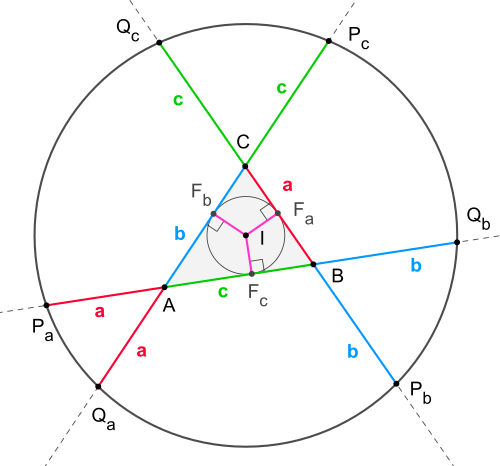
In plane geometry, the Conway circle theorem states that when the sides meeting at each vertex of a triangle are extended by the length of the opposite side, the six endpoints of the three resulting line segments lie on a circle whose centre is the incentre of the triangle. The circle on which these six points lie is called the Conway circle of the triangle.123 The theorem and circle are named after mathematician John Horton Conway.
Proof
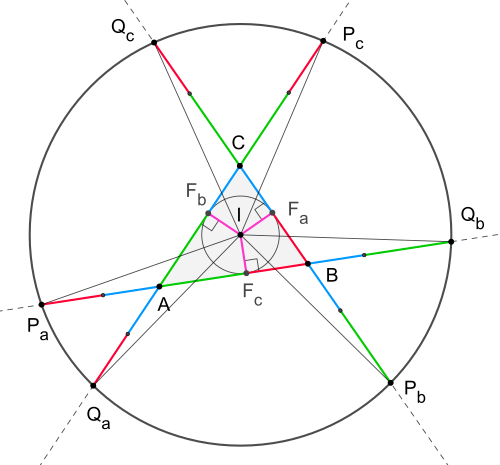
Let I be the center of the incircle of triangle ABC, r its radius and Fa, Fb and Fc the three points where the incircle touches the triangle sides a, b and c. Since the (extended) triangle sides are tangents of the incircle it follows that IFa, IFb and IFc are perpendicular to a, b and c. Furthermore, the following equalities for line segments hold. |AFc|=|AFb|, |BFc|=|BFa|, |CFa|=|CFb|. With that the six triangles IFcPa, IFcQb, IFaPb, IFaQc, IFbQa and IFbPc all have a side of length |AFc|+|BFc|+|CFa| and a side of length r with a right angle between them. This means that due SAS congruence theorem for triangles all six triangles are congruent, which yields |IPa|=|IQa|=|IPb|=|IQb|=|IPc|=|IQc|. So the six points Pa, Qa, Pb, Qb, Pc and Qc have all the same distance from the triangle incenter I, that is they lie on a common circle with center I.
Additional properties
The radius of the Conway circle is
where and are the inradius and semiperimeter of the triangle.3
Generalisation
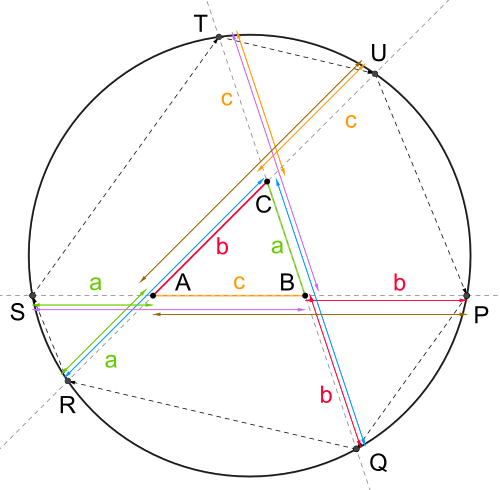
Conway's circle is a special case of a more general circle for a triangle that can be obtained as follows: Given any △ABC with an arbitrary point P on line AB. Construct BQ = BP, CR = CQ, AS = AR, BT = BS, CU = CT. Then AU = AP, and PQRSTU is cyclic.4
If you place P on the extended triangle side AB such that BP=b and BP being completely outside the triangle then the above constructions yield Conway's circle theorem.
References
References
- "John Horton Conway". www.cardcolm.org. Archived from the original on 20 May 2020. Retrieved 29 May 2020.
- Weisstein, Eric W. "Conway Circle". MathWorld. Retrieved 29 May 2020.
- Francisco Javier García Capitán (2013). "A Generalization of the Conway Circle" (PDF). Forum Geometricorum. 13: 191–195.
- Michael de Villiers (2023). "Conway's Circle Theorem as a Special Case of a More General Side Divider Theorem". Learning and Teaching Mathematics (34): 37–42.
External links
External links
- Kimberling, Clark. "Encyclopedia of Triangle Centers".
- Colin Beveridge: Conway’s Circle, a proof without words. The Aperiodical, 7 May 2020
- Colin Beveridge, Elizabeth A. Williams: Conway’s Circle Theorem: a proof, this time with words. The Aperiodical, 11 June 2020 (Video, 9:12 min.)
- De Villiers, Michael. "Conway's Circle Theorem as special case of Side Divider (Windscreen Wiper) Theorem". dynamicmathematicslearning.com.
- Polster, Burkard (6 April 2024). "Conway's Iris and the Windscreen Wiper Theorem". Mathologer. YouTube.