| Convolvulus | |
|---|---|
| |
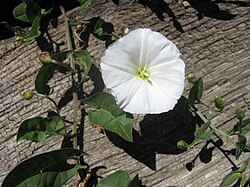
| Convolvulus arvensis | |
Scientific classification 
| |
| Kingdom: | Plantae |
| Clade: | Embryophytes |
| Clade: | Tracheophytes |
| Clade: | Spermatophytes |
| Clade: | Angiosperms |
| Clade: | Eudicots |
| Clade: | Asterids |
| Order: | Solanales |
| Family: | Convolvulaceae |
| Tribe: | Convolvuleae |
| Genus: | Convolvulus L. |
| Type species | |
| Convolvulus arvensis L.
| |
| Species | |
Convolvulus is a genus of about 2001 to 25023 species of flowering plants in the bindweed family Convolvulaceae,4 with a cosmopolitan distribution; the Plants of the World Online database currently accepts 227 species and 12 natural hybrids.5 Common names include bindweed and morning glory; both are names shared with other closely related genera.
Taxonomy
The genus Calystegia, until recently widely accepted, has been shown to be genetically embedded within Convolvulus,6 and is now treated as a synonym of it by the Plants of the World Online database.5
Description
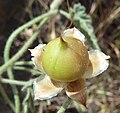
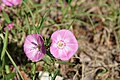
They are annual or perennial herbaceous vines; a few species are woody shrubs. They grow to heights of 0.3–4 m scrambling through ground vegetation, shrubs and trees; the shrubby species (e.g. C. cneorum) growing to 0.5 m tall with a woody base. The leaves are spirally arranged, and the flowers trumpet-shaped, mostly white or pink, but blue, violet, purple, or yellow in some species.7
Ecology
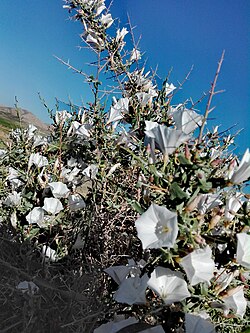
Many of the species are invasive weeds; but others are cultivated for their attractive flowers, while some are globally threatened.
Convolvulus species are used as food plants by the larvae of some Lepidoptera species, including the convolvulus hawk moth, the sweet potato leaf miner (Bedellia somnulentella) and the gem; the leaf miner Bucculatrix cantabricella feeds exclusively on C. cantabricus.
Gallery
-
 Convolvulus dorycnium
 -
-
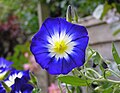 Cultivated Convolvulus tricolor
 -
-
-
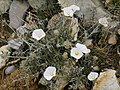 Convolvulus cneorum in Catalonia, Spain
 -
 Convolvulus cephalopodus in Behbahan
 -
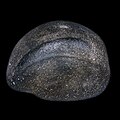 Seed under a microscope
References
References
- Carine, M. A. and L. Robba. (2010). Taxonomy and evolution of the Convolvulus sabatius complex (Convolvulaceae). Phytotaxa 14 1.
- Convolvulus. Flora of China.
- Convolvulus. The Jepson eFlora. 2013.
- Parnell, J. and Curtis, T. 2012. Webb's An Irish Flora. Cork University Press. ISBN 978-185918-4783
- "Convolvulus L." Plants of the World Online. Retrieved 2026-05-25.
- Mitchell, Thomas C.; Williams, Bethany R. M.; Wood, John R. I.; Harris, David. J.; Scotland, Robert W.; Carine, Mark A. (2016). "How the temperate world was colonised by bindweeds: biogeography of the Convolvuleae (Convolvulaceae)". BMC Evolutionary Biology. 16 (1): 1–12. doi:10.1186/s12862-016-0591-6. ISSN 1471-2148. PMC 4719731. PMID 26787507.
- Thorogood, Chris (2016). Field guide to the wild flowers of the western Mediterranean. Richmond (Va.): Kew publishing Royal botanic gardens. pp. 412–414. ISBN 978-1-84246-616-2.
External links
External links
- Beach, Chandler B., ed. (1914). . . Chicago: F. E. Compton and Co.
- Flora Europaea: Convolvulus