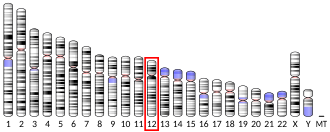
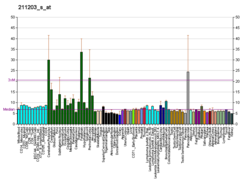
Contactin 1 (CNTN1) is a protein which in humans is encoded by the CNTN1 gene.56
Function
The protein encoded by this gene is a member of the immunoglobulin superfamily. It is a glycosylphosphatidylinositol (GPI)-anchored neuronal membrane protein that functions as a cell adhesion molecule. It may play a role in the formation of axon connections in the developing nervous system. Two alternatively spliced transcript variants encoding different isoforms have been described for this gene.6
Interactions
CNTN1 has been shown to interact with PTPRB.78
References
References
- GRCh38: Ensembl release 89: ENSG00000018236 – Ensembl, May 2017
- GRCm38: Ensembl release 89: ENSMUSG00000055022 – Ensembl, May 2017
- "Human PubMed Reference:". National Center for Biotechnology Information, U.S. National Library of Medicine.
- "Mouse PubMed Reference:". National Center for Biotechnology Information, U.S. National Library of Medicine.
- Berglund EO, Ranscht B (Jun 1994). "Molecular cloning and in situ localization of the human contactin gene (CNTN1) on chromosome 12q11-q12". Genomics. 21 (3): 571–82. doi:10.1006/geno.1994.1316. PMID 7959734.
- "Entrez Gene: CNTN1 contactin 1".
- Sakurai T, Lustig M, Nativ M, Hemperly JJ, Schlessinger J, Peles E, Grumet M (Feb 1997). "Induction of neurite outgrowth through contactin and Nr-CAM by extracellular regions of glial receptor tyrosine phosphatase beta". The Journal of Cell Biology. 136 (4): 907–18. doi:10.1083/jcb.136.4.907. PMC 2132488. PMID 9049255.
- Peles E, Nativ M, Campbell PL, Sakurai T, Martinez R, Lev S, Clary DO, Schilling J, Barnea G, Plowman GD, Grumet M, Schlessinger J (Jul 1995). "The carbonic anhydrase domain of receptor tyrosine phosphatase beta is a functional ligand for the axonal cell recognition molecule contactin". Cell. 82 (2): 251–60. doi:10.1016/0092-8674(95)90312-7. PMID 7628014. S2CID 18084292.
External links
External links
Further reading
Further reading
- Walsh FS, Doherty P (Nov 1991). "Glycosylphosphatidylinositol anchored recognition molecules that function in axonal fasciculation, growth and guidance in the nervous system". Cell Biology International Reports. 15 (11): 1151–66. doi:10.1016/0309-1651(91)90061-M. PMID 1838307.
- Peles E, Schlessinger J, Grumet M (Apr 1998). "Multi-ligand interactions with receptor-like protein tyrosine phosphatase beta: implications for intercellular signaling". Trends in Biochemical Sciences. 23 (4): 121–4. doi:10.1016/S0968-0004(98)01195-5. PMID 9584610.
- Olive S, Dubois C, Schachner M, Rougon G (Nov 1995). "The F3 neuronal glycosylphosphatidylinositol-linked molecule is localized to glycolipid-enriched membrane subdomains and interacts with L1 and fyn kinase in cerebellum". Journal of Neurochemistry. 65 (5): 2307–17. doi:10.1046/j.1471-4159.1995.65052307.x. PMID 7595520. S2CID 39142478.
- Peles E, Nativ M, Campbell PL, Sakurai T, Martinez R, Lev S, Clary DO, Schilling J, Barnea G, Plowman GD, Grumet M, Schlessinger J (Jul 1995). "The carbonic anhydrase domain of receptor tyrosine phosphatase beta is a functional ligand for the axonal cell recognition molecule contactin". Cell. 82 (2): 251–60. doi:10.1016/0092-8674(95)90312-7. PMID 7628014. S2CID 18084292.
- Berglund EO, Ranscht B (Jun 1994). "Molecular cloning and in situ localization of the human contactin gene (CNTN1) on chromosome 12q11-q12". Genomics. 21 (3): 571–82. doi:10.1006/geno.1994.1316. PMID 7959734.
- Reid RA, Bronson DD, Young KM, Hemperly JJ (Jan 1994). "Identification and characterization of the human cell adhesion molecule contactin". Brain Research. Molecular Brain Research. 21 (1–2): 1–8. doi:10.1016/0169-328X(94)90372-7. PMID 8164510.
- Yoshihara Y, Kawasaki M, Tamada A, Nagata S, Kagamiyama H, Mori K (Sep 1995). "Overlapping and differential expression of BIG-2, BIG-1, TAG-1, and F3: four members of an axon-associated cell adhesion molecule subgroup of the immunoglobulin superfamily". Journal of Neurobiology. 28 (1): 51–69. doi:10.1002/neu.480280106. PMID 8586965.
- Sakurai T, Lustig M, Nativ M, Hemperly JJ, Schlessinger J, Peles E, Grumet M (Feb 1997). "Induction of neurite outgrowth through contactin and Nr-CAM by extracellular regions of glial receptor tyrosine phosphatase beta". The Journal of Cell Biology. 136 (4): 907–18. doi:10.1083/jcb.136.4.907. PMC 2132488. PMID 9049255.
- Xiao ZC, Taylor J, Montag D, Rougon G, Schachner M (Apr 1996). "Distinct effects of recombinant tenascin-R domains in neuronal cell functions and identification of the domain interacting with the neuronal recognition molecule F3/11". The European Journal of Neuroscience. 8 (4): 766–82. doi:10.1111/j.1460-9568.1996.tb01262.x. PMID 9081628. S2CID 30389358.
- Xiao ZC, Hillenbrand R, Schachner M, Thermes S, Rougon G, Gomez S (Sep 1997). "Signaling events following the interaction of the neuronal adhesion molecule F3 with the N-terminal domain of tenascin-R". Journal of Neuroscience Research. 49 (6): 698–709. doi:10.1002/(SICI)1097-4547(19970915)49:6<698::AID-JNR4>3.0.CO;2-2. PMID 9335257. S2CID 10209383.
- Pierre K, Rougon G, Allard M, Bonhomme R, Gennarini G, Poulain DA, Theodosis DT (Jul 1998). "Regulated expression of the cell adhesion glycoprotein F3 in adult hypothalamic magnocellular neurons". The Journal of Neuroscience. 18 (14): 5333–43. doi:10.1523/JNEUROSCI.18-14-05333.1998. PMC 6793479. PMID 9651216.
- Revest JM, Faivre-Sarrailh C, Maeda N, Noda M, Schachner M, Rougon G (Apr 1999). "The interaction between F3 immunoglobulin domains and protein tyrosine phosphatases zeta/beta triggers bidirectional signalling between neurons and glial cells". The European Journal of Neuroscience. 11 (4): 1134–47. doi:10.1046/j.1460-9568.1999.00521.x. PMID 10103110. S2CID 23803785.
- Berglund EO, Murai KK, Fredette B, Sekerková G, Marturano B, Weber L, Mugnaini E, Ranscht B (Nov 1999). "Ataxia and abnormal cerebellar microorganization in mice with ablated contactin gene expression". Neuron. 24 (3): 739–50. doi:10.1016/S0896-6273(00)81126-5. PMID 10595523. S2CID 16663068.
- Pierre K, Dupouy B, Allard M, Poulain DA, Theodosis DT (Aug 2001). "Mobilization of the cell adhesion glycoprotein F3/contactin to axonal surfaces is activity dependent". The European Journal of Neuroscience. 14 (4): 645–56. doi:10.1046/j.0953-816x.2001.01682.x. PMID 11556889. S2CID 43151749.
- Kazarinova-Noyes K, Malhotra JD, McEwen DP, Mattei LN, Berglund EO, Ranscht B, Levinson SR, Schachner M, Shrager P, Isom LL, Xiao ZC (Oct 2001). "Contactin associates with Na+ channels and increases their functional expression". The Journal of Neuroscience. 21 (19): 7517–25. doi:10.1523/JNEUROSCI.21-19-07517.2001. PMC 6762905. PMID 11567041.
- Pavlou O, Theodorakis K, Falk J, Kutsche M, Schachner M, Faivre-Sarrailh C, Karagogeos D (Jul 2002). "Analysis of interactions of the adhesion molecule TAG-1 and its domains with other immunoglobulin superfamily members". Molecular and Cellular Neurosciences. 20 (3): 367–81. doi:10.1006/mcne.2002.1105. PMID 12139915. S2CID 714233.
- Garwood J, Heck N, Reichardt F, Faissner A (Jun 2003). "Phosphacan short isoform, a novel non-proteoglycan variant of phosphacan/receptor protein tyrosine phosphatase-beta, interacts with neuronal receptors and promotes neurite outgrowth". The Journal of Biological Chemistry. 278 (26): 24164–73. doi:10.1074/jbc.M211721200. PMID 12700241.