| Conostylis juncea | |
|---|---|
| |
Scientific classification 
| |
| Kingdom: | Plantae |
| Clade: | Embryophytes |
| Clade: | Tracheophytes |
| Clade: | Spermatophytes |
| Clade: | Angiosperms |
| Clade: | Monocots |
| Clade: | Commelinids |
| Order: | Commelinales |
| Family: | Haemodoraceae |
| Genus: | Conostylis |
| Species: | C. juncea
|
| Binomial name | |
| Conostylis juncea | |
| |
| Occurrence data from AVH | |
Conostylis juncea is a rhizomatous, tufted perennial, grass-like plant or herb in the family Haemodoraceae, and is endemic to the south-west of Western Australia. It has cylindrical or flat leaves and yellow flowers on a short flowering stem.
Description
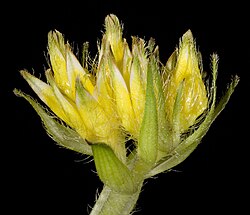
Conostylis juncea is a rhizomatous, proliferous perennial with tufts up to 20 cm (7.9 in) in diameter. Its leaves are more or less round in cross-section or almost flat, 100–400 mm (3.9–15.7 in) long and 1–4 mm (0.039–0.157 in) wide and usually glabrous with prominent veins. The flowers borne just above the ground on a short flowering stalk with broadly egg-shaped or lance-shaped green bracts at the base. The perianth is hairy, yellow or greenish-yellow, 12–20 mm (0.47–0.79 in) long with lobes 9–12.5 mm (0.35–0.49 in) long. The anthers are 3.5–6 mm (0.14–0.24 in) long. Flowering occurs from July to September.234
Taxonomy and naming
Conostylis juncea was first formally described in 1839 by Stephan Endlicher in Novarum Stirpium Decades.56 The specific epithet (juncea) means "rush-like".7
Distribution and habitat
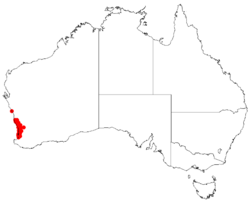
This species of conostylis grows in sand in open woodland and heath in near-coastal areas between Jurien Bay and Australind in the Avon Wheatbelt, Geraldton Sandplains, Jarrah Forest and Swan Coastal Plain bioregions of south-western Western Australia.23
Conservation status
Conostylis juncea is listed as "not threatened" by the Western Australian Government Department of Biodiversity, Conservation and Attractions.3
References
References
- "Conostylis juncea". Australian Plant Census. Retrieved 5 December 2021.
- Hopper, S.D; Purdie, R.W; George, A.S; Patrick, S.J. "Conostylis juncea". Australian Biological Resources Study, Department of Agriculture, Water and the Environment. Retrieved 5 December 2023.
- "Conostylis juncea". FloraBase. Western Australian Government Department of Biodiversity, Conservation and Attractions.
- Green, John W. (1961). "The Genus Conostylis R.Br. II. Taxonomy". Proceedings of the Linnean Society of New South Wales. 85 (3): 356–357. Retrieved 5 December 2023.
- "Conostylis juncea". APNI. Retrieved 5 December 2023.
- Endlicher, Stephan (1839). Endlicher, Stephan; Fenzl, Eduard (eds.). Novarum Stirpium Decades. Vol. 3. Vienna: K.K. Naturhistorisches Hofmuseum. pp. 19–20. Retrieved 5 December 2023.
- Sharr, Francis Aubi; George, Alex (2019). Western Australian Plant Names and Their Meanings (3rd ed.). Kardinya, WA: Four Gables Press. p. 229. ISBN 9780958034180.