| Emission nebula | |
|---|---|
| H II region | |
| dark nebula | |
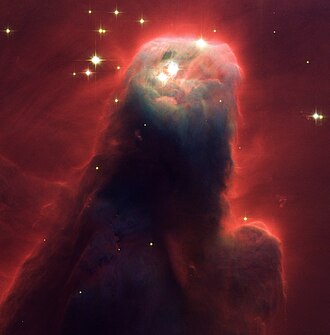 Taken on April 2, 2002 by the Hubble Space Telescope | |
| Observation data: J2000.0 epoch | |
| Right ascension | 06h 41m 15s1 |
| Declination | +09° 21′1 |
| Distance | 2,7002 ly |
| Apparent magnitude (V) | — |
| Apparent dimensions (V) | 3 arcmins1 |
| Constellation | Monoceros |
| Physical characteristics | |
| Radius | 43 ly |
| Absolute magnitude (V) | — |
| Notable features | Christmas Tree Cluster |
| Designations | NGC 2264 (portion) |
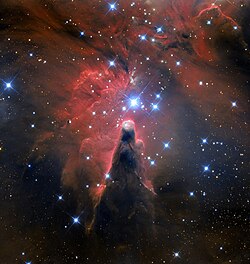
The Cone Nebula is an H II region in the constellation of Monoceros. It was discovered by William Herschel on December 26, 1785, at which time he designated it H V.27. The nebula is located about 830 parsecs or 2,700 light-years from Earth. The Cone Nebula forms part of the nebulosity surrounding the Christmas Tree Cluster. The designation of NGC 2264 in the New General Catalogue refers to both objects and not the nebula alone.
Description
The diffuse Cone Nebula, so named because of its apparent shape, lies in the southern part of NGC 2264, the northern part being the magnitude-3.9 Christmas Tree Cluster. It is in the northern part of Monoceros, just north of the midpoint of a line from Procyon to Betelgeuse.
The cone's shape comes from a dark absorption nebula consisting of cold molecular hydrogen and dust in front of a faint emission nebula containing hydrogen ionized by S Monocerotis, the brightest star of NGC 2264. The faint nebula is approximately seven light-years long (with an apparent length of 10 arcminutes), and is 2,700 light-years from Earth.
The nebula is part of a much larger star-forming complex—the Hubble Space Telescope was used to capture images of forming stars in 1997.
Notes and references
- "SEDS information on NGC2264". Students for the Exploration and Development of Space. Retrieved 2009-03-27.
- Nemiroff, R.; Bonnell, J., eds. (7 January 2002). "The Mysterious Cone Nebula". Astronomy Picture of the Day. NASA. Retrieved 2009-03-27.
- 2,700 × sin( 10′ / 2 ) = 3-4 ly. radius
External links
External links
- "NGC 2264, the Cone Nebula and the Xmas Tree". SEDS Messier Database.
- Nemiroff, R.; Bonnell, J., eds. (7 January 2002). "The Mysterious Cone Nebula". Astronomy Picture of the Day. NASA.
- Cone Nebula pictures from ESA-Hubble
- Hubble image of Cone Nebula
- "NAME Cone Nebula". SIMBAD. Centre de données astronomiques de Strasbourg.