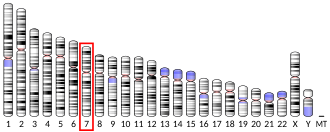






Collagen alpha-2(I) chain is a protein that in humans is encoded by the COL1A2 gene.56
This gene encodes one of the chains for type I collagen, the fibrillar collagen found in most connective tissues. Mutations in this gene are associated with osteogenesis imperfecta, Cardiac-valvular and Arthrochlasia type Ehlers–Danlos syndrome, idiopathic osteoporosis, and atypical Marfan syndrome. Symptoms associated with mutations in this gene, however, tend to be less severe than mutations in the gene for alpha-1 type I collagen, since alpha-2 is less abundant. Multiple messages for this gene result from multiple polyadenylation signals, a feature shared by most of the other collagen genes.7
References
References
- GRCh38: Ensembl release 89: ENSG00000164692 – Ensembl, May 2017
- GRCm38: Ensembl release 89: ENSMUSG00000029661 – Ensembl, May 2017
- "Human PubMed Reference:". National Center for Biotechnology Information, U.S. National Library of Medicine.
- "Mouse PubMed Reference:". National Center for Biotechnology Information, U.S. National Library of Medicine.
- Retief E, Parker MI, Retief AE (May 1985). "Regional chromosome mapping of human collagen genes alpha 2(I) and alpha 1(I) (COLIA2 and COLIA1)". Human Genetics. 69 (4): 304–308. doi:10.1007/BF00291646. PMID 3857213. S2CID 30209998.
- Wenstrup RJ, Cohn DH, Cohen T, Byers PH (June 1988). "Arginine for glycine substitution in the triple-helical domain of the products of one alpha 2(I) collagen allele (COL1A2) produces the osteogenesis imperfecta type IV phenotype". The Journal of Biological Chemistry. 263 (16): 7734–7740. doi:10.1016/S0021-9258(18)68560-6. PMID 2897363.
- "Entrez Gene: COL1A2 collagen, type I, alpha 2".
Further reading
Further reading
- Byers PH, Wallis GA, Willing MC (1991). "Osteogenesis imperfecta: translation of mutation to phenotype". Journal of Medical Genetics. 28 (7): 433–442. doi:10.1136/jmg.28.7.433. PMC 1016951. PMID 1895312.
- Kuivaniemi H, Tromp G, Prockop DJ (1991). "Mutations in collagen genes: causes of rare and some common diseases in humans". FASEB Journal. 5 (7): 2052–2060. doi:10.1096/fasebj.5.7.2010058. PMID 2010058. S2CID 24461341.
- Kuivaniemi H, Tromp G, Prockop DJ (1997). "Mutations in fibrillar collagens (types I, II, III, and XI), fibril-associated collagen (type IX), and network-forming collagen (type X) cause a spectrum of diseases of bone, cartilage, and blood vessels". Human Mutation. 9 (4): 300–315. doi:10.1002/(SICI)1098-1004(1997)9:4<300::AID-HUMU2>3.0.CO;2-9. PMID 9101290. S2CID 6890740.
- Rossert J, Terraz C, Dupont S (2001). "Regulation of type I collagen genes expression". Nephrology, Dialysis, Transplantation. 15 (Suppl 6): 66–68. doi:10.1093/ndt/15.suppl_6.66. PMID 11143996.
- Blaschitz A, Montero-Lopez R, El-Sobky TA, Baraka MM, Abdulhady H, Dawoud H, et al. (April 2026). "Severe Osteogenesis Imperfecta Due to Homozygous Glycine Substitutions in COL1A1 and COL1A2". European Journal of Endocrinology lvag064. doi:10.1093/ejendo/lvag064. PMID 41985044.