| Coccothrinax argentea | |
|---|---|
| |
Scientific classification 
| |
| Kingdom: | Plantae |
| Clade: | Embryophytes |
| Clade: | Tracheophytes |
| Clade: | Spermatophytes |
| Clade: | Angiosperms |
| Clade: | Monocots |
| Clade: | Commelinids |
| Order: | Arecales |
| Family: | Arecaceae |
| Genus: | Coccothrinax |
| Species: | C. argentea
|
| Binomial name | |
| Coccothrinax argentea | |
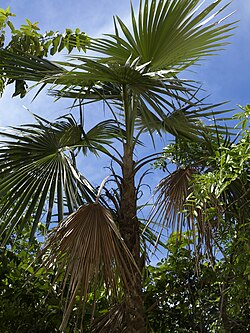
Coccothrinax argentea is a palm which is endemic to Hispaniola.2
This species is frequently confused with Coccothrinax argentata.
Description
It is a medium-sized palm, growing to about 10 m tall. The leaves are dark green above and silvery below; like other Coccothrinax species, C. argentea is a fan palm.3
Uses
Very young leaves are eaten as a vegetable.4 It is also used medicinally by traditional healers to treat uterine fibroids and hot flashes.5
Name
Common names include: Hispaniola silver thatch palm,3 Cana,5 Guano, Latanye marron, Latanye savanne,6 Broom palm, Hispaniolan silver palm, Silver thatch palm, Palmera plateada de La Hispaniola, Guanito, Guano de escoba.
References
References
- Timyan, J. (2022). "Coccothrinax argentea". IUCN Red List of Threatened Species. 2022 e.T213404193A213978316. doi:10.2305/IUCN.UK.2022-2.RLTS.T213404193A213978316.en. Retrieved 29 May 2025.
- "Coccothrinax argentea". Royal Botanic Gardens, Kew: World Checklist of Selected Plant Families. Retrieved 2007-01-30.
{{cite web}}: CS1 maint: deprecated archival service (link) - Palm and Cycad Society of Australia. "Palms: Coccothrinax argentea". Retrieved 2007-01-30.
- Haynes, Jody; John McLaughlin (November 2000). "Edible Palms and Their Uses" (PDF). Fact Sheet MDCE-00-50-1. University of Florida Institute of Food and Agricultural Sciences. Archived from the original (PDF) on 2006-09-26. Retrieved 2007-01-30.
- Balick, Michael J.; Fredi Kronenberg; Andreana L. Ososki; Marian Reiff; Adriane Fugh-Berman; Bonnie O'Connor; Maria Roble; Patricia Lohr; Daniel Atha (2000). "Medicinal plants used by Latino healers for women's health conditions in New York City" (PDF). Economic Botany. 54 (3): 344–357. doi:10.1007/BF02864786. Retrieved 2007-01-30.
- Henderson, Andrew; Galeano, Gloria; Bernal, Rodrigo (1995). Field Guide to the Palms of the Americas. Princeton, New Jersey: Princeton University Press. ISBN 978-0-691-08537-1.