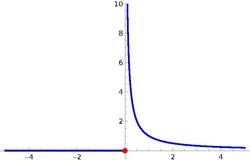
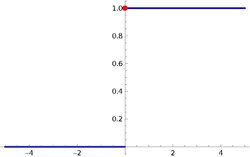
In mathematics, particularly in functional analysis and topology, closed graph is a property of functions.12 A real function is closed if the graph is closed, meaning that it contains all of its limit points. Every such continuous function has a closed graph, but the converse is not necessarily true.
More generally, a function f : X → Y between topological spaces has a closed graph if its graph is a closed subset of the product space X × Y.
This property is studied because there are many theorems, known as closed graph theorems, giving conditions under which a function with a closed graph is necessarily continuous. One particularly well-known class of closed graph theorems are the closed graph theorems in functional analysis.
Definitions
Graphs and set-valued functions
- Definition and notation: The graph of a function f : X → Y is the set
- Gr f := { (x, f(x)) : x ∈ X} = { (x, y) ∈ X × Y : y = f(x)}.
- Notation: If Y is a set then the power set of Y, which is the set of all subsets of Y, is denoted by 2Y or 𝒫(Y).
- Definition: If X and Y are sets, a set-valued function in Y on X (also called a Y-valued multifunction on X) is a function F : X → 2Y with domain X that is valued in 2Y. That is, F is a function on X such that for every x ∈ X, F(x) is a subset of Y.
- Some authors call a function F : X → 2Y a set-valued function only if it satisfies the additional requirement that F(x) is not empty for every x ∈ X; this article does not require this.
- Definition and notation: If F : X → 2Y is a set-valued function in a set Y then the graph of F is the set
- Gr F := { (x, y) ∈ X × Y : y ∈ F(x)}.
- Definition: A function f : X → Y can be canonically identified with the set-valued function F : X → 2Y defined by F(x) := { f(x)} for every x ∈ X, where F is called the canonical set-valued function induced by (or associated with) f.
- Note that in this case, Gr f = Gr F.
Closed graph
We give the more general definition of when a Y-valued function or set-valued function defined on a subset S of X has a closed graph since this generality is needed in the study of closed linear operators that are defined on a dense subspace S of a topological vector space X (and not necessarily defined on all of X). This particular case is one of the main reasons why functions with closed graphs are studied in functional analysis.
- Assumptions: Throughout, X and Y are topological spaces, S ⊆ X, and f is a Y-valued function or set-valued function on S (i.e. f : S → Y or f : S → 2Y). X × Y will always be endowed with the product topology.
- Definition:3 We say that f has a closed graph in X × Y if the graph of f, Gr f, is a closed subset of X × Y when X × Y is endowed with the product topology. If S = X or if X is clear from context then we may omit writing "in X × Y"
- Observation: If g : S → Y is a function and G is the canonical set-valued function induced by g (i.e. G : S → 2Y is defined by G(s) := { g(s)} for every s ∈ S) then since Gr g = Gr G, g has a closed (resp. sequentially closed) graph in X × Y if and only if the same is true of G.
Closable maps and closures
- Definition: We say that the function (resp. set-valued function) f is closable in X × Y if there exists a subset D ⊆ X containing S and a function (resp. set-valued function) F : D → Y whose graph is equal to the closure of the set Gr f in X × Y. Such an F is called a closure of f in X × Y, is denoted by f, and necessarily extends f.
- Additional assumptions for linear maps: If in addition, S, X, and Y are topological vector spaces and f : S → Y is a linear map then to call f closable we also require that the set D be a vector subspace of X and the closure of f be a linear map.
- Definition: If f is closable on S then a core or essential domain of f is a subset D ⊆ S such that the closure in X × Y of the graph of the restriction f |D : D → Y of f to D is equal to the closure of the graph of f in X × Y (i.e. the closure of Gr f in X × Y is equal to the closure of Gr f |D in X × Y).
Closed maps and closed linear operators
- Definition and notation: When we write f : D(f) ⊆ X → Y then we mean that f is a Y-valued function with domain D(f) where D(f) ⊆ X. If we say that f : D(f) ⊆ X → Y is closed (resp. sequentially closed) or has a closed graph (resp. has a sequentially closed graph) then we mean that the graph of f is closed (resp. sequentially closed) in X × Y (rather than in D(f) × Y).
When reading literature in functional analysis, if f : X → Y is a linear map between topological vector spaces (TVSs) (e.g. Banach spaces) then "f is closed" will almost always means the following:
- Definition: A map f : X → Y is called closed if its graph is closed in X × Y. In particular, the term "closed linear operator" will almost certainly refer to a linear map whose graph is closed.
Otherwise, especially in literature about point-set topology, "f is closed" may instead mean the following:
- Definition: A map f : X → Y between topological spaces is called a closed map if the image of a closed subset of X is a closed subset of Y.
These two definitions of "closed map" are not equivalent. If it is unclear, then it is recommended that a reader check how "closed map" is defined by the literature they are reading.
Characterizations
Throughout, let X and Y be topological spaces.
- Function with a closed graph
If f : X → Y is a function then the following are equivalent:
- f has a closed graph (in X × Y);
- (definition) the graph of f, Gr f, is a closed subset of X × Y;
- for every x ∈ X and net x• = (xi)i ∈ I in X such that x• → x in X, if y ∈ Y is such that the net f(x•) := (f(xi))i ∈ I → y in Y then y = f(x);3
- Compare this to the definition of continuity in terms of nets, which recall is the following: for every x ∈ X and net x• = (xi)i ∈ I in X such that x• → x in X, f(x•) → f(x) in Y.
- Thus to show that the function f has a closed graph we may assume that f(x•) converges in Y to some y ∈ Y (and then show that y = f(x)) while to show that f is continuous we may not assume that f(x•) converges in Y to some y ∈ Y and we must instead prove that this is true (and moreover, we must more specifically prove that f(x•) converges to f(x) in Y).
and if Y is a Hausdorff space that is compact, then we may add to this list:
and if both X and Y are first-countable spaces then we may add to this list:
- Function with a sequentially closed graph
If f : X → Y is a function then the following are equivalent:
- f has a sequentially closed graph (in X × Y);
- (definition) the graph of f is a sequentially closed subset of X × Y;
- for every x ∈ X and sequence x• = (xi)∞
i=1 in X such that x• → x in X, if y ∈ Y is such that the net f(x•) := (f(xi))∞
i=1 → y in Y then y = f(x);3
- set-valued function with a closed graph
If F : X → 2Y is a set-valued function between topological spaces X and Y then the following are equivalent:
- F has a closed graph (in X × Y);
- (definition) the graph of F is a closed subset of X × Y;
and if Y is compact and Hausdorff then we may add to this list:
and if both X and Y are metrizable spaces then we may add to this list:
i=1 in X and y• = (yi)∞
i=1 in Y such that x• → x in X and y• → y in Y, and yi ∈ F(xi) for all i, then y ∈ F(x).
Characterizations of closed graphs (general topology)
Throughout, let and be topological spaces and is endowed with the product topology.
Function with a closed graph
If is a function then it is said to have a closed graph if it satisfies any of the following are equivalent conditions:
- (Definition): The graph of is a closed subset of
- For every and net in such that in if is such that the net in then 3
- Compare this to the definition of continuity in terms of nets, which recall is the following: for every and net in such that in in
- Thus to show that the function has a closed graph, it may be assumed that converges in to some (and then show that ) while to show that is continuous, it may not be assumed that converges in to some and instead, it must be proven that this is true (and moreover, it must more specifically be proven that converges to in ).
and if is a Hausdorff compact space then we may add to this list:
- is continuous.4
and if both and are first-countable spaces then we may add to this list:
- has a sequentially closed graph in
Function with a sequentially closed graph
If is a function then the following are equivalent:
- has a sequentially closed graph in
- Definition: the graph of is a sequentially closed subset of
- For every and sequence in such that in if is such that the net in then 3
Sufficient conditions for a closed graph
- If f : X → Y is a continuous function between topological spaces and if Y is Hausdorff then f has a closed graph in X × Y.3 However, if f is a function between Hausdorff topological spaces, then it is possible for f to have a closed graph in X × Y but not be continuous.
Closed graph theorems
Conditions that guarantee that a function with a closed graph is necessarily continuous are called closed graph theorems. Closed graph theorems are of particular interest in functional analysis where there are many theorems giving conditions under which a linear map with a closed graph is necessarily continuous.
- If f : X → Y is a function between topological spaces whose graph is closed in X × Y and if Y is a compact space then f : X → Y is continuous.3
Examples
Continuous but not closed maps
- Let X denote the real numbers ℝ with the usual Euclidean topology and let Y denote ℝ with the indiscrete topology (where note that Y is not Hausdorff and that every function valued in Y is continuous). Let f : X → Y be defined by f(0) = 1 and f(x) = 0 for all x ≠ 0. Then f : X → Y is continuous but its graph is not closed in X × Y.3
- If X is any space then the identity map Id : X → X is continuous but its graph, which is the diagonal Gr Id := { (x, x) : x ∈ X}, is closed in X × X if and only if X is Hausdorff.6 In particular, if X is not Hausdorff then Id : X → X is continuous but not closed.
- If f : X → Y is a continuous map whose graph is not closed then Y is not a Hausdorff space.
Closed but not continuous maps
- Let X and Y both denote the real numbers ℝ with the usual Euclidean topology. Let f : X → Y be defined by f(0) = 0 and f(x) = 1/x for all x ≠ 0. Then f : X → Y has a closed graph (and a sequentially closed graph) in X × Y = ℝ2 but it is not continuous (since it has a discontinuity at x = 0).3
- Let X denote the real numbers ℝ with the usual Euclidean topology, let Y denote ℝ with the discrete topology, and let Id : X → Y be the identity map (i.e. Id(x) := x for every x ∈ X). Then Id : X → Y is a linear map whose graph is closed in X × Y but it is clearly not continuous (since singleton sets are open in Y but not in X).3
- Let (X, 𝜏) be a Hausdorff TVS and let 𝜐 be a vector topology on X that is strictly finer than 𝜏. Then the identity map Id : (X, 𝜏) → (X, 𝜐) is a closed discontinuous linear operator.7
See also
See also
- Almost open linear map – Map that satisfies a condition similar to that of being an open mapPages displaying short descriptions of redirect targets
- Closed graph theorem – Theorem relating continuity to graphs
- Closed graph theorem (functional analysis) – Theorems connecting continuity to closure of graphs
- Kakutani fixed-point theorem – Fixed-point theorem for set-valued functions
- Open mapping theorem (functional analysis) – Condition for a linear operator to be open
- Webbed space – Space where open mapping and closed graph theorems hold
- Graph continuous function
References
References
- Baggs, Ivan (1974). "Functions with a closed graph". Proceedings of the American Mathematical Society. 43 (2): 439–442. doi:10.1090/S0002-9939-1974-0334132-8. ISSN 0002-9939.
- Ursescu, Corneliu (1975). "Multifunctions with convex closed graph". Czechoslovak Mathematical Journal. 25 (3): 438–441. doi:10.21136/CMJ.1975.101337. ISSN 0011-4642.
- Narici & Beckenstein 2011, pp. 459–483.
- Munkres 2000, p. 171.
- Aliprantis, Charlambos; Kim C. Border (1999). "Chapter 17". Infinite Dimensional Analysis: A Hitchhiker's Guide (3rd ed.). Springer.
- Rudin p.50
- Narici & Beckenstein 2011, p. 480.
- Köthe, Gottfried (1983) [1969]. Topological Vector Spaces I. Grundlehren der mathematischen Wissenschaften. Vol. 159. Translated by Garling, D.J.H. New York: Springer Science & Business Media. ISBN 978-3-642-64988-2. MR 0248498. OCLC 840293704.
- Kriegl, Andreas; Michor, Peter W. (1997). The Convenient Setting of Global Analysis (PDF). Mathematical Surveys and Monographs. Vol. 53. Providence, R.I: American Mathematical Society. ISBN 978-0-8218-0780-4. OCLC 37141279.
- Munkres, James R. (2000). Topology (2nd ed.). Upper Saddle River, NJ: Prentice Hall, Inc. ISBN 978-0-13-181629-9. OCLC 42683260. (accessible to patrons with print disabilities)
- Narici, Lawrence; Beckenstein, Edward (2011). Topological Vector Spaces. Pure and applied mathematics (Second ed.). Boca Raton, FL: CRC Press. ISBN 978-1584888666. OCLC 144216834.
- Robertson, Alex P.; Robertson, Wendy J. (1980). Topological Vector Spaces. Cambridge Tracts in Mathematics. Vol. 53. Cambridge England: Cambridge University Press. ISBN 978-0-521-29882-7. OCLC 589250.
- Rudin, Walter (1991). Functional Analysis. International Series in Pure and Applied Mathematics. Vol. 8 (Second ed.). New York, NY: McGraw-Hill Science/Engineering/Math. ISBN 978-0-07-054236-5. OCLC 21163277.
- Schaefer, Helmut H.; Wolff, Manfred P. (1999). Topological Vector Spaces. GTM. Vol. 8 (Second ed.). New York, NY: Springer New York Imprint Springer. ISBN 978-1-4612-7155-0. OCLC 840278135.
- Swartz, Charles (1992). An introduction to Functional Analysis. New York: M. Dekker. ISBN 978-0-8247-8643-4. OCLC 24909067.
- Trèves, François (2006) [1967]. Topological Vector Spaces, Distributions and Kernels. Mineola, N.Y.: Dover Publications. ISBN 978-0-486-45352-1. OCLC 853623322.
- Wilansky, Albert (2013). Modern Methods in Topological Vector Spaces. Mineola, New York: Dover Publications, Inc. ISBN 978-0-486-49353-4. OCLC 849801114.