| Clochafarmore | |
|---|---|
| Cloch an Fhir Mhóir (Irish) | |
| Cúchulainn's Stone | |
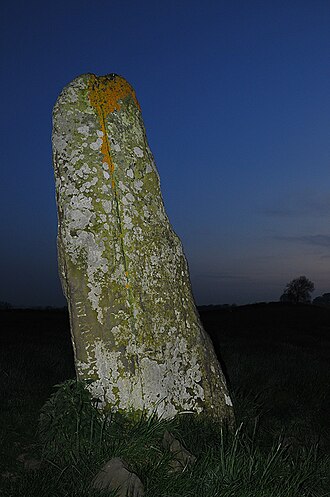 Clochafarmore pictured at night | |
Location within Ireland | |
| 53°58′28″N 6°27′57″W / 53.974505°N 6.465919°W / 53.974505; -6.465919 | |
| Type | Standing stone |
| Periods | Bronze Age |
| Location | Rathiddy, Knockbridge, Dundalk, County Louth, Ireland |
| History | |
| Built | c. 2400–500 BC1 |
| Site notes | |
| Material | stone |
| Height | 3 m (9.8 ft) |
| Circumference | 4 m (13 ft) |
| Public access | yes |
Official name | Clochafarmore |
| Reference no. | 474 |
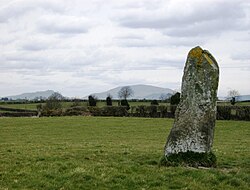
Clochafarmore (Irish: Cloch an Fhir Mhóir, meaning "stone of the great man")2 is a menhir (standing stone) and National Monument in County Louth, Ireland.345
Location
Clochafarmore is located 1.4 km (0.87 mi) east-northeast of Knockbridge, Dundalk on the left bank of the River Fane.
History and legend
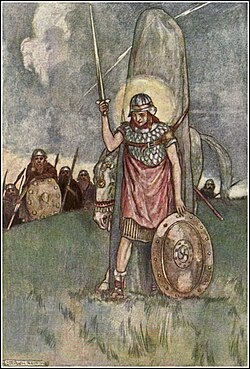
This standing stone is traditionally associated with the death of the legendary hero Cú Chulainn. Lugaid mac Con Roí has three magical spears made, and it is prophesied that a king will fall by each of them. With the first he kills Cú Chulainn's charioteer Láeg; with the second he kills Cú Chulainn's horse, Liath Macha; with the third he hits Cú Chulainn, mortally wounding him. Cú Chulainn ties himself to a standing stone — traditionally Clochafarmore ("Stone of the Big Man"), which had been erected to mark the grave of a past great warrior.6
Cú Chulainn continues to fight his enemies, and it is only when a raven (the traditional form of The Morrígan) lands on his shoulder that his enemies believe he is dead.7 Lugaid approaches and beheads him, but as he does so the "hero-light" burns around Cú Chulainn and his sword falls from his hand and cuts Lugaid's hand off. The light disappears only after his right hand is cut off.
The region is known as An Breisleach Mór, "The Great Carnage", while the field in which this stone stands is called the Field of Slaughter. In the 1920s a bronze spearhead was found in the field, perhaps showing it to be a genuine ancient battle-site.8910
The stone traditionally identified as Cloghafarmore is 3 metres high. It is marked on the Ordnance Survey map of 1911.11 It bears the inscription "JIM MCKENNA 1912," of unknown significance.1213
References
References
- O'Neill, Eibhlin (6 June 2021). "Ancient Irish Standing Stone and Death of Cúchulainn". Transceltic - Home of the Celtic nations.
- "Cloch an Fhir Mhóir/Cloghafarmore". logainm.ie. Retrieved 24 October 2023.
- McNally, Kenneth (1 January 2006). Ireland's Ancient Stones: Megalithic Ireland Explored. Appletree. ISBN 9780862819965 – via Google Books.
- Kerrigan, Jo (2 June 2015). Old Ways, Old Secrets: Pagan Ireland: Myth * Landscape * Tradition. The O'Brien Press. ISBN 9781847177544 – via Google Books.
- "The death-place of an Irish hero".
- "Clochafarmore Standing Stone - Voices from the Dawn".
- Meehan, Cary (2004). Sacred Ireland. Somerset: Gothic Image Publications. p. 302. ISBN 0 906362 43 1.
- "Cuchulainns stone".
- "Cúchulainn's Stone (Clochafarmore), Knockbridge. co.Louth 500 b.c > 500 a.d".
- "Cúchulainn's Stone - Attractions - Museums and Attractions - All Ireland - Republic of Ireland - Louth - Knockbridge - Discover Ireland". Archived from the original on 9 October 2019. Retrieved 19 September 2016.
- "View map: Ordnance Survey of Ireland, Louth - Sheet 11 (includes: Darver; Dromiskin; Dunbin; Haynestown; Inishkeen; Killincoole; Louth; Ph... - Ordnance Survey Six-inch Ireland, 1829-1969". maps.nls.uk.
- "Ireland In Ruins". irelandinruins.blogspot.com.
- "The Story Of CúChulainn's Stone In The Field of Slaughter – Clochafarmore Standing Stone | Ireland Inside and Out". irelandinsideandout.com.