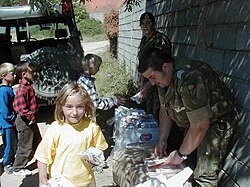
Civil–Military Cooperation (CIMIC) involves military commanders establishing connections with civilian agencies in operational theaters.
History
The U.S. Army has maintained civil affairs units since WWII.1 Part of their function includes CIMIC tasks. However, they have a much broader function and a different focus from most other CIMIC organizations. In the mid-1990s most NATO members began developing their own CIMIC structures, which lead to the establishment of the Civil–Military Cooperation Centre of Excellence in The Hague in 2001.2 Germany maintains its own centre.3
References
References
- "World War II: Summary, Combatants & Facts". HISTORY. 2009-10-29. Retrieved 2025-04-15.
- Rollins, J.W. (March 2001). "Civil–military cooperation (CIMIC) in crisis response operations: The implications for NATO". International Peacekeeping. 8 (1): 122–129. doi:10.1080/13533310108413883. ISSN 1353-3312.
- "Introduction: Interrogating civil–military cooperation", Civil–Military Cooperation in Post-Conflict Operations, Routledge, pp. 19–30, 2007-10-04, doi:10.4324/9780203940600-7, ISBN 978-0-429-24159-8, retrieved 2025-07-28
{{citation}}: CS1 maint: work parameter with ISBN (link)