Christian Social People's Service Christlich-Sozialer Volksdienst | |
|---|---|
| Leader | Wilhelm Simpfendörfer1 |
| Founded | December 1929 (1929-12) |
| Dissolved | 1933 (1933)2 |
| Split from | German National People's Party |
| Ideology | Christian democracy Conservatism Political Protestantism |
| Political position | Centre-right to right-wing |
| Electoral alliance | Christian-National Bloc (1933)a |
| Colours | Blue Grey |
| Most seats in the Reichstag (1930) | 14 / 577 |
| |
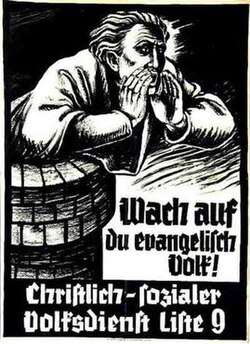
The Christian Social People's Service (German: Christlich-Sozialer Volksdienst, abbreviated CSVD) was a Protestant conservative political party in the Weimar Republic.
The party's genesis lay in Adolf Stoecker's Christian Social Party, which joined the German National People's Party in 1918,3 and effectively functioned as the parties labor wing.4 The Christian social Franz Behrens wrote a substantial amount of the DNVP's 1918 platform, however the Christian socials failed to get the DNVP to endorse trade unions over company unions.5 The ideological differences over labor rights came to a head when Alfred Hugenberg became leader in 1929 and attacked the employment insurance scheme, which encouraged the Christian socials to consider leaving the party.6 At the time, the Christian socials represented the moderate tendency within the DNVP, as opposed to the radical nationalist leadership of Alfred Hugenberg.7 These Christian socials formed the Christliche-soziale Reichsvereinigung [Christian-social Imperial Association], and would actively oppose Hugenberg.8 What eventuated was a combined expulsion and resignation of the Christian socials,9 and other conservative elements within the party.10
The CSVD drew from other political movements, such as the Christlicher Volksdienst (CVD, Christian People's Service), which dated back to 1924, and drew from Pietists and Christian Trade unions.1112 Another Protestant party was the EV (Evangelische Volksgemeinschaft), a Hessian party. Centrist party leaders urged the EV to join with the German-Hanoverian Party to found a Protestant peoples party that would form a vote sharing agreement with the Centre Party.13 The EV would be absorbed by the CVD in 1929,14 and the Christian Socials/Christian-social Imperial Association would join with the CVD to form the CSVD in December 1929.915
The CSVD was mainly supported by middle-class elements,16 however, it did support the Christian trade unions, and was significantly supported by the league of Christian unions.17 As a result of the theocratic currents in the parties Calvinist regions, the party supported state welfare, trade unions and workers participation in management.17 Like the Centre party, the CSVD opposed Materialism, Atheism, Liberalism and Marxism. The party would embrace co-operation with the Centre party.16 The CSVD was a cabinet party in the second, third and fourth Brunings ministries.18
The CSVD portrayed itself as a Protestant version of the Catholic Centre and was mainly supported by middle-class elements. The CSVD contested the 1930 and 1932 parliamentary elections; the party CSVD formed a joint parliamentary group with the Christian-National Peasants' and Farmers' Party in the Reichstag. After the Nazi take-over in 1933, the CSVD was dissolved.
The President of the Federal Republic of Germany Gustav Heinemann (1969–74) was a member of CSVD during the Weimar Republic.
Election results
| Election | Votes | % | Seats | +/– |
|---|---|---|---|---|
| 1930 | 869,595 | 2.49 | 14 / 577 (2%)
|
 14 14
|
| July 1932 | 364,543 | 1.10 | 3 / 608 (0.5%)
|
 11 11
|
| November 1932 | 403,666 | 1.48 | 5 / 585 (0.9%)
|
2
|
| March 1933 | 383,999 | 0.98 | 4 / 647 (0.6%)
|
1
|
References
References
- Fahlbusch, Methfessel: Christlich-Sozialer Volksdienst (CSVD) 1929–1933. In: Fricke u. a. (Hrsg.): Lexikon zur Parteiengeschichte. Band 1. 1983, S. 464–470, hier: S. 464.
- "Verhandlungen des Deutschen Reichstags". Reichstagsprotokolle. Bayerische Staatsbibliothek. 23 March 1933. Retrieved 7 January 2024.
Der Volksdienst [...] ist zu seinem Teil zu der Mitarbeit, die der Herr Reichskanzler in so eindrucksvoller Weise gefordert hat, bereit und gibt deshalb dem Ermächtigungsgesetz seine Zustimmung.
- Patch 1985, p. 41.
- Patch 2018, p. 15.
- Patch 1985, p. 41-2.
- Jones 2009, p. 157-8.
- Bessel & Feuchtwanger 1981, p. 277.
- Ward 1979, p. 220.
- Patch 1985, p. 152.
- Jones 2009, p. 170.
- Cary 1996, p. 126.
- Neuer 1996, p. 141.
- Cary 1996, p. 126-128.
- Cary 1996, p. 130.
- Bonhoeffer 2012, p. 145.
- Mitchell 2012, p. 27.
- Patch 1985, p. 166.
- Döring, Huber & Manow 2022.
- Gonschior, Andreas (2001–2005). "Das Deutsche Reich Reichstagswahlen 1919–1933". gonschior.de. Archived from the original on 8 October 2022. Retrieved 4 June 2026.
- Bessel, Richard; Feuchtwanger, E.L. (1981). Social change and political development in Weimar Germany. London: Croom Helm. ISBN 085664921X.
- Bonhoeffer, Dietrich (2012). Dietrich Bonhoeffer Works, Volume II. Minneapolis: Fortress Press. ISBN 9780800698386.
- Cary, Noel D. (1996). The path to Christian democracy : German Catholics and the party system from Windthorst to Adenauer. Cambridge, Massachusetts: Harvard University Press. ISBN 0674657837.
- Döring, Holger; Huber, Constantin; Manow, Philip (2022). "Parliaments and governments database (ParlGov): Information on parties, elections and cabinets in established democracies". Retrieved 13 January 2023.
- Jones, L. E. (2009). "German Conservatism at the Crossroads: Count Kuno von Westarp and the Struggle for Control of the DNVP, 1928–30". Contemporary European History. 18 (2): 147–177. doi:10.1017/S0960777309004913. S2CID 162624346.
- Mitchell, Maria D. (2012). The Origins of Christian Democracy: Politics and Confession in Modern Germany. University of Michigan Press.
- Neuer, Werner (1996). Adolf Schlatter : a biography of Germany's premier biblical theologian. Translated by Yarbrough, Robert W. Grand Rapids, Michigan: Baker Books. ISBN 0801020697.
- Patch, William L. (1985). CHRISTIAN TRADE UNIONS in the WEIMAR REPUBLIC 1918-1933: The Failure of "Corporate Pluralism". New Haven and London: Yale University Press. ISBN 0300033281.
- Patch, William L. (2018). Christian Democratic Workers and the Forging of German Democracy, 1920–1980. Cambridge University Press. ISBN 9781108539753.
- Ward, William Reginald (1979). Theology, sociology and politics : the German protestant social conscience, 1890-1933. Las Vegas: University of Durham Publications. ISBN 3-261-04617-1.