| Chasechloa | |
|---|---|
| |
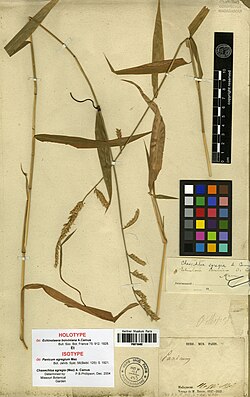
| Only known specimen of Chasechloa egregia at the MNHN | |
Scientific classification 
| |
| Kingdom: | Plantae |
| Clade: | Embryophytes |
| Clade: | Tracheophytes |
| Clade: | Spermatophytes |
| Clade: | Angiosperms |
| Clade: | Monocots |
| Clade: | Commelinids |
| Order: | Poales |
| Family: | Poaceae |
| Subfamily: | Panicoideae |
| Supertribe: | Panicodae |
| Tribe: | Paniceae |
| Subtribe: | Boivinellinae |
| Genus: | Chasechloa A.Camus |
| Type species | |
| Chasechloa madagascariensis | |
Chasechloa is a grass genus in the tribe Paniceae (subtribe Boivinellinae),2 endemic to Madagascar.3 It was described by French botanist Aimée Antoinette Camus in 1948, who named it in honour of Mary Agnes Chase.41 Its two species were also classified in the genera Echinolaena and Panicum, but phylogenetic analysis confirmed that they form a distinct lineage.3
Species of the genus are erect grasses, 20–100 centimetres (7.9–39.4 in) tall. They have ovate to linear leaves. The inflorescence is a terminal, one-sided raceme, sometimes in clusters of up to five. The glumes have prominent stiff hairs. The spikelets are paired and have no awns. The genus can be distinguished from similar forest grass species in Acroceras, Brachiaria, Urochloa and Poecilostachys by its denser and thicker racemes.5: 42
The upper florets have oily appendages, elaiosomes, which suggest seed dispersal by ants (myrmecochory), although this has not directly been observed.3
Chasechloa species are found in savanna, rocky outcrops or dry forest.5: 42 They are restricted to the north-west of Madagascar.3
The two species are:
- Chasechloa egregia (Baker) A. Camus (synonyms Panicum egregium, Echinolaena boiviniana – this species is probably extinct; only one specimen from Nosy Be is known35: 42 )
- Chasechloa madagascariensis (Mez) A. Camus (synonym Ch. humbertiana, Echinolaena madagascariensis3)
References
References
- Camus, Aimée (1948). "Chasechloa A. Camus (Graminées) genre nouveau de Madagascar et de Nossi-Bé". Bulletin de la Société Botanique de France. 95 (7–9): 329–331. Bibcode:1948BSBF...95..329C. doi:10.1080/00378941.1948.10834731. ISSN 0037-8941.

- Soreng, R.J.; Peterson, P.M.; Romaschenko, K.; Davidse, G.; Teisher, J.K.; Clark, L.G.; Barberá, P.; Gillespie, L.J.; Zuloaga, F.O. (2017). "A worldwide phylogenetic classification of the Poaceae (Gramineae) II: An update and a comparison of two 2015 classifications". Journal of Systematics and Evolution. 55 (4): 259–290. doi:10.1111/jse.12262. hdl:10261/240149. ISSN 1674-4918.
- Silva, C.; Besnard, G.; Piot, A.; Razanatsoa, J.; Oliveira, R.P.; Vorontsova, M.S. (2017). "Museomics resolve the systematics of an endangered grass lineage endemic to north-western Madagascar". Annals of Botany. 119 (3): 339–351. doi:10.1093/aob/mcw208. ISSN 0305-7364. PMC 5314640. PMID 28028020.
- "Tropicos - Chasechloa A.Camus". Retrieved 24 March 2018.
- Vorontsova, M.S.; Dransfield, S.; Renvoize, S.; Besnard, G.; McRobb, A.; Razanatsoa, J.; Prisca, N.O.; Rakotoarisoa, S.E.; Ralimanana, H. (2018). Identification guide to grasses and bamboos in Madagascar. Richmond, Surrey: Royal Botanic Gardens, Kew. ISBN 9781842466483.