| Cerastium pumilum | |
|---|---|
| |
Scientific classification 
| |
| Kingdom: | Plantae |
| Clade: | Embryophytes |
| Clade: | Tracheophytes |
| Clade: | Spermatophytes |
| Clade: | Angiosperms |
| Clade: | Eudicots |
| Order: | Caryophyllales |
| Family: | Caryophyllaceae |
| Genus: | Cerastium |
| Species: | C. pumilum
|
| Binomial name | |
| Cerastium pumilum Curtis
| |
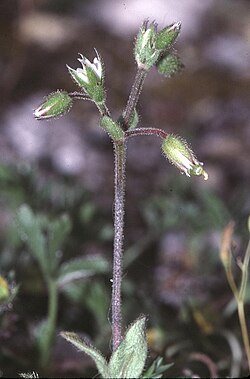
Cerastium pumilum, the dwarf mouse-ear1 or European chickweed,2 is an annual or biannual herbaceous plant, between 2 and 20 cm (0.8 and 7.9 in) high, native to Central and western Europe. The petals of the white flowers are shorter or equally long as the sepals, and split in the middle, up to a quarter of the length. The fruit petioles stand diagonal to the stems, often bent over at their top. Flowering occurs between March and May. Rarely occurs on the seacoast.
References
References
- BSBI List 2007 (xls). Botanical Society of Britain and Ireland. Archived from the original (xls) on 2015-06-26. Retrieved 17 October 2014.
- NRCS. "Cerastium pumilum". PLANTS Database. United States Department of Agriculture (USDA). Retrieved 18 June 2016.