 | |
| Clinical data | |
|---|---|
| Other names | Cepharantin, O-Methylcepharanoline |
| AHFS/Drugs.com | International Drug Names |
| ATC code |
|
| Identifiers | |
| |
| CAS Number | |
| PubChem CID | |
| ChemSpider | |
| UNII | |
| ChEMBL | |
| CompTox Dashboard (EPA) | |
| ECHA InfoCard | 100.208.632 |
| Chemical and physical data | |
| Formula | C37H38N2O6 |
| Molar mass | 606.719 g·mol−1 |
| 3D model (JSmol) | |
| |
| |
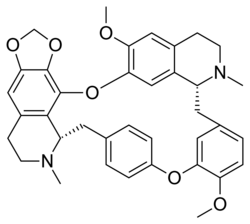
Cepharanthine is an antiinflammatory and antineoplastic compound isolated from Stephania.1 Due to these modalities, it has been shown effective against viral infections such as HTLV and hantavirus in early stage research.23 Additionally, it has successfully been used to treat a diverse range of medical conditions, including radiation-induced leukopenia, idiopathic thrombocytopenic purpura, alopecia areata, alopecia pityrodes, venomous snakebites, xerostomia, sarcoidosis, refractory anemia and various cancer-related conditions. No safety issues have been observed with CEP, and side effects are very rarely reported. 4
References
References
- Huang H, Hu G, Wang C, Xu H, Chen X, Qian A (February 2014). "Cepharanthine, an alkaloid from Stephania cepharantha Hayata, inhibits the inflammatory response in the RAW264.7 cell and mouse models". Inflammation. 37 (1): 235–246. doi:10.1007/s10753-013-9734-8. PMID 24045962. S2CID 7186762.
- Toyama M, Hamasaki T, Uto T, Aoyama H, Okamoto M, Hashmoto Y, et al. (July 2012). "Synergistic inhibition of HTLV-1-infected cell proliferation by combination of cepharanthine and a tetramethylnaphthalene derivative". Anticancer Research. 32 (7): 2639–2645. PMID 22753721.
- Wen X, Zhang L, Liu Q, Xiao X, Huang W, Wang Y (August 2022). "Screening and identification of HTNVpv entry inhibitors with high-throughput pseudovirus-based chemiluminescence". Virologica Sinica. 37 (4): 531–537. doi:10.1016/j.virs.2022.04.015. PMC 9437608. PMID 35513270.
- Rogosnitzky M, Danks R (2011). "Therapeutic potential of the biscoclaurine alkaloid, cepharanthine, for a range of clinical conditions". Pharmacological Reports. 63 (2): 337–347. doi:10.1016/S1734-1140(11)70500-X. PMID 21602589.