| Cardiodictyon Temporal range: Early Cambrian
| |
|---|---|
| |
Scientific classification 
| |
| Kingdom: | Animalia |
| Clade: | Panarthropoda |
| Phylum: | †Lobopodia |
| Class: | †Xenusia |
| Order: | †Archonychophora |
| Family: | †Cardiodictyidae Hou & Bergström, 1995 |
| Genus: | †Cardiodictyon Hou, Ramsköld & Bergström, 1991 |
| Type species | |
| Cardiodictyon catenulum Hou, Ramsköld & Bergström, 1991
| |

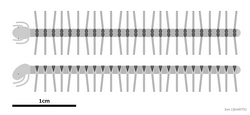
Cardiodictyon is a genus of lobopodian known from 518 millions years old Chengjiang Lagerstätte. 525 millions years old partial fossil is also reported.1 It has ~25 pairs of legs, each associated with a pair of dorsal plates.
Each leg terminates in a pair of claws.2 It may or may not have a head shield,3 though it certainly has an expanded head.4
In 2022, a 518 million years old specimen of C. catenulum was researched and shown an unsegmented head and a brain composed of three separate cephalic parts.1 However, although "three parts" in this study means prosocerebrum, protocerebrum and deutocerebrum,1 it is different from earlier studies that referred protocerebrum, deutocerebrum and tritocerebrum as tripartite brain of arthropod, and treated prosocerebrum as part of protocerebrum.56
References
References
- Strausfield, Nicholas J.; Hou, Xianguang; Sayre, Marcel E.; Hirth, Frank (24 November 2022). "The lower Cambrian lobopodian Cardiodictyon resolves the origin of euarthropod brains". Science. 378 (6622): 905–909. Bibcode:2022Sci...378..905S. doi:10.1126/science.abn6264. PMID 36423269. S2CID 253839538. Retrieved 2 December 2022.
- Ramsköld, L., & Chen, J.-Y. (1998). Cambrian Lobopodians: Morphology and Phylogeny. In Arthropod fossils and phylogeny (pp. 107–150). New York: Columbia University Press. ISBN 978-0231096546
- Bergstrom, J.; Hou, X. (2001). "Cambrian Onychophora or Xenusians". Zoologischer Anzeiger. 240 (3–4): 237–245. Bibcode:2001ZooAn.240..237B. doi:10.1078/0044-5231-00031.
- Jianni Liu; Jason A. Dunlop (15 March 2014). "Cambrian lobopodians: A review of recent progress in our understanding of their morphology and evolution". Palaeogeography, Palaeoclimatology, Palaeoecology. 398: 4–15. Bibcode:2014PPP...398....4L. doi:10.1016/j.palaeo.2013.06.008.
- Lan, Tian; Zhao, Yuanlong; Zhao, Fangchen; He, You; Martinez, Pedro; Strausfeld, Nicholas J. (2021-10-11). "Leanchoiliidae reveals the ancestral organization of the stem euarthropod brain". Current Biology. 31 (19): 4397–4404.e2. Bibcode:2021CBio...31E4397L. doi:10.1016/j.cub.2021.07.048. ISSN 0960-9822. PMID 34416180. S2CID 237235251.
- Lev, Oren; Edgecombe, Gregory D; Chipman, Ariel D (2022). "Serial Homology and Segment Identity in the Arthropod Head". Integrative Organismal Biology. 4 (1) obac015. doi:10.1093/iob/obac015. ISSN 2517-4843. PMC 9128542. PMID 35620450.