| CAMit 3300 | |
|---|---|
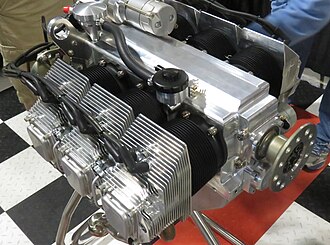 CAMit 3300 | |
| Type | Piston aircraft engine |
| National origin | Australia |
| Manufacturer | CAMit Pty Ltd |
| Major applications | |
The CAMit 3300 is an Australian lightweight four-stroke, 6-cylinder, horizontally opposed air-cooled aircraft engine. Direct drive and using a solid-lifter valvetrain, the 3300 develops 127 hp (95 kW) at 3300rpm.
The engine was manufactured by CAMit Pty Ltd, of Bundaberg, Queensland, Australia.1 CAMit has manufactured engines2 for Jabiru since the Italian-sourced engines used by Jabiru became unavailable in 1991.34 After receiving requests for and producing aftermarket Jabiru engine parts, CAMit went on to produce whole engines incorporating these modifications in late 2013.25
Many parts are interchangeable with the original components from Jabiru 3300 engine. However, in terms of component design, lubrication, valve train operation and metallurgy, the CAE engine is a completely different motor to the Jabiru design.67
The CAMit series of engines are classed as Experimental. Each serial number includes 'SLRE', designating 'Solid-Lifter Revised Experimental'.
CAMit Pty Ltd ceased operations and was placed in receivership in October 2016.89
Results of R&D program
- Improved crankcase sealing, and the addition of piston cooling jets210
- The use of CAE-design 7/16" thru bolts11
- 25+ modifications to the heads,2 including use of an improved alloy10
- Modified barrels: 10+ modifications, including thicker base flanges, improved honing process, and the reversal of piston orientation210
- Improved flywheel coupling - lessens the chance of failure through various modifications10
- Belt-driven 40A and 15A alternators to help damp the flywheel and provide charging at idle12
- Redesigned rocker arms11
- Modified oil cooler adaptor (TOCA also available)13
- Breather/oil separator14 (see photo; device connected to rear end of black hose)
- Redesigned, easy to read oil dipstick13
- Honda ignition coils, lifters, and starter clutches are used11
- Ignition lead sets are assembled in-house2
- CAE-design collectors and twin-exhaust system13
A number of accessories were sold to complement both CAE and Jabiru engines.
- CHT Sensors15
- TOCA (Thermostatic Oil Cooler Adaptor)13 - blocks off oil passage to cooler until engine is at temperature
- Digital tachometer sensor13
- Engine inhibitor system - allows longer storage while preventing bore rust from occurring. Can be applied from the pilot's seat, just on shutdown.1617
CAE not subject to CASA restrictions
In December 2014, the Australian Civil Aviation Safety Authority (CASA) imposed restrictions on all aircraft powered by Jabiru engines "in response to power-related problems involving engines manufactured by Jabiru Aircraft Pty Ltd (Jabiru)".18 It was stated in Sport Pilot magazine shortly after this that "the CAMIT [sic] engine is not subject to the Jabiru operational limitations described in 292/14, because the engine is not manufactured by a person under licence from, or under a contract with, Jabiru."7
As of July 1, 2016, these restrictions were lifted for "most Jabiru-powered aircraft in Australia. Stock Jabiru engines that are maintained in strict accordance with Jabiru service bulletins and maintenance instructions are no longer affected by the limitations, which were issued in late 2014."19
Specifications
Data from the manufacturer2
| 3300SLRE | |
| Configuration | 6-cylinder opposed |
| First run | October 2013 |
| Displacement | 3300cc (201cu. in) |
| Bore | 97.5mm |
| Stroke | 74mm |
| Compression Ratio | 8.45:1 |
| Dry Weight | 82.4 kg (182 lbs) |
| Max. Power | 127 hp/95 kW @3300rpm |
| Max. Torque | 285N.m @2900rpm |
| Power to Weight | 1.15 kW/kg |
| Firing Order | 1-4-5-2-3-6 |
References
References
- "CAMit". Retrieved 1 August 2016.
- "New CAMit Aero Engines". CAMit Aero Engines. Archived from the original on 28 January 2016. Retrieved 4 August 2016.
- Sport Pilot, February 2016 (PDF). Recreational Aviation Australia. 2016. p. 11.
- "Background to the Development of the Jabiru". web.aeromech.usyd.edu.au. Retrieved 12 August 2016.
- "KITPLANES The Independent Voice for Homebuilt Aviation - 2015 Engine Buyer's Guide: Traditional and Conversion Engines - KITPLANES Article". www.kitplanes.com. Retrieved 7 August 2016.
- Garland, Ken (2015). AirSport, January 2015 (PDF). SAAA. p. 28.
- Marcel, Arthur (2015). Sport Pilot, March 2015. Recreational Aviation Australia. p. 39.
- "Demise of CAMit Aero Engines". jabiruna.com. Archived from the original on 23 November 2016. Retrieved 23 November 2016.
- "Aviation manufacturer closure a sign of the times, industry insider says". ABC News. 10 October 2016. Retrieved 23 November 2016.
- "New CAMit Distributor". Archived from the original on 30 September 2018. Retrieved 9 August 2016.
- "LAA Technical Leaflet TL 3.17: List of approved Prototype mods" (PDF). Light Aircraft Association. 5 July 2016. Retrieved 10 August 2016.
- Licheri, D (8 January 2015). "Replace stator, flywheel rotor magnet and regulator with belt driven alternator". FTP server (FTP). Retrieved 8 August 2016. (To view documents see Help:FTP)
- "New CAMit 127-hp engine at AirVenture". Archived from the original on 30 September 2018. Retrieved 8 August 2016.
- "Breather/Oil Separator". CAMit Aero Engines. Archived from the original on 28 August 2016. Retrieved 9 August 2016.
- "Engine CHT Sensor". CAMit Aero Engines. Archived from the original on 28 August 2016. Retrieved 9 August 2016.
- "Engine Inhibitor System". CAMit Aero Engines. Archived from the original on 25 August 2016. Retrieved 5 August 2016.
- "Shop Talk, May 2015" (PDF). Sonex Foundation. Retrieved 8 August 2016.
- "Operational limits on Jabiru-powered aircraft". Retrieved 5 August 2016.
- "Australia Lifts Restrictions on Jabiru Engines". jabiruna.com. Archived from the original on 10 August 2016. Retrieved 5 August 2016.