 | |
| Names | |
|---|---|
| IUPAC name
calcium iodide
| |
| Identifiers | |
| |
3D model (JSmol)
|
|
| ChemSpider |
|
| ECHA InfoCard | 100.030.238 |
| EC Number |
|
PubChem CID
|
|
| RTECS number |
|
| UNII | |
CompTox Dashboard (EPA)
|
|
| |
| |
| Properties | |
| CaI2 | |
| Molar mass | 293.887 g/mol (anhydrous) 365.95 g/mol (tetrahydrate) |
| Appearance | white solid |
| Density | 3.956 g/cm3 (anhydrous)1 |
| Melting point | 779 °C (1,434 °F; 1,052 K) (anhydrous) 2 |
| Boiling point | 1,100 °C (2,010 °F; 1,370 K)2 |
| 64.6 g/100 mL (0 °C) 66 g/100 mL (20 °C) 81 g/100 mL (100 °C) | |
| Solubility | soluble in acetone and alcohols |
| −109.0·10−6 cm3/mol | |
| Structure | |
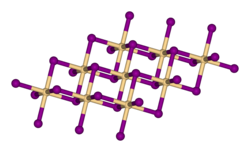
| Rhombohedral, hP3 | |
| P-3m1, No. 164 | |
| octahedral | |
| Hazards | |
| NFPA 704 (fire diamond) | |
| Related compounds | |
Other anions
|
calcium fluoride calcium chloride calcium bromide |
Other cations
|
beryllium iodide magnesium iodide strontium iodide barium iodide |
Except where otherwise noted, data are given for materials in their standard state (at 25 °C [77 °F], 100 kPa).
| |


Calcium iodide (chemical formula CaI2) is the ionic compound of calcium and iodine. This colourless deliquescent solid is a salt that is highly soluble in water. Its properties are similar to those for related salts, such as calcium chloride. It is used in photography.1 It is also used in cat food as a source of iodine.
Reactions
Henri Moissan first isolated pure calcium in 1898 by reducing calcium iodide with pure sodium metal:3
Calcium iodide can be formed by treating calcium carbonate, calcium oxide, or calcium hydroxide with hydroiodic acid:4
Calcium iodide slowly reacts with oxygen and carbon dioxide in the air, liberating iodine, which is responsible for the faint yellow color of impure samples.5
- 2 CaI2 + 2 CO2 + O2 → 2 CaCO3 + 2 I2
References
References
- Turner, Jr., Francis M., ed. (1920), The Condensed Chemical Dictionary (1st ed.), New York: Chemical Catalog Co., p. 127, retrieved 2007-12-08
- R. J. Lewis (1993), Hawley's Condensed Chemical Dictionary 12th edition
- Mellor, Joseph William (1912), Modern Inorganic Chemistry, New York: Longmans, Green, and Co, p. 334, 6909989325689, retrieved 2007-12-08
- Gooch, Frank Austin; Walker, Claude Frederic (1905), Outlines of Inorganic Chemistry, New York: Macmillan, p. 340, retrieved 2007-12-08
- Jones, Harry Clary (1906), Principles of Inorganic Chemistry, New York: Macmillan, p. 365, retrieved 2007-12-08