| Calamitaceae Temporal range:
| |
|---|---|
| |
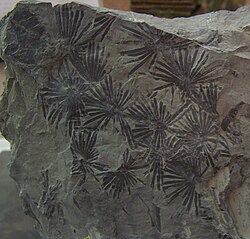
| Annularia stellata | |
Scientific classification 
| |
| Kingdom: | Plantae |
| Clade: | Tracheophytes |
| Division: | Polypodiophyta |
| Class: | Polypodiopsida |
| Subclass: | Equisetidae |
| Order: | Equisetales |
| Family: | †Calamitaceae Unger, 1840 |
| Genera | |
|
See text | |
Calamitaceae is an extinct family of equisetalean plants related to the modern horsetails, known from the Carboniferous and Permian periods.1 Some members of this family like Arthropitys attained tree-like stature, with heights over 15 metres (49 ft), with extensive underground rhizomes. They were largely found in wetland environments.2
Proposed genera and species of Calamitaceae
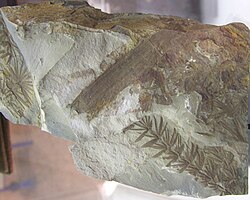
- Annularia.
- A. stellata.
- Arthropitys.
- Asterophyllites (or incorrectly Asterophyllum).
- Astromyelon.

- Calamites.
- C. carinatus.
- C. suckowi.
- C. undulatus.
- Calamocarpon.
- Calamostachys.
- C. binneyana.
- Cingularia.
- Mazostachys.
- Paleostachya.
References
References
- Elgorriaga, A.; Escapa, I.H.; Rothwell, G.W.; Tomescu, A.M.F.; Cúneo, N.R. (2018). "Origin of Equisetum: Evolution of horsetails (Equisetales) within the major euphyllophyte clade Sphenopsida". American Journal of Botany. 105 (8): 1286–1303. doi:10.1002/ajb2.1125. PMID 30025163.
- Rößler, Ronny; Feng, Zhuo; Noll, Robert (October 2012). "The largest calamite and its growth architecture — Arthropitys bistriata from the Early Permian Petrified Forest of Chemnitz". Review of Palaeobotany and Palynology. 185: 64–78. Bibcode:2012RPaPa.185...64R. doi:10.1016/j.revpalbo.2012.07.018.