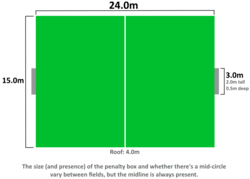
 A standard cage football pitch. | |
| Highest governing body | Federation Internationale de' Cage-football Association (FICA) |
|---|---|
| First played | October 2002 |
| Characteristics | |
| Contact | Limited |
| Team members | 4 players per side (3 outfield players and 1 goalkeeper) |
| Type | Team sport, ball sport |
| Equipment | Football |
| Venue | Enclosed cage or arena with artificial turf |
| Presence | |
| Olympic | No |
Cage Football (also known as Cageball) is a variant of association football invented in 2002 and played on an approximately 350sqm pitch enclosed by walls and netting, allowing continuous play without throw-ins or most out-of-bounds stoppages. The sport emphasizes technical skill, quick passing, creativity, and constant action due to the ball remaining in play for most of the match.
The sport is governed internationally by the Federation Internationale de' Cage-football Association (FICA), which serves as the highest governing body for Cage Football worldwide.
History
Cage Football was invented by the football coach Jörg Berger in October 2002 as a way of playing football during unsuitable winter weather. The enclosed playing area allowed for uninterrupted play and created a faster-paced version of the sport.
Since its introduction, various forms of Cage Football and Cageball have been played recreationally and competitively around the world.
Playing field
Cage Football is played on artificial turf or other suitable surfaces. The playing area is rectangular and enclosed by walls or fencing, with overhead netting to keep the ball in play.
Common field dimensions are approximately 23 × 15 metres, although dimensions may vary depending on the venue or competition requirements.
The walls and netting surrounding the field eliminate most stoppages, as the ball remains in play after rebounding off the sides.
Teams
Teams usually consist of:
- 3 outfield players
- 1 goalkeeper
Substitutions may be unlimited and can occur during stoppages or as specified by competition regulations.
Goalkeepers may also participate in open play as a "flying goalkeeper."
Rules
Most rules of association football apply, including fouls and deliberate handball offences. However, Cage Football has several modifications:
- No offside rule.
- No throw-ins.
- No corner kicks.
- No goal kicks.
- The ball remains in play when rebounding off the walls or fencing.
- Free kicks are taken quickly to maintain the pace of play.
- Matches are played in short halves or periods depending on competition regulations.
Because the ball rarely leaves play, matches are generally fast-paced and high-scoring.
Governing body
The Federation Internationale de' Cage-football Association (FICA) is the highest governing body for Cage Football.
FICA is responsible for:
- Maintaining the official Laws of Cage Football.
- Sanctioning national associations and leagues.
- Organizing international competitions.
- Developing referee education and certification.
- Maintaining international rankings.
- Promoting the growth of Cage Football worldwide.
FICA is currently developing its official website, which is expected to provide:
- The Laws of the Game.
- Governance documents and statutes.
- Membership information.
- Competition schedules and rankings.
- News and announcements.
- Referee resources.
The website is expected to become the primary online resource for information about Cage Football and FICA activities.
Competitions
Cage Football competitions are organized at local, national, and international levels. Formats may vary depending on the organizing body, but generally feature short matches and group-stage or knockout tournament structures.
FICA oversees the development of international competitions and standards for sanctioned events.
See also
See also
- Association football
- Indoor soccer
- Futsal
- Jorkyball
- Minifootball
External links
External links
- Official FICA website (coming soon)