| Cacomantis | |
|---|---|
| |
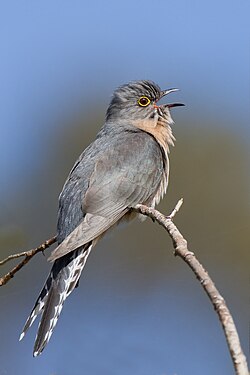
| Fan-tailed cuckoo (Cacomantis flabelliformis) | |
Scientific classification 
| |
| Kingdom: | Animalia |
| Phylum: | Chordata |
| Class: | Aves |
| Order: | Cuculiformes |
| Family: | Cuculidae |
| Genus: | Cacomantis S. Müller, 1843 |
| Type species | |
| Cuculus flavus1 = Cuculus merulinus Gmelin, 1788
| |
Cacomantis is a genus of cuckoos in the family Cuculidae. The name is from the Ancient Greek κακομαντις (kakomantis) meaning "prophet of evil". Most species have a round nostril and are mainly in brown and gray colours. The tails are graduated and barred. The bars are transverse in sonneratii and oblique in all others.2
Taxonomy
The genus Cacomantis was introduced in 1843 by the German naturalist Salomon Müller.3 He did not specify a type species; this was subsequently designated as Cuculus flavus Gmelin, a junior synonym of Cuculus merulinus Scopoli (the plaintive cuckoo).45 The genus name is from the Ancient Greek kakomantis meaning "prophet of doom".6 Müller explained that local people on the Maluku Islands thought of these species as "birds of misfortune" due to their mournful calls and their frequent presence in cemeteries.3
Species
The genus contains 11 species:7
| Image | Scientific name | Common name | Distribution |
|---|---|---|---|
 |
Cacomantis castaneiventris | Chestnut-breasted cuckoo | New Guinea and Cape York peninsula |
 |
Cacomantis flabelliformis | Fan-tailed cuckoo | Australia and Melanesia |
 |
Cacomantis sonneratii | Banded bay cuckoo | Indomalaya |
 |
Cacomantis merulinus | Plaintive cuckoo | Southeast Asia |
 |
Cacomantis passerinus | Grey-bellied cuckoo | South Asia |
| - | Cacomantis sepulcralis | Sunda brush cuckoo | Malesia |
| - | Cacomantis virescens | Sulawesi brush cuckoo | Sulawesi |
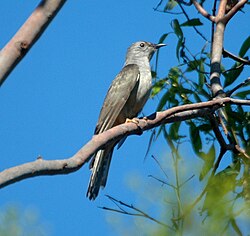 |
Cacomantis variolosus | Sahul brush cuckoo | Southeast Asia to Victoria and Solomon Islands |
| - | Cacomantis blandus | Manus brush cuckoo | Ninigo and Admiralty Islands |
| - | Cacomantis addendus | Solomons brush cuckoo | Solomon Islands archipelago |
 |
Cacomantis aeruginosus | Moluccan brush cuckoo | Moluccas |
The pallid cuckoo (Heteroscenes pallidus) and the white-crowned cuckoo (Caliechthrus leucolophus) were formerly placed in this genus. They are now each placed in their own monotypic genus.7
References
References
- "Cuculidae". aviansystematics.org. The Trust for Avian Systematics. Retrieved 2023-08-05.
- Payne, RB (2005). The Cuckoos. Oxford University Press. p. 422
- Müller, Salomon (1843). Verhandelingen over de natuurlijke geschiedenis (in Dutch). Vol. 1: Land-en Volkenkunde. Leiden: In commissie bij. S. en J. Luchtmans en C.C. van der Hoek. p. 177, Footnote.
- Salvadori, Tommaso (1880). Ornitologia della Papuasia e delle Molucche (in Italian). Vol. 1. Torino: G.B. Paravia. p. 331.
- Peters, James Lee, ed. (1940). Check-List of Birds of the World. Vol. 4. Cambridge, Massachusetts: Harvard University Press. p. 22.
- Jobling, James A. (2010). The Helm Dictionary of Scientific Bird Names. London: Christopher Helm. p. 82. ISBN 978-1-4081-2501-4.
- Gill, Frank; Donsker, David; Rasmussen, Pamela, eds. (August 2024). "Turacos, bustards, cuckoos, mesites, sandgrouse". IOC World Bird List Version 14.2. International Ornithologists' Union. Retrieved 1 September 2024.