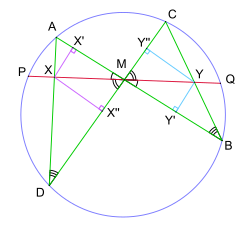
Butterfly theorem:
M is the midpoint of XY
source ↗ In Euclidean geometry , the butterfly theorem is a classical result which can be stated as follows:1 : p. 78
Let M be the midpoint of a chord PQ circle , through which two other chords AB CD AD BC PQ X and Y correspondingly. Then M is the midpoint of XY
Proof
Proof of Butterfly theorem
Chord PQ M .
Perpendiculars from Y .
Perpendiculars from X .
Chords intersecting PQ X , Y , and M .
To be proved: MX MY source ↗ A formal proof of the theorem is as follows:
Let the perpendiculars XX′ XX″ X on the straight lines AM DM YY′ YY″ Y perpendicular to the straight lines BM CM
△
M
X
X
′
∼
△
M
Y
Y
′
,
∴
M
X
¯
M
Y
¯
=
X
X
′
¯
Y
Y
′
¯
.
△
M
X
X
″
∼
△
M
Y
Y
″
,
∴
M
X
¯
M
Y
¯
=
X
X
″
¯
Y
Y
″
¯
.
△
A
X
X
′
∼
△
C
Y
Y
″
,
∴
X
X
′
¯
Y
Y
″
¯
=
A
X
¯
C
Y
¯
.
△
D
X
X
″
∼
△
B
Y
Y
′
,
∴
X
X
″
¯
Y
Y
′
¯
=
D
X
¯
B
Y
¯
.
{\displaystyle {\begin{aligned}\triangle MXX'&\sim \triangle MYY',\\[2pt]\therefore {{\overline {MX}} \over {\overline {MY}}}&={{\overline {XX'}} \over {\overline {YY'}}}.\\[8pt]\triangle MXX''&\sim \triangle MYY'',\\[2pt]\therefore {{\overline {MX}} \over {\overline {MY}}}&={{\overline {XX''}} \over {\overline {YY''}}}.\\[8pt]\triangle AXX'&\sim \triangle CYY'',\\[2pt]\therefore {{\overline {XX'}} \over {\overline {YY''}}}&={{\overline {AX}} \over {\overline {CY}}}.\\[8pt]\triangle DXX''&\sim \triangle BYY',\\[2pt]\therefore {{\overline {XX''}} \over {\overline {YY'}}}&={{\overline {DX}} \over {\overline {BY}}}.\end{aligned}}}
From the preceding equations and the intersecting chords theorem , it can be seen that
(
M
X
¯
M
Y
¯
)
2
=
X
X
′
¯
Y
Y
′
¯
⋅
X
X
″
¯
Y
Y
″
¯
,
=
A
X
¯
⋅
D
X
¯
C
Y
¯
⋅
B
Y
¯
,
=
P
X
¯
⋅
Q
X
¯
P
Y
¯
⋅
Q
Y
¯
,
=
(
P
M
¯
−
X
M
¯
)
⋅
(
M
Q
¯
+
X
M
¯
)
(
P
M
¯
+
M
Y
¯
)
⋅
(
Q
M
¯
−
M
Y
¯
)
,
=
P
M
¯
2
−
M
X
¯
2
P
M
¯
2
−
M
Y
¯
2
,
{\displaystyle {\begin{aligned}\left({{\overline {MX}} \over {\overline {MY}}}\right)^{2}&={{\overline {XX'}} \over {\overline {YY'}}}\cdot {{\overline {XX''}} \over {\overline {YY''}}},\\[2pt]&={{\overline {AX}}\cdot {\overline {DX}} \over {\overline {CY}}\cdot {\overline {BY}}},\\[2pt]&={{\overline {PX}}\cdot {\overline {QX}} \over {\overline {PY}}\cdot {\overline {QY}}},\\[2pt]&={{\bigl (}{\overline {PM}}-{\overline {XM}}{\bigr )}\cdot {\bigl (}{\overline {MQ}}+{\overline {XM}}{\bigr )} \over {\bigl (}{\overline {PM}}+{\overline {MY}}{\bigr )}\cdot {\bigl (}{\overline {QM}}-{\overline {MY}}{\bigr )}},\\[2pt]&={{\overline {PM}}^{2}-{\overline {MX}}^{2} \over {\overline {PM}}^{2}-{\overline {MY}}^{2}},\end{aligned}}}
since PM MQ
M
X
¯
2
M
Y
¯
2
=
P
M
¯
2
−
M
X
¯
2
P
M
¯
2
−
M
Y
¯
2
.
{\displaystyle {{\overline {MX}}^{2} \over {\overline {MY}}^{2}}={{\overline {PM}}^{2}-{\overline {MX}}^{2} \over {\overline {PM}}^{2}-{\overline {MY}}^{2}}.}
Cross-multiplying the latter equation and cancelling out common terms,
M
X
¯
2
⋅
P
M
¯
2
−
M
X
¯
2
⋅
M
Y
¯
2
=
M
Y
¯
2
⋅
P
M
¯
2
−
M
X
¯
2
⋅
M
Y
¯
2
,
⇒
M
X
¯
2
⋅
P
M
¯
2
=
M
Y
¯
2
⋅
P
M
¯
2
,
⇒
M
X
¯
2
=
M
Y
¯
2
,
⇒
M
X
¯
=
M
Y
¯
.
{\displaystyle {\begin{aligned}{\overline {MX}}^{2}\cdot {\overline {PM}}^{2}-{\overline {MX}}^{2}\cdot {\overline {MY}}^{2}&={\overline {MY}}^{2}\cdot {\overline {PM}}^{2}-{\overline {MX}}^{2}\cdot {\overline {MY}}^{2},\\[4pt]\Rightarrow \quad {\overline {MX}}^{2}\cdot {\overline {PM}}^{2}&={\overline {MY}}^{2}\cdot {\overline {PM}}^{2},\\[4pt]\Rightarrow \quad {\overline {MX}}^{2}&={\overline {MY}}^{2},\\[4pt]\Rightarrow \quad {\overline {MX}}&={\overline {MY}}.\end{aligned}}}
Thus, M is the midpoint of XY
Other proofs exist,2 projective geometry .3
History
Proving the butterfly theorem was posed as a problem by William Wallace in The Gentleman's Mathematical Companion (1803). Three solutions were published in 1804, and in 1805 Sir William Herschel posed the question again in a letter to Wallace. Reverend Thomas Scurr asked the same question again in 1814 in the Gentleman's Diary or Mathematical Repository .4
References
References
Johnson, Roger A., Advanced Euclidean Geometry , Dover Publ., 2007 (orig. 1929).
Martin Celli, "A Proof of the Butterfly Theorem Using the Similarity Factor of the Two Wings", Forum Geometricorum http://forumgeom.fau.edu/FG2016volume16/FG201641.pdf
[1] , problem 8.
William Wallace's 1803 Statement of the Butterfly Theorem , cut-the-knot , retrieved 2015-05-07.
External links
External links