| Bun'ei文永 | |||
|---|---|---|---|
| February 1264 – April 1275 | |||
| |||
 Buddha of Infinite Light and Life, sculpted in Osaka in 1269 by Kōshun, Kōshin, and Jōshun. | |||
| Location | Japan | ||
| Monarch(s) | Emperor Kameyama (to March 1274) Emperor Go-Uda (from March 1274) | ||


Bun'ei (文永) was a Japanese era name (年号, nengō; lit. "year name") after Kōchō and before Kenji. This period spanned the years from February 1264 to April 1275.1 The reigning emperor was Kameyama-tennō (亀山天皇).2
Change of era
- 1264 Bun'ei gannen (文永元年); 1264: The new era name was created to mark an event or a number of events. The previous era ended and a new one commenced in Kōchō 4. The era name comes from the Book of Later Han and combines the characters 文 ("writing") and 永 ("perpetual").
Events of the Bun'ei era
- March 6, 1274 (Bun'ei 11, 26th day of the 1st month): In the 15th year of Kameyama-tennō's reign (亀山天皇15年), the emperor abdicated; and the succession (senso) was received by his cousin.3
- May 4, 1274 (Bun'ei 11, 26th day of the 3rd month): Emperor Go-Uda is said to have acceded to the throne (sokui).4 The retired Emperor Kameyama continued to exercise power as cloistered emperor.
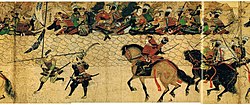
- November 19, 1274 (Bun'ei 11, 20th day of the 10th month): Battle of Bun'ei -- Kublai Khan's Mongol forces land at Hakata Bay near Fukuoka in Kyūshū. After landing and some armed skirmishes, the invaders withdraw to spend the night on shipboard. That night, a storm sinks several ships, and the fleet retreats to Korea rather than pressing their initial advantage.5 In the course of the day's fighting, the Hakozaki Shrine was burned to the ground.6 Nihon Ōdai Ichiran explains that the invaders were defeated because they lacked arrows.7
See also
See also
- Mongol invasions of Japan
- Battle of Kōan - the second invasion attempt by Kublai Khan, in 1281.
Notes
Notes
- Nussbaum, Louis-Frédéric. (2005). "Bun'ei" in Japan Encyclopedia, p. 90, p. 90, at Google Books; n.b., Louis-Frédéric is pseudonym of Louis-Frédéric Nussbaum, see Deutsche Nationalbibliothek Authority File.
- Titsingh, Isaac. (1834). Annales des empereurs du Japon, pp. 253-261, p. 253, at Google Books; Varley, H. Paul. (1980). Jinnō Shōtōki. p. 232-233.
- Titsingh, p. 261, p. 261, at Google Books; Varley, p. 44; a distinct act of senso is unrecognized prior to Emperor Tenji; and all sovereigns except Jitō, Yōzei, Go-Toba, and Fushimi have senso and sokui in the same year until the reign of Emperor Go-Murakami.
- Titsingh, p. 262, p. 262, at Google Books; Varley, p. 44.
- Davis, Paul K. (2001). 100 Decisive Battles: From Ancient Times to the Present, p. 147.
- Turnbull, Stephen R. (2003). Genghis Khan & the Mongol Conquests 1190–1400, p. 66.
- Titsingh, p. 262, p. 262, at Google Books.
References
References
- Davis, Paul K. (1999). 100 Decisive Battles: From Ancient Times to the Present. Oxford: Oxford University Press. ISBN 978-0-19-514366-9; OCLC 0195143663
- Nussbaum, Louis-Frédéric and Käthe Roth. (2005). Japan encyclopedia. Cambridge: Harvard University Press. ISBN 978-0-674-01753-5; OCLC 58053128
- Titsingh, Isaac. (1834). Nihon Odai Ichiran; ou, Annales des empereurs du Japon. Paris: Royal Asiatic Society, Oriental Translation Fund of Great Britain and Ireland. OCLC 5850691
- Turnbull, Stephen R. (2003). Genghis Khan & the Mongol Conquests, 1190-1400. London: Routledge. ISBN 9780415968621; ISBN 9780203489505; OCLC 53948747
- Varley, H. Paul. (1980). A Chronicle of Gods and Sovereigns: Jinnō Shōtōki of Kitabatake Chikafusa. New York: Columbia University Press. ISBN 9780231049405; OCLC 6042764
External links
External links
- National Diet Library, "The Japanese Calendar" -- historical overview plus illustrative images from library's collection