| Buff-breasted wheatear | |
|---|---|

| |
| Buff-breasted wheatear in the Asir Mountains, Saudi Arabia | |
Scientific classification 
| |
| Kingdom: | Animalia |
| Phylum: | Chordata |
| Class: | Aves |
| Order: | Passeriformes |
| Family: | Muscicapidae |
| Genus: | Oenanthe |
| Species: | O. bottae
|
| Binomial name | |
| Oenanthe bottae (Bonaparte, 1854)
| |
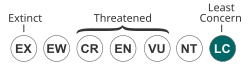
The buff-breasted wheatear (Oenanthe bottae), also known as Botta's wheatear or the red-breasted wheatear, is a species of bird in the Old World flycatcher family Muscicapidae. It is endemic to the Asir Mountains. The species is named after Paul-Émile Botta.
Heuglin's wheatear (O. heuglini) and the rusty-breasted wheatear (Oenanthe frenata) were formerly considered to be conspecific.2
Description
Resembles the larger and darker northern wheatear, but with a duller reddish breast and broader black tail tip. The sexes are alike.3
Range and habitat
It is native to the Asir Mountains of western Saudi Arabia and Yemen. Its natural habitat is subtropical or tropical high-altitude grassland. It is most common at altitudes over 1800 m.
References
References
- BirdLife International (2017). "Oenanthe bottae". IUCN Red List of Threatened Species. 2017 e.T103774053A111169032. doi:10.2305/IUCN.UK.2017-1.RLTS.T103774053A111169032.en. Retrieved 12 November 2021.
- Gill, Frank; Donsker, David; Rasmussen, Pamela, eds. (January 2023). "Chats, Old World flycatchers". IOC World Bird List Version 13.1. International Ornithologists' Union. Retrieved 7 February 2023.
- Collar, N.; Kirwan, G.M.; Christie, D.A. (2022). Billerman, S.M.; Sly, N.D. (eds.). "Buff-breasted Wheatear (Oenanthe bottae), version 1.0". Birds of the World. Ithaca, NY, USA: Cornell Lab of Ornithology. doi:10.2173/bow.rebwhe2.01.