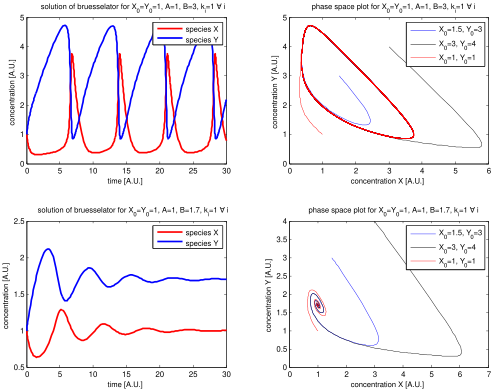


The Brusselator is a theoretical model for a type of autocatalytic reaction. The Brusselator model was proposed by Ilya Prigogine and his collaborators at the Université Libre de Bruxelles.23
It is a portmanteau of Brussels and oscillator.
It is characterized by the reactions
Under conditions where A and B are in vast excess and can thus be modeled at constant concentration, the rate equations become
where, for convenience, the rate constants have been set to 1.
The Brusselator has a fixed point at
- .
The fixed point becomes unstable when
leading to an oscillation of the system. Unlike the Lotka–Volterra equation, the oscillations of the Brusselator do not depend on the amount of reactant present initially. Instead, after sufficient time, the oscillations approach a limit cycle.4
The best-known example is a chemical clock, such as the Belousov–Zhabotinsky reaction (BZ reaction). It can be created with a mixture of potassium bromate (KBrO3), malonic acid (CH2(COOH)2), and manganese sulfate (MnSO4) prepared in a heated solution of sulfuric acid (H2SO4).5
References
References
- Lukas Wittmann (16 June 2021). "BACHELOR'S THESIS - DEVELOPMENT OF A PYTHON PROGRAM FOR INVESTIGATION OF REACTION-DIFFUSION COUPLING IN OSCILLATING REACTIONS".
- "IDEA - Internet Differential Equations Activities". Washington State University. Archived from the original on 2017-09-09. Retrieved 2010-05-16.
- Prigogine, I.; Lefever, R. (1968-02-15). "Symmetry Breaking Instabilities in Dissipative Systems. II". The Journal of Chemical Physics. 48 (4): 1695–1700. Bibcode:1968JChPh..48.1695P. doi:10.1063/1.1668896. ISSN 0021-9606.
- Dynamics of the Brusselator
- BZ reaction Archived December 31, 2012, at the Wayback Machine