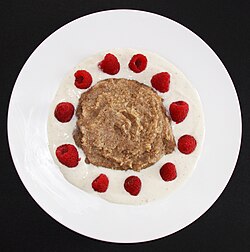
 Brenntar with vanilla sauce | |
| Type | Porridge |
|---|---|
| Place of origin | Germany (Swabia) |
| Main ingredients | Flour (usually spelt) |
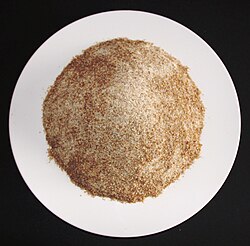
Brenntar1 or Habermus or Schwarzer Brei is a Swabian staple foodstuff, particularly prominent in the Swabian Jura and in the Allgäu. It is made of roasted flour, usually spelt flour or oat flour. This kiln-dried flour is called Musmehl.2 It is usually cooked like a porridge with water and milk.
The name Brenntar means "burned porridge", Habermus means "oat porridge", and Schwarzer Brei means "black porridge". If roasted correctly, however, Brenntar is brown, but if roasted for too long in the drying kiln it can turn black.
History
It is written in the Schwäbisches Wörterbuch that in 1540 the population on the Swabian Jura was saved from starvation by Brenntar3 and Hildegard of Bingen recommended Habermus for a healthy living.4
In the last decades, Brenntar had almost fallen into oblivion, but was rediscovered in the trend of conscious nutrition.
Nowadays, Brenntar and the Musmehl have been included in the Ark of Taste, Germany, as "almost forgotten regional-type food" by the Slow Food Deutschland Organization.35
Preparation
As a former convenience food used on a daily basis, Brenntar is quite simple to prepare. Originally the Musmehl was cooked in water only, spiced with salt. Today, there are different recipes for Habermus, for example, mixed with vegetables or sweetened with fruit.
References
References
- Barbara Ehlert: Getreide – die Grundlage unserer Zivilisation. I: Die Allgäuerin, 2010/3, S. 32/33 (PDF)
- Bentele, Josef (2012-07-31). Berichte aus vergangenen Tagen: Erinnerungen eines Westallgäuers an die "gute alte Zeit" (in German). BoD – Books on Demand. ISBN 978-3-8448-4071-1.
- "Musmehl in der Slowfood-Arche". Archived from the original on 2016-05-01. Retrieved 2017-08-20.
- Peter Pukownik: L'approche thérapeutique au quotidien d'Hildegarde de Bingen. 2017. ISBN 978-2853275514 p.40
- General-Anzeiger, Reutlinger. "Wieso Sie Musmehl mal kosten sollten". www.gea.de (in German). Archived from the original on 2017-08-20. Retrieved 2017-08-20.
Further reading
Further reading
- Aegidius Kolb, Leonhard Lidel : D' schwäbisch' Kuche, 18. Auflage, 2017. ISBN 978-3928934022 (Swabian cuisine)