| Brachyphyllum | |
|---|---|
| |
Scientific classification 
| |
| Kingdom: | Plantae |
| Clade: | Embryophytes |
| Clade: | Tracheophytes |
| Clade: | Spermatophytes |
| Clade: | Gymnospermae |
| Division: | Pinophyta |
| Class: | Pinopsida |
| Order: | Pinales |
| Family: | †Cheirolepidiaceae |
| Genus: | †Brachyphyllum A. T. Brongniart 18281 |
| Species | |
|
See text | |
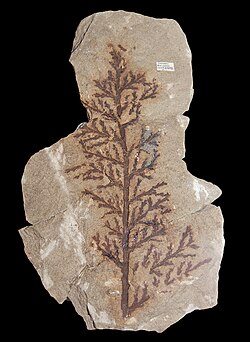
Brachyphyllum (meaning "short leaf") is a form genus of fossil coniferous plant foliage. Plants of the genus have been variously assigned to several different conifer groups including Araucariaceae and Cheirolepidiaceae.2 They are known from around the globe from the Late Carboniferous to the Late Cretaceous periods.1
List of species
- †B. yorkense
- †B. castatum
- †B. castilhoi
- †B. hondurense
- †B. mamillare
- †B. punctatum
- †B. sattlerae named after the fictional palaebotanist Ellie Sattler from the Jurassic Park franchise.3
- †B. japonicum4
- †B. dimorpha5
Location of palaeontological sites
- In Paleorrota geopark in Brazil; Upper Triassic period, the Caturrita Formation6
- The Caballos Formation of Tolima, Colombia7
- The El Plan Formation of the Department of Francisco Morazan, Honduras
- The Crato Formation of Brazil3
- The Hasandong Formation and Jinju Formation of South Korea4
- The Otlaltepec Formation in Mexico5
Correspondence with other plant elements
Amongst Cheirolepidiaceae, Brachyphyllum is known to be associated with the conifer cones Pararaucaria8 and Kachaikestrobus.9 Whilst amongst the Araucariaceae, it has been associated with the pollen cone Rabagostrobus,10 and the confier cone Arauacarites.11
References
References
- Brachyphyllum in the Paleobiology Database
- Taylor, Edith L.; Taylor, Thomas N.; Krings, Michael (2009). Paleobotany: The Biology and Evolution of Fossil Plants. Academic Press. pp. 833–834, 844–845, 848. ISBN 9780080557830.
- Batista, Maria E. P.; Kunzmann, Lutz; Sá, Artur A.; Saraiva, Antônio Á. F.; Loiola, Maria I. B. (2020). "A New Species of Brachyphyllum from the Crato Formation (Lower Cretaceous), Araripe Basin, Brazil". Ameghiniana. 57 (6): 333. Bibcode:2020Amegh..57..333B. doi:10.5710/AMGH.23.06.2020.3333. S2CID 226545919.
- Kim, Jong-Heon; Nam, Kye-Soo; Lee, Seong-Bok; Jeon, Yeong-Seok (2016). "Fossil Plants from the Early Cretaceous Hasandong Formation of Chilgok Area, Korea" (PDF). Journal of the Korean Earth Science Society. 37 (5): 295−308. doi:10.5467/JKESS.2016.37.5.295.
- Morales-Toledo, J.; Cevallos-Ferriz, S.R.S. (21 July 2023). "Is biodiversity promoted in rift-associated basins? Evidence from Middle Jurassic conifers from the Otlaltepec Formation in Puebla, Mexico". Review of Palaeobotany and Palynology. 318 104952. Bibcode:2023RPaPa.31804952M. doi:10.1016/j.revpalbo.2023.104952. S2CID 260077898.
- "Serviço Geológico do Brasil" (PDF). Cprm.gov.br. Retrieved 30 June 2022.
- Monje et al., 2016, p.38
- Escapa, Ignacio H.; Rothwell, Gar W.; Stockey, Ruth A.; Cúneo, N. Rubén (June 2012). "Seed cone anatomy of Cheirolepidiaceae (Coniferales): Reinterpreting Pararaucaria patagonica Wieland". American Journal of Botany. 99 (6): 1058–1068. Bibcode:2012AmJB...99.1058E. doi:10.3732/ajb.1100544. hdl:11336/194744. ISSN 0002-9122. PMID 22665438.
- Del Fueyo, Georgina M.; Archangelsky, Sergio; Llorens, Magdalena; Cúneo, Rubén (July 2008). "Coniferous Ovulate Cones from the Lower Cretaceous of Santa Cruz Province, Argentina". International Journal of Plant Sciences. 169 (6): 799–813. Bibcode:2008IJPlS.169..799D. doi:10.1086/533608. hdl:11336/111061. ISSN 1058-5893. S2CID 85615745.
- Kvaček, Jiří; Barrón, Eduardo; Heřmanová, Zuzana; Mendes, Mário Miguel; Karch, Jakub; Žemlička, Jan; Dudák, Jan (November 2018). Seyfullah, Leyla (ed.). "Araucarian conifer from late Albian amber of northern Spain". Papers in Palaeontology. 4 (4): 643–656. Bibcode:2018PPal....4..643K. doi:10.1002/spp2.1223. S2CID 134837045.
- Stockey, Ruth A. (July 1982). "The Araucariaceae: An evolutionary perspective". Review of Palaeobotany and Palynology. 37 (1–2): 133–154. doi:10.1016/0034-6667(82)90041-0.
Bibliography
- Monje Durán, Camila; Martínez, Camila; Escapa, Ignacio; Madriñán, Santiago (2016). "Nuevos registros de helechos y coníferas del Cretácico Inferior en la cuenca del Valle Superior del Magdalena, Colombia" (PDF). Boletín de Geología, Universidad Industrial de Santander. 38: 29–42. Retrieved 2017-03-31.
- Gee, Carole T. (2010). Plants in Mesozoic Time: Morphological Innovations, Phylogeny, Ecosystems. Indiana University Press. pp. 25–. ISBN 978-0-253-00199-3.