| Boussingaultite | |
|---|---|
| General | |
| Category | Sulfate mineral |
| Formula | (NH4)2Mg(SO4)2·6H2O |
| IMA symbol | Bsg1 |
| Strunz classification | 7.CC.60 |
| Dana classification | 29.03.07.02 |
| Crystal system | Monoclinic |
| Crystal class | Prismatic (2/m) (same H-M symbol) |
| Space group | P21/a |
| Unit cell | a = 9.324(7) Å, b = 12.597(9) Å, c = 6.211(5) Å; β = 1.472°; Z = 2 |
| Identification | |
| Formula mass | 360.60 g/mol |
| Color | Colorless, yellow pink, light yellow, pink; colorless in transmitted light |
| Cleavage | {201} perfect (synthetic) |
| Mohs scale hardness | 2 |
| Luster | Vitreous (glassy), silky |
| Streak | White |
| Diaphaneity | Transparent to translucent |
| Specific gravity | 1.73 |
| Density | 1.7 g/cm3 |
| Optical properties | Biaxial (+) |
| 2V angle | 51°11′ |
| Dispersion | r > v, perceptible |
| Solubility | Soluble in H2O |
| References | 234 |
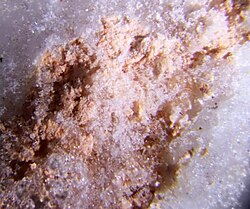
Boussingaultite is a rare ammonium magnesium hydrated sulfate mineral of the chemical formula: (NH4)2Mg(SO4)2 · 6 H2O. The formula of boussingaultite is that of Tutton's salts type. It was originally described from geothermal fields in Tuscany, Italy, where it occurs together with its iron analogue mohrite,5 but is more commonly found on burning coal dumps.6 The mineral possess monoclinic symmetry and forms clear, often rounded crystals.3
The mineral is named after the French chemist Jean-Baptiste Boussingault (1802–1887).7
Nickelboussingaultite has been found in a meteorite.8
References
References
- Warr, L.N. (2021). "IMA–CNMNC approved mineral symbols". Mineralogical Magazine. 85 (3): 291–320. Bibcode:2021MinM...85..291W. doi:10.1180/mgm.2021.43. S2CID 235729616.
- "Boussingaultite Mineral Data". Webmineral.com. Retrieved 2011-10-25.
- "Boussingaultite mineral information and data". Mindat.org. Retrieved 2011-10-25.
- "Boussingaultite" (PDF). Mineral Data Publishing. Retrieved 2011-10-25.
- Fleischer M. 1965: New mineral names. American Mineralogist, 50, pp. 805
- Chesnokov B. V. and Shcherbakova E. P. 1991: Mineralogiya gorelykh otvalov Chelyabinskogo ugolnogo basseina - opyt mineralogii tekhnogenesa. Nauka, Moscow
- Culka, Adam; Jehlička, Jan; Němec, Ivan (2009). "Raman and infrared spectroscopic study of boussingaultite and nickelboussingaultite". Spectrochimica Acta Part A: Molecular and Biomolecular Spectroscopy. 73 (3): 420–3. Bibcode:2009AcSpA..73..420C. doi:10.1016/j.saa.2008.10.026. PMID 19062333.
- Britvin, Sergey N.; Vereshchagin, Oleg S.; Vlasenko, Natalia S.; Krzhizhanovskaya, Maria G.; Ivanova, Marina A.; Volkova, Irina A. (1 February 2026). "The first meteoritic ammonium mineral: Discovery of boussingaultite in the Orgueil CI1 carbonaceous chondrite". American Mineralogist. 111 (2): 335–344. doi:10.2138/am-2025-9851.