| Bornean forktail | |
|---|---|
| |
Scientific classification 
| |
| Kingdom: | Animalia |
| Phylum: | Chordata |
| Class: | Aves |
| Order: | Passeriformes |
| Family: | Muscicapidae |
| Genus: | Enicurus |
| Species: | E. borneensis
|
| Binomial name | |
| Enicurus borneensis Sharpe, 1889
| |
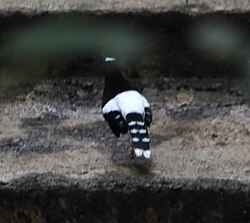
The Bornean forktail (Enicurus borneensis) is a small, black and white bird, with a long and deeply forked tail, in the Old World flycatcher family. It is endemic to the Southeast Asian island of Borneo, where it occupies streamside habitats in montane primary forest.1
Taxonomy
It is closely related to the very similar white-crowned forktail (Enicurus leschenaulti) of which it is sometimes considered a subspecies,2 and from which it was split because of:3
- a recognizably different type of mitochondrial DNA
- the reduced extent of the white forehead shield, which does not cover the crown
- its larger size and longer tail with four, rather than five, white tail patches
- different calls
- different habitat, with the Bornean forktail replacing the lowland dwelling white-crowned forktail in the mountains and in submontane areas.
References
References
- Phillipps, Quentin; Phillipps, Karen (2011). Phillipps' Field Guide to the Birds of Borneo. Oxford, UK: John Beaufoy Publishing. ISBN 978-1-906780-56-2.
- "Bornean Forktail". Species factsheet. BirdLife International. 2013. Retrieved 2013-11-16.
- Moyle, Robert G.; Schilthuizen, Menno; Rahman, Mustafa A.; Sheldon, Frederick H. (2005). "Molecular phylogenetic analysis of the white-crowned forktail Enicurus leschenaulti in Borneo". Journal of Avian Biology. 36 (2): 96–101. doi:10.1111/j.0908-8857.2005.03510.x.
- Gill F, D Donsker & P Rasmussen (Eds). 2022. IOC World Bird List (v12.2). doi : 10.14344/IOC.ML.12.2