| Bohemiclavulus Temporal range: Pennsylvanian,
| |
|---|---|
| |
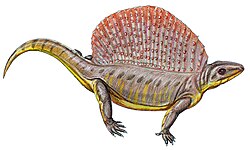
| Life reconstruction of B. mirabilis | |
Scientific classification 
| |
| Kingdom: | Animalia |
| Phylum: | Chordata |
| Clade: | Synapsida |
| Clade: | Metopophora |
| Clade: | Haptodontiformes |
| Clade: | Sphenacomorpha |
| Family: | †Edaphosauridae |
| Genus: | †Bohemiclavulus Spindler et al., 2019 |
| Type species | |
| †Bohemuclavulus mirabilis (Fritsch, 1895)
| |
| Synonyms | |
| |
Bohemiclavulus is a genus of synapsids that was discovered in the Slaný Formation of the Czech Republic.1 The type, and currently only, species is B. mirabilis.2
Discovery and naming

The holotype, NM 633, consists only of a single spinous process fragment, and it was found in the Czech Republic.
Antonin Fritsch originally named Bohemiclavulus in 1895a with the binomial Naosaurus mirabilis.3 It was renamed Ianthasaurus mirabilis in 1895b, and was renamed to Edaphosaurus mirabilis later that year.4 In 2019, a new genus was created for the species.2
Classification
Bohemiclavulus has been classified as a member of the Edaphosauridae by Spindler et al. (2019).2
The cladogram of Spindler et al. (2019) is shown simplified below:


References
References
- "Edaphosaurus mirabilis". Fossilworks. Retrieved 17 December 2021.
- Spindler, Frederik; Voigt, Sebastian; Fischer, Jan (2019). "Edaphosauridae (Synapsida, Eupelycosauria) from Europe and their relationship to North American representatives". PalZ. 94: 125–153. doi:10.1007/s12542-019-00453-2.
- Fritsch, A. (1895a). Fauna der Gaskohle und der Kalksteine der Permformation Böhmens. Vol. 3. Prag: Řivnáč.
- Fritsch, A. (1895b). Über neue Wirbelthiere aus der Permformation Böhmens nebst einer Übersicht der aus derselben bekannt gewordenen Arten. Sitzungsberichte der Königlich Böhmischen Gesellschaft der Wissenschaften 52: 1–17.