| Blue ringtail | |
|---|---|

| |
| Male, Tasmania, Australia | |

| |
| Female, Tasmania, Australia | |
Scientific classification 
| |
| Kingdom: | Animalia |
| Phylum: | Arthropoda |
| Clade: | Pancrustacea |
| Class: | Insecta |
| Order: | Odonata |
| Suborder: | Zygoptera |
| Family: | Lestidae |
| Genus: | Austrolestes |
| Species: | A. annulosus
|
| Binomial name | |
| Austrolestes annulosus | |

| |
| Synonyms3 | |
| |
The blue ringtail (Austrolestes annulosus) is an Australian damselfly.1 It is found on most of the continent.
Taxonomy
The blue ringtail was first described by Edmond de Sélys Longchamps in 1862.4
Description
The abdomen is 3 cm long.5 It can easily be confused with Austrocoenagrion lyelli or Caliagrion billinghursti, but can be differentiated through dorsal patterns. They are a thin, medium-sized damselfly with varying coloration, which depends on maturity and temperature. However most are a striking blue with minimal black markings. Females are slightly more robust than males, and have a black and white/pale blue coloration.
Distribution and habitat
It is widely distributed in most of Australia, except for the northern and north-eastern parts.4 It is active through September to April in still water bodies such as riverine pools, lakes and ponds, including temporary pools.
Etymology
The genus name Austrolestes combines the prefix austro- (from Latin auster, meaning “south wind”, hence “southern”) with Lestes, a genus name derived from Greek λῃστής (lēstēs, “robber”).6
The species name annulosus is derived from the Latin annulus ("ring") and the suffix -osus ("abounding in"), referring to the broad ring on the second abdominal segment.7
Gallery
-
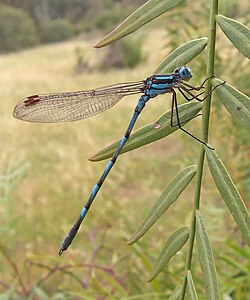 Male
Male -
 Mating pair
 -
 Female wings
 -
 Male wings
References
References
- Dow, R.A. (2017). "Austrolestes annulosus". IUCN Red List of Threatened Species. 2017 e.T87534133A87539919. doi:10.2305/IUCN.UK.2017-1.RLTS.T87534133A87539919.en. Retrieved 20 November 2021.
- Selys-Longchamps, E. (1862). "Synopsis des Agrionines, seconde légion: Lestes". Bulletin de la Classe des Science, Académie Royale de Belgique. 2 (in French). 13: 288–338 [332].
- Paulson, D.; Schorr, M.; Abbott, J.; Bota-Sierra, C.; Deliry, C.; Dijkstra, K.-D.; Lozano, F. "World Odonata List". OdonataCentral. University of Alabama. Retrieved 3 April 2026.
- "Species Austrolestes annulosus (Selys, 1862)". Australian Faunal Directory. Australian Biological Resources Study. 2022. Retrieved 3 April 2026.
- Daley, Elizabeth; Daley, Anthony (2007). Wings: an introduction to Tasmania's winged insects. Riffles Pty. Ltd. p. 7. ISBN 978-0-9804006-2-5.
- Endersby, Ian (2012). "Etymology of the Dragonflies (Insecta: Odonata) named by R.J. Tillyard, F.R.S." Proceedings of the Linnean Society of New South Wales. 134: 1–16.
- Endersby, Ian; Fliedner, Heinrich (2015). The Naming of Australia's Dragonflies. Eltham, Victoria, Australia: Busybird Publishing. ISBN 9781925260625.
Media related to Austrolestes annulosus at Wikimedia Commons