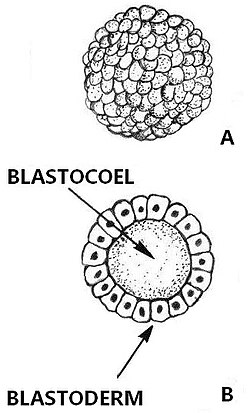
A blastoderm (germinal disc, blastodisc), also called the cicatricula , is a single layer of embryonic epithelial tissue that makes up the blastula.1 It encloses the fluid-filled blastocoel. Gastrulation follows blastoderm formation, where the tips of the blastoderm begins the formation of the ectoderm, mesoderm, and endoderm.2
Formation
The blastoderm is formed when the oocyte plasma membrane begins cleaving by invagination, creating multiple cells that arrange themselves into an outer sleeve to the blastocoel.1
In oviparous animals
In chicken eggs, the blastoderm represents a flat disc after embryonic fertilization.3 At the edge of the blastoderm is the site of active migration by most cells.4
DNA repair genes are highly expressed in chicken blastoderms.5
References
References
- Gilbert, Scott F. (2000). "Early Drosophila Development". Developmental Biology (6th ed.). Sunderland MA: Sinauer Associates. ISBN 0-87893-243-7. NBK10081.
- "blastoderm". The Free Dictionary. Retrieved 20 April 2018.
- "Tutorial on chick early development". www.ucl.ac.uk. University College London. 27 March 2019.
- Bellairs, Ruth; Osmond, Mark (2014). "3. Early Stages". Atlas of Chick Development (3rd ed.). Academic Press. pp. 15–28. ISBN 978-0-12-384952-6.
- Rengaraj D, Won S, Jung KM, Woo SJ, Lee H, Kim YM, Kim H, Han JY (January 2022). "Chicken blastoderms and primordial germ cells possess a higher expression of DNA repair genes and lower expression of apoptosis genes to preserve their genome stability". Sci Rep. 12 (1): 49. Bibcode:2022NatSR..12...49R. doi:10.1038/s41598-021-04417-y. PMC 8741993. PMID 34997179.
- Campbell, Neil A.; Reece, Jane B. (2005). Biology (7th ed.). Pearson Publishing. ISBN 978-0-8053-7171-0.